Category: BUSINESS DEVELOPMENT

  • 10 Successful Influencer Marketers

    10 Successful Influencer Marketers

    Estimated reading time: 9 minutes

    Why did you buy the phone you are using? Why did you see that movie at the cinema (or on Netflix)? When you question more of your recent decisions, it will surprise you to know how much of them are influenced by influencer marketers.

    That’s how powerful influencer marketing is, and every business, including SMEs, can take advantage of it.

    Who are Influencer Marketers?

    You know who a marketer is, so who is an influencer? And then who is an influencer marketer?

    You guessed right – an influencer is one with influence within a particular niche. In other words, someone who is famous and whose opinions are respected as far as a niche is concerned.

    With that established, an influencer marketer is, therefore, one who uses their influence to promote products and services subtly.

    Types of influencer marketers

    Celebrity / Tier 1 Influencers

    You come across famous faces on every social media platform these days. From the know musicians down to popular actors and actresses, they all use social media to connect with their fans. And that’s a good thing for business owners who need to advertise.

    At a time, this was the only known form of influencer marketing. Those days when the only people known to have influence are celebrities.

    While things may have changed a little these days, celebrities are still quite important in influencer marketing, and in fact, they are.

    Most times though, using celebrities for influencer marketing can be likened to seeing a flock of birds flying and randomly shooting in the air, hoping one of them will get caught. No target, just hope (and Insha Allah). Because there are so many birds, there is a possibility one of them will actually get caught.

    What this means is that celebrities often have massive followership on social media. With that, there is a guarantee that the products they promote will be exposed to many people. But the question is, how many of the followers would be interested in that type of product?

    But considering how influential celebrities can be on their fans, some of them won’t be going out of their way to patronize the products they promote. For instance, when Wizkid was announced as a brand ambassador for Tecno, some iPhone users promised to switch to android (Tecno) just because of Wizkid.

    You May Also Like: 10 MSME Experts Every Entrepreneur Should Follow in Nigeria

    This probably explains why Nigerian celebrities are daily cashing out from all influencer marketing deals, including brand endorsements.

    Macro / Tier 2 Influencers

    The celebrities in tier one became celebrities through their work and content in the mainstream media. On the other hand, the guys here are celebrities, and they attained that status using the internet.

    They range from skit makers, podcast creators, vloggers and other online content makers. You probably have names in your head already – yes, them.

    Compared to celebrities, these guys have lesser followership on social media but a more defined niche. Think of celebrities as the federal government of influencer marketing and macro-influencers as the state government. In other words, macro-influencers are closer to the people.

    They are the next target of businesses and brands who cannot afford celebrities and have a relatively more defined audience.

    They are more present on Instagram than any other social media platform.

    Micro / Tier 3 Influencers

    When we say influencer marketers, these guys are the first to come to mind of an average social media user (especially Twitter).

    They literally live on social media because that’s the only way to explain how they react to every trending topic. Of course, it’s a strategy to stay relevant and visible.

    Most of them try to carve a niche for themselves and constantly dish out contents that have to do with that niche.

    They work with different local and international brands to promote their products and services on social media. 

    Another thing they try to do in trending hashtags. Mostly using the “giveaway strategy”, they keep a keyword or hashtag trending on Twitter by getting people to use it in exchange for some rewards. I personally have a problem with this strategy sometimes, but that’s a discussion for another day.

    Since this article’s focus is influencer marketers for SMEs, the list comprises mostly of influencers in this category.

    Nano / Tier 4 Influencers

    An average person would probably not see them as influencers, but these guys have some level of influence, too, and more brands are beginning to realize that. Due to ambition, though, many tend not to last too long here before moving to become micro-influencers.

    Nano influencers don’t necessarily have niches with followers often less than 5k. 

    Most people are beginning to see the influencers in the other categories as who they truly are – disguising marketers. This may affect results as the trust level is not as high as it used to be. But that’s one thing Nano influencers have going for them – trust. Their small group of followers trust them and believe whatever they say because they come across as just regular social media users.

    10 Successful Influencer Marketers SMEs Can Ride-on in Nigeria

    Aproko Doctor

    Nonso Igemba, known widely as Aproko Doctor, is an influencer marketer of repute.

    He is a medical doctor who saves lives at the hospital and even on social media with his various health tips. Many social media users have credited their new lifestyle to him.

    In an interview with Guardian Life, he shared a “testimony” of how his content saved the life of a young girl who was choking. “…she had swallowed her sister’s earring and would have choked to death if her mother had not come across a thread I made on what to do if you have a child who is choking. She followed the instructions and saved her baby’s life, there have been numerous other cases.”

    Seeing the success he has recorded with written tips and nuggets, Aproko Doctor recently started creating video contents which are also recording massive success. In his videos, he usually plays the character of a tech-savvy native medical doctor. You may have to see one of the videos to understand.

    Over the years, Nonso has used his content to grow massive popularity and followership on social media, especially Twitter, where he currently has over 927k followers.

    There is no doubting his influence in this niche as he is currently the number one voice on Twitter Nigeria as far as healthy living is concerned. This perfectly positions him as a goto person for anyone who may want to promote a product or services in that industry.

    Aproko Doctor’s contact details

    • Email address: business@blackbamboonigeria.com
    • Phone number: +234 800 000 0000
    • Twitter: @aproko_doctor

    Mazi Ibe

    Mazi Ibe is another big name on Twitter. In 2019, Lotto9ja unveiled him as their brand ambassador along with Zlatan Ibile and Alex Ekubo.

    While he can help promote SMEs, he has also worked with some of the biggest brands out there, including Union bank, Airtel, Nairabet, Dstv, Bolt, etc.

    His niches cut across entertainment, sports and lifestyle, so you know who to link up with if your audience or target is in any of those categories.

    With massive 319k+ followers on Twitter with his social media marketing skills at his disposal, he is definitely not one to overlook when it comes to influencer marketing.

    Mazi Ibe’s contact details

    • Email address: ipissmedia@gmail.com or info@ipissmedia.com.ng
    • Phone number: 07031299632
    • Twitter: @MaziIbe_

    Pamilerin

    Also known as Omo Iya Ologi, Pamilerin Adegoke is arguably the most known non-celebrity person on Twitter. He is popular like that.

    His former verified Twitter account was suspended at a time along with its thousands of followers. He went on to open another account, and today he has over 462k followers.

    Pamilerin’s niche cuts across business, media, lifestyle and entertainment, and he works with both SMEs and big brands.

    Pamilerin’s contact details

    Four-Eyed Edo Boy

    Alex Oraifo, known widely as the Four-eyed Edo boy, is another reputable influencer marketer to reckon with. I personally think he stands out from the rest, thanks to wittiness and storytelling prowess.

    He has a unique way of creating witty and funny contents around trending topics, which has endeared him to lots of social media users.

    This is not verified information, but there is a high possibility that 50% of Twitter screenshots that get shared on other social media platforms such as Instagram and Whatsapp are Alex’s tweets. His 558k+ followers on Twitter is proof of this.

    His niche cut across business, entertainment and lifestyle. And oh, he is also an artist and dancer.

    Four-eyed Edo boy’s contact details

    Aunty Ada

    Aunty Ada is the first lady here, but definitely not the last. You wouldn’t be wrong to call her the call the first lady of Twitter influencer marketing too. Some people say she is one of the first set of influencer marketers in Nigeria.

    Over the years, she has built a brand for herself by helping small, medium, and big businesses reach their Twitter audiences. 

    Her niches are mostly lifestyle, business and entertainment. Of course, Nigeria’s recent events have made everyone more active in politics, and she is not an exception.

    With over 336k followers engaging with her contents, SMEs wouldn’t be making the wrong decision to work with her.

    Aunty Ada’s contact details

    • Email address: Auntyadaa@gmail.com
    • Twitter: @Auntyadaa

    Danny Walter

    Danny Walter is another known name on social media. Arguably the number one shoe plug on twitter, Danny Walter doubles as an influencer marketer, and he seems to be doing pretty well at both.

    Stand to be corrected, but an average Twitter user who needs to get a nice pair of shoes would most likely think of Danny Walter first. Businesses in shoe lines should note this.

    He has also had his fair share of Twitter bans, and his current account has over 307k followers.

    Aside from footwear, his other niches cut across cryptocurrency, fashion, business and lifestyle.

    Danny Walter’s contact details

    • Email address: dannywalterpr@gmail.com
    • Phone number: 09011342097
    • Twitter: @Danny_Walterr

    Naija Brand Chick

    Shoutout to these people holding it down on Instagram. Nelly, widely known as Naija brand chick popular on Instagram. She creates educative and informative contents that would help businesses grow on her IG page.

    Read more about Naija Brand Chick and other MSME experts here.

    Naija Brand Chick’s contact details

    Hustlers Square

    Diyemowei Lily is the brain and face behind hustlers square. She is a popular influencer marketer, especially among SMEs on Instagram. Read more about Hustlers Square and other MSME experts here.

    Hustler Square’s contact details

    Tricia Biz

    Tricia Biz is not your regular influencer. She has been in the game for a while, helping small, medium and big brands reach their target market. Read more about Tricia Biz and other MSME experts here.

    Tricia Biz’s contact details

    • Email address: info@triciabiz.com
    • Phone number: 08141140043
    • Instagram: Triciabiz

    Volqx

    Ending the list with a Twitter influencer marketer. Not sure what his real name is, Volqx is a well-known influencer on Twitter who has built a large following by creating engaging and relatable contents.

    Volqx’s contact details

    • Email address: info@volqx.com

    Conclusion

    And there you have our recommended influencer marketers you can work with as an SME in the country with their contact details.

    Who should have been on the list? And have you worked any of them – how was your experience

    Related Articles

  • 10 MSME Experts Every Entrepreneur Should Follow in Nigeria

    10 MSME Experts Every Entrepreneur Should Follow in Nigeria

    ICON_PLACEHOLDEREstimated reading time: 8 minutes

    MSME experts in Nigeria or influencers provide inspiration, tips, advice and other contents to help you navigate the murky waters of entrepreneurship.

    Trust me; you need all the help you can get. And these guys on the list have built a reputation from helping entrepreneurs like yourself.

    Check out this list of 10 MSME experts every entrepreneur in Nigeria should follow on social media (in no particular order)

    Naija Brand Chick

    Nelly Agbogu, widely known as Naija Brand Chick, is an MSME expert who has her base on Instagram. Her journey into the business world started with her struggle with weight loss. Her quest for a solution to this led her to start baking healthy options, and the rest they say is history.

    “My biggest challenge birthed my business journey” are the words of Nelly which succinctly explains how she became the Naija Brand Chick and the proud founder of Nellies healthy food & snack company.

    Her primary forte is helping small business owners maximise the power of social media to grow their businesses. If this sounds like something you’d like for your small business, then you know you should go follow her on Instagram.

    Aside from dropping tips and advises on entrepreneurship and business growth, The Naija Brand Chick has put together comprehensive courses on the same topic for her followers.

    Her website is naijabradchick.com, where you can find some of her courses and discover more about her. She also has affiliate programmes for individuals that may want to help her sell her courses.

    So far, she has partnered with big names such as Access Bank, Google, Sterling bank, First bank, Pampers, and Lagos state government.

    Nelly’s verified Instagram account currently has 222k followers and about 11,281 posts.

    Hustlers Square

    You probably know Jagaban, but have you heard of the Jagaban of Instagram?

    Diyemowei-Odior Oluchi is the face behind the Hustlers Square Instagram page. She is an MSME expert who is also based on Instagram.

    Her slogan, “We rise by raising others”, tells her story as she has continued to rise in popularity and influence as she continues to help small businesses grow.

    Her journey started with helping friends and family members succeed in their respective small businesses. Soon, she figured she could share her experience with other small businesses so they can experience growth as well—that birthed Hustlers Square.

    Her brand is focused mostly on women entrepreneurs. She started Hustlers Square because she believes “every woman deserves equal opportunity to make her own money, be independent and empowered”.

    Today, she has featured on Vanguard, Business Day and Techpoint Africa. She has also worked with some renowned brands such as Vconnect, Rubies, Sterling bank, Flutterwave, Anakle, Nipost, Visa, etc.

    She currently has 300k followers across all social media platforms, with 238k followers coming from Instagram.

    Ife Durosinmi Etti

    Ife Durosinmi is an author, entrepreneur and gender equality advocate.

    She moved back to Nigeria from the UK in 2012 after working with Arcadia Group, a multinational retailing company in London. Back in Nigeria, she joined the Nigerian Breweries (Heineken Operating Company) as a Young African Talent (YAT), and her career has continued to be on an upward trajectory from there.

    Her book, Accessing Grants for Startups: A guide for African entrepreneurs, is a book that “shows the opportunities available locally and internationally for entrepreneurs in Africa such as Grants, Fellowships, Business Accelerators and Incubators that can help take your business to the next level. It provides entrepreneurs with the skills necessary to fill out applications for opportunities in a more professional manner to increase your chances of submitting a successful application.”

    If you are an entrepreneur, especially one in the startup line, and you’d appreciate some information on raising capital, then link up with Ife on Instagram.

    Wole Oluyemi co

    Wole Oluyemi is a self-acclaimed Market Place Evangelist. He has a particular interest in MSME, specifically Food, Travel and Photography. 

    The Chartered Accountant regularly speaks on Tax, SME business, Finance and Strategy. These are areas every entrepreneur would most likely appreciate some help.

    His Instagram page, @WoleOluyemiCo, has a touch of excellence and class and among the fastest-growing Instagram pages in Nigeria.

    He has diversified experience, which spans Cameroon, Ghana, South Africa, Angola, Congo and the USA.

    Wole has been featured in major newspapers and blogs in Nigeria, including Business Day, Punch, The Guardian and Bella Naija.

    His target market is “high net worth individuals (HNIs), CSuite executives and other senior executives of large organisations” to “develop or refine their investments and corporate strategy through conversations that inspire and ignites high-performance culture, efficient resource utilisation and sustainable business growth”.

    He currently has over 122k followers on social media, 62k on Instagram, and 60k on Twitter.

    Ken Ndubuisi

    Ken Ndubuisi is a famous paid traffic specialist and social media consultant. He is the head of operations at TCY Africa, a digital marketing consulting firm specialising in harnessing social media’s power to help small businesses generate more leads.

    So, if you a small business looking to generate more leads using social media, you know whom to connect with.

    Ken has worked with renowned clients such as Printivo, Hotels.ng, WhoGoHost, Lagos State Government and MAX.ng. 

    His primary forte is Facebook, and he is a Facebook Blueprint Certified Digital Marketing Associate, a member of Facebook Blueprint Trainer Network and a Facebook Blueprint Certified Media Buying Professional.

    Ezim

    What more do you need as an entrepreneur if not paying and returning customers? This is what Ezim is committed to helping entrepreneurs, and MSMEs get. 

    Sometimes referred to as “The StartUp Fairy”, she is committed to helping businesses avoid the same mistakes she had made when she started her business. In her words, “learning might cost you, making avoidable mistakes will cost you more”

    Like some of the women on the list, she is passionate about helping female entrepreneurs “start and scale their startups through tailored marketing and strategy sessions”.

    Besides providing inspirational and insightful contents on startup and entrepreneurship, Ezim also has comprehensive courses on her website.

    She also does business reviews on her Instagram page such that business owners select a topic, and then she goes on to discuss it for one hour. To her, what matters most is asking the right questions.

    Ezim educates her followers on creating products and services that attract and retain paying customers. Isn’t that something that should interest you as a business owner?

    Akin Alabi

    He founded the first indigenous betting company in Nigeria, Nairabet; a member of the Federal House of Representatives, so that makes him a politician; and he is the author of the business and marketing book, Small Business, Big Money (one of the books on our marketing books list).

    With his wealth of experience, Oloye Akin Alabi is indeed an expert in all things business (and politics, to an extent). 

    His tweets and other social media posts are always straightforward, frank and void of sugarcoating. Take it or leave it type of content.

    Also, he has a podcast, The AskAkinAlabi show, which is dedicated to answering as many questions as possible about business and politics.

    He started Nairabet because he noticed there was a hungry market for sports betting in the country. He utilises every opportunity to emphasise the importance of having a hungry market before starting any business.

    You can join his over 269k Twitter followers or the 208k on Instagram.

    Ogbeni Dipo

    Dipo Awojide, widely known as Ogbeni Dipo, is a senior lecturer in strategy at Nottingham Business School. He is a career, human resources and personal development coach.

    His startup, BTDT Hub, is a human capital development startup dedicated to linking business owners to the right talents through staff recruitment and training.

    In 2019, Dipo became the first Nigerian to be named in the Top 20 LinkedIn Voices of the year. Clearly, unlike others here, he is also quite influential on LinkedIn.

    While Dipo talks business and entrepreneurship sometimes, you need to link up with him for human resources. That’s something every company is going to need at some point.

    Aside from this, Dipo’s contents on personal development will also prove crucial to an entrepreneur. At the end of the day, everyone needs personal development.

    He has 500+ connections on LinkedIn, over 48k followers on IG and 800k+ followers on Twitter.

    Tricia Biz

    Popularly known as Tricia Biz, Tricia Ikponmwonba is a “marketing and launch expert”. Considering how daunting launching a new product can be most times, it’s beneficial to have someone like Tricia willing to help.

    She is also a self-acclaimed “business fixer”, so you know whom to call if you need something fixed in your business.

    Etisalat Nigeria, Unilever, GlaxoSmithKline, Nigerian Breweries, Nokia, Multichoice, British American Tobacco, Mastercard, Emirates, The Bridge Clinic, Japan Tobacco International, D’light, Wrigleys and Coca-Cola all make up the list brands she has worked within the space of 10 years. What a CV!

    She has varieties of qualification and membership of professional bodies that help stand out.

    Tricia has helped tonnes of small businesses and has been featured in The Guardian Newspaper.

    See what she said – “If you’re mostly up late at night, twiddling your toes in old socks, and worrying over your business, you need to STAHP! Call “TriciaBiz – The Business Fixer”, and she’ll fix you up” 

    Brings back memories of “Better Call Saul” (as seen in the Breaking Bad series).

    She has a massive presence on Instagram with over 209k followers.

    Ola Brown

    She is the founder of the first of its kind company in West Africa, Flying Doctors Nigeria. The company is dedicated to providing air ambulance services to companies and individuals.

    She has her dues, and it makes sense that she looks up to Aliko Dangote.

    Dr Ola talks about economics, policymaking, investment, healthcare, corporate governance and, of course, gender issues mostly on Twitter and LinkedIn.

    She is an inspiration to many, predominantly female entrepreneurs, and there is a lot to learn from her.

    Orekunrin, as she is also called, has featured on CNBC, Arise and CNN. And her goal to breach the gap between healthcare and finance.

    Conclusion

    Their niches and industries may differ, and some are even more experienced than others. But what they all have in common is helping entrepreneurs.

    Sometimes, all you need as an entrepreneur is just that extra help from an external force. And you can get it by connecting with these MSME experts on social media.

    Follow them and learn from their contents. And when you feel like you need specific help from them, do not hesitate to reach out. Cheers!

  • 7 of The Best Loan Apps in Nigeria

    7 of The Best Loan Apps in Nigeria

    Estimated reading time: 11 minutes

    Most often we get to that point where we need extra push to get a business moving, or just need that extra money to keep us afloat until that break through comes. At some of those times, getting such quick loans from friends aren’t all that what we may want to consider – At such instances, we loathe the ideas of walking into a bank.

    Luckily, we have some apps and online platforms in Nigeria that would be willing to give out such cash breaks without so much of a collateral that would demand for your head.

    Attached is a video that I recommend; it has most of the tips that you need to know before you go for any of these apps.

    https://www.youtube.com/watch?v=HDOzHtLa36s

    In no particular order, listed below is a list of some of the best loan apps in Nigeria that can help you with that fast loan without collateral. All you have to do to get a loan is to get a smartphone, some data/network access, download any of the listed apps anytime.

    No Paperwork needed, No Guarantor. No Collateral; and it is 24/7 Available.

    1. Branch – https://branc.co
    2. Carbon – https://ng.getarbon.co
    3. Palmcredit – NEWEDGE (newedgefinance.com)
    4. Okash – Home (o-kash.com)
    5. Fairmoney – FairMoney Loan App
    6. Aella Credit – Quick and easy financial services (aellaapp.com)
    7. Blackcopper – Blackcopper

    There, you have it, the list of the best loan apps in Nigeria.

    They have something in common, which is the fact that they are all money lending apps. However, they are slightly different from each other in terms of interest rate, amount offered, speed of delivery, mode of payment and target market (individuals, businesses or both).

    Almost everyone has had those moments when they needed a money lending app to settle a personal or business need – You needed a fast cash.

    No one wants to go through that stress of filling papers upon papers and having to look for collaterals to get loans from banks. Not in this era of instant gratification.

    Thanks to the recent boom in the Nigerian Fintech industry, there is a rise in the number of apps that borrow money in the country. That means individuals and business owners can now access quick loans for personal use and business development.

    So, it’s good news for everyone as there are now several money lending apps that you can download and get a loan from within minutes.

    No collateral. No paperwork. No stress. All from the comfort of your home. And very reasonable interest rate.

    Must Read: Preparing for the New Year: A Guide for Business Owners

    Branch

    Arguably the most popular of the lot, Branch is an easy to use app to borrow money in Nigeria. Are you thinking of getting “money at the speed of life”? This is what Branch represents.

    The loan app says they are committed to “building a new frontier of finance — where banks aren’t physical, paperwork is obsolete, and possibility is the end game.”

    From application to loan dispensation, the entire process of getting a loan from Branch money lending app starts and ends on the Branch mobile app.

    While Branch doesn’t require any form of collateral to process your application, they look out for the following:

    1. Your handset details
    2. Repayment history
    3. GPS data
    4. Contact lists
    5. SMS logs

    The above are measures the loan app put in place to enable you to pay back loans taken. 

    How to get a loan from Branch app

    The process of getting a loan from Branch is relatively easy and straight to the point. 

    1. Download the Branch app from the Google play store
    2. Create your account by filling a form in less than 30 seconds and submit for a review
    3. Apply for the loan that would solve your need and which you can conveniently payback, and have it delivered to your bank account within minutes
    4. Payback your loan on time to unlock larger loan amounts in subsequent applications

    Interest Rate: 15% – 34%

    Loan amounts: ₦1,000 – ₦200,000

    Loan terms: 4 – 40weeks

    Target market: Individuals and businesses

    Must Read: How to Start an Online Business

    Carbon (Paylater)

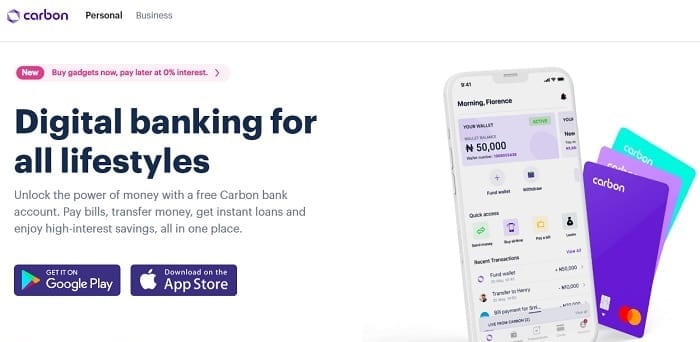
    Formerly known as Paylater, Carbon is a digital banking app that also gives out loan to individuals and businesses. The app provides all sorts of exciting financial services, including savings, investment, payments and so on.

    Hence, Carbon is more than an app for borrowing money; it is an app that offers “digital banking for all lifestyles”. However, for this post, let’s focus on its loan feature.

    Insured by NDIC and certified by the Central Bank of Nigeria (CBN), Carbon loan does not require any form of collateral, neither would you have to fill any form. The entire process is online, and you will receive your loan within minutes.

    How to get a loan from Carbon app

    1. Download the Carbon app from the iOS app store or Google Play store
    2. Register in few minutes by providing a few details about yourself
    3. Go ahead and apply for loans
    4. Your loan would be sent to your wallet on the app from where you can use it for different transactions. You can also send the money from your wallet to your bank account so you can withdraw it.
    5. Payback your loan on time to unlock higher amounts. Also, you stand a chance of getting 10 – 100% cashback when you pay back your loan on time.

    Interest Rate: 1.75% – 30%

    Loan amounts: ₦1,500 – ₦1,000,000

    Loan terms: Up to 64 weeks

    Target market: Individuals and businesses

    Must Read: 7 Financial Tools for Small Business Owners

    PalmCredit

    PalmCredit is another mobile app that gives Nigerians easy and convenient loan. Boasting of being “Nigeria No. 1 online loan…”, the money lending app offers flexible loans with reasonable interest rates.

    As with most other loan apps, paying back your loan on time on PalmCredit helps you to update your credit score. The implication of that is you get higher offers when next you apply for a loan.

    Some of its unique fixtures include offering up to 100k loan with a daily interest rate of 1.2%.

    How to get a loan from PalmCredit

    1. Download the Palmcredit mobile app from your app store
    2. Register and set your account in minutes
    3. Apply for a loan
    4. Get approval within minutes
    5. The loan is disbursed to your bank account

    Interest Rate: 14% – 24%

    Loan amounts: ₦2,000 – ₦100,000

    Loan terms: 14 – 180 days

    Target market: Individuals

    Okash

    A product of OPay, Okash is another loan app that offers loans to Nigerians. The app is committed to increasing access to loan facilities to the underserved section of the society.

    You get loan decisions on Okash within seconds, and once your loan is approved, you’d receive funds within 5 minutes.

    For your first loan application on Okash, you can’t get more than ₦10,000. The money will increase in subsequent applications, especially if you pay back your loan on time.

    Okash loans are provided in partnership with Blue Ridge Microfinance bank; hence you can pay back your loan via direct transfer to Blue Ridge Microfinance bank account (Zenith Bank Account No:1130085518)

    How to get loan from Okash

    1. Download and install the Okash app from your app store
    2. Register an account
    3. Select the product or loan amount you’d like to apply for
    4. Provide necessary information and submit your application
    5. You may get a call for verification after submitting your application. Ensure you provide the right information
    6. E-sign the loan agreement after approval
    7. After this, the approved loan will be dispensed to your registered bank account

    Interest Rate: 23 – 35%

    Loan amounts: ₦3,000 – ₦500,000

    Loan terms: 7 days – 365 days

    Target market: Individuals and businesses

    Fairmoney

    Fairmoney is a money lending app for Nigerians where you can get a loan within 5 minutes. You know this is a big deal if you’ve had to wait for days to get a loan from your bank.

    Fairmoney is not just a loan app, by the way. The app also provides some essential financial solutions such as airtime recharge and payment of bills.

    The primary requirement for a Fairmoney loan is your BVN, and you can get as much as N500,000. And you can spread repayments in multiple instalments for ease and flexibility.

    How to get a loan from Fairmoney

    1. Download the Fairmoney app from the Playstore
    2. Signup with your phone number and create your PIN
    3. Click apply on the home page
    4. Answer the few questions provided
    5. Get a loan offer
    6. Choose amount and tenor
    7. Accept the loan offer
    8. Provide bank details where you want your money sent and get it within minutes

    Interest Rate: 10 – 30%

    Loan amounts: ₦1,500 – ₦500,000

    Loan terms: 61 – 180 days

    Target market: Individuals and businesses

    Aella Credit

    Aella Credit is a fintech app that provides such services as payments, investment, and loans. The app makes it “super easy for anyone to borrow, invest and make payments” without excuses.

    The money lending app even offers affordable insurance services for its customers. Now, that’s something different compared to others in the list.

    For Aella, the end goal is to provide financial inclusion for all, irrespective of social class or profession.

    How to get a loan from Aella Credit

    1. Download the Aella app from your app store
    2. Create your account by filling out your details in less than a minute
    3. Answer some quick questions to update your profile
    4. Click the “check eligibility” button to see if you qualify for a loan and how much
    5. Apply for the loan, and it will be sent to your provided bank account within minutes
    6. Payback your loan on time 

    Interest Rate: 4 – 20%

    Loan amounts: ₦2,000 – ₦1,000,000

    Loan terms: 1 – 3 months

    Target market: Individuals and businesses

    Blackcopper

    If you are thinking of an app where you can borrow money to grow your business, then checkout Blackcopper. The app is committed to keeping “the wheels turning for your business”. 

    Aside from giving quick loans to individuals and businesses, Blackcopper also has investment opportunities for its users. Sign up to benefit from either of the two services the app offers.

    How to get a loan from Blackcopper

    1. Download the Blackcopper mobile app from Apple store or Google Play store
    2. Register your account by providing the required information. Secure your account by verifying it via mail
    3. Access Quick loans for your business needs or access investment opportunities on the app

    Interest Rate: As low as 3.74%

    Loan amounts: ₦500,000

    Loan terms: Up to 6 months

    Target market: Individuals and Businesses

    FAQ

    What are the main eligibility conditions precedent to loan

    1. You must bee between the ages of 22 – 59 years old2
    2. Have a verifiable source of income
    3. Live and/or work in cities where we operate
    4. Have a savings or current bank account with any commercial bank

    What are the required documentation to apply for a loan, using any of the loan apps?

    You need your bank statement, a government issued ID card and utility bill (optional).

    What is The Interest Rate on Branch Loan App?

    Branch offers loans from ₦1,000 to ₦200,000. Loan terms range from 4 – 40 weeks. Interest ranges from 15% – 34% with an equivalent monthly interest of 3% – 21% and APR of 33% – 261%, depending on your loan option. 

    Conclusion

    Accessing loans for personal needs and business development is no longer so much of an issue. However, resist the urge to get a loan when you don’t need one or don’t have a clear plan to pay back.

    Also, take your time to study these money lending apps’ terms and conditions before submitting your application for loans. Be sure you agree with these terms to prevent future regrets, especially in terms of the interest rate.

    Do you know of other loan apps with amazing offers and excellent services? Share in the comments.

    Suggested Readings:

  • How To Determine the Best Products to Sell On Digital Platforms in 2021

    How To Determine the Best Products to Sell On Digital Platforms in 2021

    ICON_PLACEHOLDEREstimated reading time: 16 minutes

    If you sell products online or plan on jumping into the business, this is for you.

    Digital platforms look easy on the outside but are they? Ensure to do a thorough market research before you take the plunge.

    Instagram’s biggest selling market segments include Beauty, Fashion, Health, Lifestyle and fitness, Art, Business Consulting Services, Travel, and Animals. Keep this list in mind when you think about what products to sell and make lots of money from on Instagram

    Many businesses have signed cheques to fail. It is evident because they intentionally kick out the need to conduct useful market research before determining the best product to sell on digital platforms in the 2020s. Each digital platform out there attracts its own unique type of customers.

    Technology, beyond doubt, has been a blessing, but ignorance about its benefits is still a problem.

    Many startups and entrepreneurs delve into putting out products on digital platforms without prior knowledge about their ability to sell, nor factors that affect their ability to sell on such platforms. 

    Like physical locations, digital platforms provide an online space for you to sell. Truth is people are shopping online, they’re just not buying from everyone – There are specific factors that influence their buying decisions online, as well as in the real world.

    Although online platforms are very flexible, the same rules of product research before sales apply here too. Before you conclude on a product to sell, there are certain factors you must consider. These factors, all make selecting products quite delinquent, but the right advice on the specific tools for productivity on these digital platforms will cancel out these limitations.

    Before we go further, if you found this post randomly and want to learn about starting an online business, then read: How to Start an Online Business

    OR UNRAVEL BUSINESS MYSTERIES IN: Product Marketing demystified

    Photo Credit: Premium Times

    The online space has changed rapidly over the years – from a social interaction platform to a marketplace. These days, buyers tend to consult their digital devices before purchasing products.

    Buyers have given up the urge to drag their feet languidly in the physical market places Some often dirty), and prefer to shop from their desk while sipping hot cocoa. 

    The following items can help you decide on the best product to sell and on which of the numerous digital platforms to sell on.

    Types of Products to Sell on Digital Platforms

    Just imagine a marketplace and think about the buying options available. Digital platforms also offer many product choices, including physical products and digital products. These products have their advantages, and it depends solely on what the seller wants or the customers’ demand.

    Sadly, not all products, digital or physical, do well on all sales channels. Your understanding of the type of products that sell on the diversely available channels would help you sell effectively.

    Needless to say, there are factors that affect customer buying patterns and as a seller, your mastery of these factors determine to a large extent how you succeed in sales.

    1. Commoditized Products

    These are general products produced by large industries and are available in stores with no price difference. Products that fall in the same categories by different competitors have fixed prices. A problem with commoditised products is that small brands often find it hard to compete with more prominent brands. Large brands like Amazon and Etsy often offer free delivery for these products and reduce the prices.

    2.  Niche Products

    Niche products, on the other hand, are unique products made available by specific suppliers. Their unique attributes give them a competitive edge over other products because they are usually in limited quantities. 

    The sale of digital products is known to enhance the business’s ease of handling. Types of digital products that startups and small companies sell include;

    3. Software

    More recently, the use of software in the business world has tremendously increased. Different brands rely on software to work efficiently; software is a digital product worth selling. Examples include video animation or image editing, graphics design software, etc.

    4. Mobile Apps

    People are getting more attracted to mobile apps’ user interfaces and experiences. They would prefer to use them for their activities rather than rely on the web application. For example, most people prefer using the mobile Facebook app than the web application because of the user interface and experience. You can leverage on selling these apps if your business tilts towards making technological products.

    5. Online courses

    Online course creation is an efficient way of making a profit off digital platforms. The way everyone is interested in learning a new skill is great to monetise. Online courses offer the opportunity to make profits at little or no cost. Just making pre-recorded videos and selling them to your target audience at your convenience can generate the income you need, and in most cases – passively.

    How To Find Products To Sell on Digital Platforms

    After identifying the factors necessary for selecting products to sell, you have to carry out the research. With the influx of commercial sites on the internet today, many people are already leveraging digital platforms to make sales. It implies an increase in competition and too many choices to make about the particular product to sell. It can be quite challenging and confusing to most entrepreneurs and startups. 

    Imagine this scenario, where you’ve taken e-commerce courses because you are determined to sell online. Still, the specific problem you are facing is your inability to select the perfect product to sell. 

    You’ve brainstormed on ideas and have asked a few friends what they think about a product, and everyone’s idea seems like a journey you’re not ready to start.

    Well, it is not a strange feeling. Entrepreneurs and startups at a point of their lives, often go through this process. Even before Amazon hit the charts and became a thriving online market, it started as an idea. Technology has provided valuable research opportunities with business tools that aid these more effectively and efficiently on a lighter note. Here are some digital tools available to help you identify the market gaps and capitalise for your business.

    All the Amazon Methods:

    Most people have frequented popular e-commerce markets like Amazon to shop. As a result, more retailers go on the platform to buy and sell. To know the best products trending on the platform as a newbie seller, you should check Amazon’s “Movers and Shakers” or the “Best Sellers Rank (BSR)” pages. This information can show you how well a product performs when compared to other products in its category. The Amazon Movers & Shakers section specifically provides you with the kinds of products currently trending on Amazon. These tools can help you decide on the type of product you want to sell depending on what people ask.

    eBay Sales Data:

    Another place to carry out your product research is on eBay. Unlike Amazon, eBay has less traffic from people and retailers. However, it has the search data that can also know what products are likely to turn heads in the marketplace. Its sales data can help your product research and help calculate profit margins for the product you plan to sell.

    Comparison Shopping Engines:

    CSEs are websites that use search engines specifically for products. They function similarly with Google search bar but are quite different. Their results focus on the features, reviews, prices and other criteria customers use to find products that interest them. Comparison Shopping Engines also aids consumers to find multiple retailers offering the product they want to buy. Using these websites gives you access to a wide range of products options currently on sale.

    Perform Keyword Research 

    When people or your potential customers want to inquire about products online, the specific words and phrases they input into their search engines are the Keywords. Keywords work well with search engines, because the more frequently a particular keyword is used, it increases its ranking on the web. Which, in turn, informs you of the interest of your potential customer. Researching keywords can save you from getting random products and stocking your e-commerce site with it. It will guide you on the right product to sell.

    To make use of the Google Keyword Planner tool, type in the word or a string of words and then keep pressing “more like this.” it will help you know the best combinations to make with the products you’re about to sell. Maybe you wanted to sell a wristwatch; after using the Google Keyword Planner, you might have to add a necktie to the wristwatch idea.

    Look Through Product Reviews

    Social proofs have magical effects on recommending the next hot product. There are many e-commerce sites with product reviews, and you can get inspiration from these sites about the next jaw breaking idea that can smash the market. There are other areas, including social media pages which are excellent sources of online reviews and can give you an idea of selling products.

    What is the Best Digital Platform for Sales?

    Leveraging digital platforms to sell your products has gone beyond owning an e-commerce site and uploading your sales pictures. For you to be able to succeed, it depends on your passion, experience, grit and marketing strategies. Several business tools can help you achieve your business success goals.

    There is a bevvy of options to choose from when leveraging digital platforms to sell. You do not have to spend too much or go through the stress you would typically encounter when starting a physical store. The online marketplace can be a great digital platform to join when launching your business career. There are different online marketing platforms, including Alibaba.com, Amazon, Jumia, Konga etc. 

    You can leverage Social Media. The transformation of social media from a messaging app to now a marketplace has improved online selling. Social media tools have become great outlets for marketing and selling your products. All you need is an excellent digital device with mobile data and great choice on the media platform to leverage. There is a pool of social media options, including Facebook, Twitter, Instagram, Pinterest, Whatsapp and more to get a better market experience. 

    Lastly, you could add a shopping cart to your website. If you already have an existing website, you could leverage it for your sales by adding a shopping cart and placing pictures of the products you desire to sell.

    The best choice for you may depend on your experience handling these digital platforms and your business goals.

    FOR MORE, SEE: Top-Selling/Hot Businesses in Nigeria

    Why Should You Sell on Digital Platforms?

    Making an increased profit as a business owner without leveraging digital platforms has become wishful thinking. Seasonality and recent happenings have contributed to the increased use of digital media for transacting business. Despite the struggle that you might face adjusting to this way of life; you sell various benefits online.

    SUGGESTED: Why Products Fail and How To Avoid The Pitfalls

    1. It Increases Your Reach

    Leveraging on the use of digital tools and platforms to sell your products online, increases your reach.

    An online store removes the barrier of being constrained by the number of customers visiting your physical store. It also removes geographical barrier limitations, selling across different towns, states and borders have become possible.

    Various digital platforms have specified uses and advantages; an online site helps your products reach international shoppers. Social sites can enable you to reach new demographics. Online marketplaces like Amazon, and Jumia give access to broader audience coverage and allow you to find specific niche markets. 

    2.  Saves Time

    Comfort and convenience are standard terms in the use of digital platforms for sales. Leveraging these tools and platforms allows you to cater to shoppers who have no intention of visiting your physical store to make purchases. Online shopping offers your customers’ product options to choose from when your physical store is not open. The specificity of online shopping makes room for saving time, unlike the usual brick and mortar store where customers make phone calls about availability, specifications and working hours. Online shopping rules out their need because people can find the information on their social media pages and website pages.

    3. Customers Insights and Analytics

    A great feature on digital platforms is the availability of the analytics and insights feature. The analytics helps you make sense of your data, consisting of your customer’s information, including demographics, behaviour, and activity information, to uncover meaningful trends. The insight feature is the result obtained from the use of the analytics. The analytics and insights tools are essential in tracking your product’s progress on the internet to see how it is doing in the store. It can also monitor your customers and derive sufficient data from knowing how they interact with the site, what purchase they left incomplete, and how to retarget them. It also provides opportunities to learn about your customer’s interests, desires, pain points, and buying traits. They provide valuable metrics that allow you to make better decisions that meet your customer’s needs.

    4. It is Scalable

    Another important reason why you should leverage digital platforms to sell your products is that it allows you to scale. Using analytics and insights, you have an idea of the products that are doing well on the market, products that need restocking and products that aren’t working. Scaling reports are essential and can guide you in making choices that can interest your customer base. There has to be a growing demand for the product for the seller to restock. Restocking a physical store can be a pain in the neck. Still, an online store removes all stress and makes it an enjoyable activity.

    5. No Opening Time Restrictions

    Digital platforms eliminate the need to postpone activities or conditions due to its convenience in its operation mode. There are no closing hours on digital media; businesses can generate income at all times, and customers have the freedom to shop as they deem fit.

    Digital Product Research (Howto)

    Before deciding on a product to sell, you must consider certain factors before jumping off the cliff. You have to research what products will succeed in the market and understand how it aligns with your brand’s goal or vision. There are essential factors that you must consider before choosing a product to sell on digital platforms.

    During the pandemic that changed the global world’s operations, certain products’ demand increased rapidly. Products like face masks and shields, hand sanitisers, tissues and other toiletries topped demands. People could let go of the things they wanted for these other things they needed because of the season and the market trends. Before choosing a product to sell, ensure you have taken a good look at the trending products to determine what next to sell.

    If you own a blog read: How to Do Affiliate Marketing for Bloggers

    Product Demand 

    You’re not going on a wild goose chase. I believe you would not want to jump into the market with just any product popping into your head. You’d have to check how the product is doing first in the market. You should ask real questions like, how are people perceiving the product? Does it look like it has the potential of becoming a hotcake? Is it easing any customer pain point?

    The use of sales estimators (JungleScout) or shopping websites can help you find the most demanded products. It helps you understand the frequency of sales your dream product makes in a week month and determine your profit margin.

    Product Source

    You cannot dash into selling a product without knowing who your significant suppliers will be. If you manufacture the product yourself, there are questions about where you’ll get your consistent supply of raw materials. Ensure your wholesale product suppliers are reliable before you delve into the product. Failure to do this might bring unnecessary hold to your operation as you begin to build momentum.

    Search Engine Friendly

    One advice most digital entrepreneurs give startups and new businesses is that they must be discoverable. After you decide to leverage the digital platform to carry out your business, you must ensure that your product is search engine friendly. Insist on the use of keyword research, Google AdWords to know what products are commonly searched for to be able to situate yourself as a solution to these problems. 

    Product Shipment (Order Fulfillment)

    Before you decide to take that advice you got from your friends seriously to become productive, you should consider if your product is shippable. Despite the complexities a product might possess, your customers expect free shipment or low freight cost. However, to avoid losses and cost buildup, you can set out time to consider your product’s properties. These properties include the product’s weight and dimensions to know how you’d price the product to offset shipping costs.

    Target Market

    Determining the niche of audience your product is going to is vital. Assuming you want to sell a line of handbags, don’t be aloof of your target audience when running your social media ads. You wouldn’t just send the ads running on just anybody’s feed, which will lead to waste of money. You’ll have to specifically target young women within the ages of eighteen and above. Knowing your target audience eliminates the chances of putting your products in the faces of those who do not understand and need them.

    Competitor’s Research

    Before you swim, you must test the waters. Similarly, in business, you have to know and understand your competition. You need to know other brands who are selling similar products you sell. You need to monitor their activities, progress, strategies, and objectives to better position yourself. There is a need to review their plan to know how it works for them, and then you’ll have a better way to improve yourself and learn how better to acquire their customers. You can do this by research, scouring the marketplace, checking reviews and feedbacks, surveys etc. 

    Pricing

    Some people find it challenging to define the price of their products. And as a result, they settle for any figure that gives them profit. Before setting off to the market with your desired service, you must consider your product’s cost. High prices put people off except your product proves to be very valuable. Customers will pay a premium for gold but will not pay a premium for a pen because they perceive that the later is of lower value. Before you set out to launch a product into the digital space, you must consider its cost and then set its price.

    Profitability

    The goal of every business irrespective of the market is to make profits. It would be unwise to invest your time, money and energy into products that will not bring profits to your business. You have to clearly state your profit on every product to help you figure out the markup you’ll need on every product to succeed. You have to calculate all the costs you’ll incur in production, storage, shipment, and marketing and estimate your profit margin on each product.

    SEE: How to Create a Digital Product that Generates at Least a Million Naira

    Conclusion

    Determining the best product to sell on digital platforms might be challenging, like fighting the wind. Careful consideration of the factors that affect the selection of these products will determine if your business will succeed or not. In reality, the entrepreneurs and brands who succeed in online marketplaces are the same ones who have the tenacity to do well in physical stores. They are always ready; they master the rules and succeed in the markets.

  • Why Products Fail, and How to Avoid the Pitfalls

    Why Products Fail, and How to Avoid the Pitfalls

    ICON_PLACEHOLDEREstimated reading time: 16 minutes

    The Internet is inundated with failed products and failed startups; especially from Nigeria and most of Africa. Nigeria, for example, has her fair share of failed businesses ranging from the most recent exit of GoMyWay, to the acquisition of Konga, Olx, Camplus, Showroom.ng and Some from other parts of Africa, like Wabona (2012 – 2015), Tress (2016 – 2018), Podozi (2014 – 2018) and a host of others.

    A brief analysis, however, reveals that most of these businesses regardless of their brilliant business ideas failed due to common pitfalls. And surprisingly, nonetheless, about 80% of startups fail due to the same pitfalls.

    As common as these pitfalls are, one would wonder why the pattern persists!

    This article is a deep-dive into these pitfalls, with the lofty vision of helping startups fully understand them and how to best avoid them.

    The Identified Startup Pitfalls Are:

    • Poor Market Research
    • Incorrect Pricing
    • Customer Negligence
    • Misalignment with Business Processes
    • Fixing a Problem that doesn’t Exist
    • Poor Product Quality
    • Lack of Patience
    • Weak Market Launch
    • Delayed Market Entry
    • Product Trends
    • Marketing failure

    So how do these pitfalls cause startups and products failure?

    Many new innovative ideas and products of famous companies have been unable to survive after they launched. A significant reason is that they assume quickly, without any significant research, that their products will appeal to their customers.

    Take the Edsel Ford automobile introduced into the market in 1957. Henry Ford’s company invested a large chunk of money and dedicated about ten years in developing this product. The plan was to create a line of flashy cars for the middle-class citizens, and they named it after his deceased son Edsel.

    On the day of the launch, Henry Ford dubbed about 18 variations of the car, a stunt which no other car manufacturer has ever pulled in history. After the gimmicks and hypes about the vehicle’s awesomeness, a colossal disappointment shrouded the public’s eyes on launch day—a clear distinction between what they were expecting and what they got.

    In 1980, the Edsel was pulled from the market, a bitter realisation that people preferred cheaper and less sophisticated brands than an ugly looking car with an unusual name.

    Right from the car’s development and the details they focused on, the company had assumed the product would be a hit in the marketplace. But they thought wrong.

    Harvard Business School asserts that 95% of the 30,000 new products (digital and physical) introduced every year fail. Every business will cringe at the slightest thought that their developed product will die, after the investments and the resources pumped in for the product’s success.

    Reasons Why Products Fail

    To launch a successful product that thrives well in the marketplace is quite tricky. Every business owner desires to establish a product that sells like hot cake. Still, when they ignore certain principles, their products are swiftly pulled out of the market. Many large business products that didn’t thrive well in the past flopped because of different factors that were in play. Looking back to Edsel Ford’s story, there were many reasons why the product failed. Although some people tried to blame appearance and features, there was more to it.

    Generally speaking, certain factors determine the success or the failures of a product. These factors tend to differ among the kinds of products released but are all relatable.

    So you have launched your latest food product into the market, and you were optimistic that the product was going into the market to solve breakfast problems among corporate workers. The odds were all in your favour the last time you checked. After its release, it was as if you threw it out on the streets to crash and burn. Here are some reasons why a product fails.

    • Poor Market Research
    • Incorrect Pricing
    • Customer Negligence
    • Misalignment with business processes
    • Fixing a Problem that doesn’t exist
    • Poor product quality
    • Lack of patience
    • Target Market
    • Weak Market Launch
    • Delayed market entry

    Poor Market Research

    One of the reasons why your idea stands a great chance at failure is because you assume too soon. You believe that since you think it’s viable, everyone else will have a similar emotional attachment to your product. Your product will remain irrelevant to your customers if they can’t find a use for it.

    Market research is a determinant to the success of any product idea. Lack of proper market research and analysis can lead to loss of information necessary for the product’s success. Adequate market research helps the business to know and understand who their customers are and how the market works. It helps to give a detailed description of who your customers are and what their interests are. You also need to know about your competition, who they are, their position and strategies in the market. How do they acquire their clients and customers? What they are doing right and wrong.

    Test launch or beta testing is another neglected aspect of market research. Launching beta versions of the product before the official launch date will help you understand what your customers think about your product. Test launches are vital because they guide you towards capturing the product loopholes. The feedback you get will be necessary for improving the product. But if your research fails to meet these requirements, then your product is at full speed to its doom.

    The Ford Edsel practically had no prior test launch. The product was shipped sealed to the dealers because they wanted an element of surprise. It didn’t end well because the audience had no idea whatsoever about what they were expecting. They made the mistake of assuming everyone would love their product since they were a trusted brand; thus, they lost over $250 million. The management pulled the product out of the market 24 months after its launch. Market research is critical to the success of any product.

    Incorrect Pricing

    The money subject has always been prickly. Usually, in attempts at uniqueness and brand difference, companies will design products with many features. As a result, these companies record heightened costs because the cost margin of the products has increased. To recover all that the business invested during the development phase, these companies exaggerate their prices. This strategy sometimes works for trusted brands but doesn’t work for others. When customers disagree with this stance, they tend to move to other brands with similar products at a lower price.

    A great fix to a pricing problem is to compare your competitor’s prices to know the range at which you should set yours. But it might become problematic if your product is new. There needs to be a pre-launch market test to understand what they stand to gain after purchasing your product.

    Customer Negligence

    Your customers are integral to your product success. Extricating your customers from the process of product development can be a reason why products fail. In the product marketing strategy, the customers play a vital role in determining how valuable your product will be. Although overdependence on the customer’s feedback can sometimes lead a business astray; it is necessary to listen to what customers say since they are the reason you created the product. Your product is only valuable to your customers based on what they define as value. You cannot solve their problems when you do not understand their pains. Knowing your customers helps give your products a unique feel because their pain points are made evident. It can guide you on learning how to improve the products to meet their specific needs. Your product generally is valuable to your customers at three levels:

    • Because it interests them, that is it solves their immediate need.
    • It cures their pain to an extent or on a longer-term or
    • Like candy, they desire it as a basic necessity.

    A great example is the Coca Cola Blak launch, a coke blend with a coffee after taste. The product was pulled out of the market shortly because they realised later that the customers preferred the old coke better.

    Your customers might not have the rights to tell you what to produce, but it’s wise to let them input into the product you’re creating. It helps you to know how better your product can serve them.

    Misalignment with Business Processes

    Aligning your product to the vision of the company isn’t something you want to take for granted. The business world can be competitive. You might get swayed by the air of competition blowing from what others are doing, and then you want to create something eyes have not seen.

    Your customer’s trust is not something to be taken on a light note. When your product derails from the original vision they are familiar with, it will bring about conflicting interests and a truckload of trust issues.

    You might be on a shady slope of losing more loyal customers because they have no idea of what is happening. It might get difficult to win back their trust. For example, you are in the food and beverage sector, and then your new product tends towards developing an iPhone. Not only would you hack to pieces the trust of the working-class women and men, but it will give them a cause to doubt your potential.

    Fixing a Problem that doesn’t Exist

    The goal of every product is to create a solution. Your product loses relevance if the users or customers find it useless. Creating products and ideas can be very interesting. After your brainstorming sessions, your thoughts will probably sound like a million bucks. Deep down, you are sure that it will shut down the market and shoot sales into your bank account hoops when it’s launched. You probably have those earth-shattering ideas that could give you the chills by mere thinking about them. But the downside of this is when your customers don’t feel the same way.

    Nobody will buy a product that does not resonate with their beliefs. When it doesn’t mean anything to them, it loses its value and usefulness, and soon they forget it. When Google launched its Glass product, it seemed like a significant technological break. But soon, the ridiculous pricing, design and privacy issues emerged. The public realised they did not need such a product. Gradually, they forgot that it ever existed.

    Poor Product Quality

    A product which has an inferior quality is sure to fail. The beauty and quality of the product are the first things customers see before settling for the benefits the product offers. When the branding and the quality of the product are not good enough, the product dies quicker than its lifespan.

    Your clients in the fashion industry have a great knack for identifying fake designer bags and purses. If your product’s quality isn’t top-notch, your customers will drag your brand’s reputation into the mud.

    Defects like this occur when companies set unrealistic time frames for the launch of their new products. During product development, the developers give all their attention and time to other product development parts. While they ignore, it’s usability and user experience. The managers dismiss all efforts to get to them with “we will do that later”.

    When a customer senses the lack of quality in a product, they can also dissuade others from using your product and in the long run, affect the reputation of your brand and company. Hence, you should take the quality of your product seriously during the product’s developmental process.

    Lack of Patience

    Some companies desire to strike gold the first time they launch their ideas. The virtue of patience is best explained in details by Napoleon Hill in the Three Feet from Gold story in his book “Think and Grow Rich.” A man went in search of gold. He was motivated beyond doubt that his speculations were accurate, and he began to dig a piece of soil. He persisted until he found a shiny ore, he became excited at his breakthrough. He covered up the ground and retraced his steps back home to regroup with his friends. He acquired the right machinery and came prepared to mine gold. After a while into drilling, the vein of gold dwindled, and the gold was gone.

    They scourged the ground frantically till they finally accepted their fate that they had jumped too soon into conclusion. The man sold his machinery at a measly amount to a junk man.

    The junkman sought counsel from a soil engineer. When he scouted the area, he discovered fault lines in the mine. The engineer confirmed that the junkman would find the gold three feet from their present location. When the junkman got there, he found a million dollars of ore in the mine.

    It takes patience to realise the potentials of your product. The agile businessman has no business for patience; all he wants to do is make it big overnight. Impatience has led companies to withdraw stellar products from the market and as a result, lost out on goldmines.

    Weak Market Launch

    Marketing plays significant roles in the success of a product. At every level of product development, there should be a great deal of marketing. Your customers and market need to know what you are up to and what they should expect in the process of development. It is no news that most companies feel the surprise element should be the centre of focus for a successful product launch. Others think marketing is an obscene word, “a great product will market itself” they say. They direct their efforts towards developing the product; thus, more products are stacked yearly in failure archives and have been why products fail.

    Give your product a chance to succeed. To do this, it must have the AIDA support (awareness, interest, desire, action), which stems from continuous advertising and creative wit.

    Delayed Market Entry

    Even if patience is a virtue, withholding the product from entering the market is equal to brutally ending its lifespan. For example, a mobile phone company takes five years to produce a new phone for its customers. But a competitor releases a phone too with similar features in probably three years. The first phone company will lose its customer’s trust because people are anxious. When you’re not helping their anxiety, they will lose interest in your product and quench their stress with a competitor who promises them something similar and better. Now finding a new space to compete with your customers is near impossible.

    How to Avoid the Pitfalls

    Every business can avoid chances of pitfalls in their products. There is no doubt that every business owner dreads to fail. Every year, the statistics of failed products always beat the rates of successful outcomes. However, you can channel or embrace failure to test what ideas are viable. We are now in the agile transformation era where larger companies are beginning to adopt small business principles. The concept of failure isn’t a thing to dread because businesses can test ideas through the fail-fast culture. Despite the teaming advantages and benefits of the fail-fast culture, strategy proves to be a better option for ensuring a company’s product success. In product marketing strategy, companies and marketers pull together patience, perseverance and intuition to make things work. These are some strategies that can help your company or business stray from the pits of failure.

    Ensuring a Product Market Fit

    It is usually not always easy to locate the path of a product-market fit. Based on product marketing strategy, you have to carry out detailed market research, to know your customers. Check competitor’s sites for reviews to see what they are doing right. Then you’ll have to rely on some intuition, calculations, data and signals to predict what product will turn heads in the industry. This approach is messier than the fail-fast method because it requires careful planning and deductions about the next phases. Here are signs that your product tilts towards a flattering product-market fit.

    • A massive positive reaction and reviews: When your product gets to the stage where the market is impressed, it results in many positive responses from the public. Despite the vast competition in the mobile phones industry, the positive feedback about the iPhone still skyrockets.
    • Monetisation too can be proof that your product has gained a product-market fit. Not all products have the potential to be monetised right from day one. Some people believe that focusing on monetisation will inhibit growth. However, if your product tends towards generating revenue for you, it means it is on the path of success.

    Carry Out Sufficient Market Research

    There is a difference between learning what your customers want and listening to them say what they want. In market research, you must collect data from your target market, your customers and your competition. Detailed analysis is usually required to find out more about your customer’s buyer persona and traits to inform you about who they are. However, a significant part of the market research often ignored is the non-customer avatar.

    Always focusing on your customer’s feedback and reviews will inhibit your creativity. After identifying who your usual customers are, try ignoring their input and changing your approach by putting your product before your non-customers. This time, you’re trying to shift focus from the people you are used to because you are trying to explore newer clients. Here are specific questions that you can answer when carrying out this market research.

    • Who are the customers not using your products? Provide justifiable reasons.
    • Identify what customers have thought about your service and declined it, and why have they done this? Explore ways to solve the problem.
    • Who are those customers who have not gotten to know about your product and have high chances of considering your product?

    Finding solutions to these questions gives you a more comprehensive view of who your market is. There is no harm in sailing your boat on more expansive waters to get the public’s idea to shape your creativity.

    Combat False Claims And Preventing Bad Reviews

    Sometimes, products fail because companies make outrageous claims that their products can do the impossible. Eventually, when the market is swayed and convinced to purchase these products, it leads to bad reviews and possible customer withdrawal. When you aren’t sure about your products’ capabilities, refrain from making assumptions because your company’s future or reputation is always on the line.

    Since the strategy is vital at this phase, it is pertinent to consider that the product passes through beta testing to inform its capabilities. The Edsel failed to accommodate this into their strategy and planning. Hence, even if they had spent a fortune trying to make the car and secure different features to work in the car, it still flopped.

    Define Failure

    Your failures are non-existent if you do not know what they are. You cannot decipher the degree of loss of your product if you haven’t defined it. To measure the level of failure, you should understand it from the standpoint of your company’s goals and vision. Your product fails if it does not meet the positioning of the company.

    KEEP AT IT, DON’T QUIT

    There are two types of failures recognised; reversible failures and irreversible failures.

    • Reversible failures: This occurs when the company can identify the root of the problem. Here, the company still has the financial capacity to help it renew.
    • Irreversible failures: This occurs when the company is bankrupt, or the competition has shrunk its opportunities, and there is no hope for its survival.

    Differentiating between failures is quite challenging and is worse if there’s no prior definition of failure.

    READ: FOUR ESSENTIAL TIPS ON SALES AND MARKETING

    Final Words

    An underlying factor to why products fail is because many businesses are afraid to fold. Since failure is inevitable, there’s no need to stall. Due to the improvement in technology, product development has become less complicated. It is easier to carry out research using digital tools, google forms and surveys to know what customers need. Carry out extensive marketing because your products might have failed because they were chiefly in the faces of people who didn’t need them. Increase your scope, connect the dots and sail on expanse waters, then launch your product.

  • Product Packaging and How it Influences Sales

    Product Packaging and How it Influences Sales

    ICON_PLACEHOLDEREstimated reading time: 8 minutes

    Product packaging goes a long way in influencing sales, and we are going to be exploring the how of that shortly.

    First, let me tell you a story.

    I needed to travel to Ogun state, so I went to the nearest park to board a bus. I got a bus and now have to wait for it to get filled so we can leave.

    While waiting, different vendors approached me and other passengers, trying to sell their goods. One of them was selling “choco milo”, a very familiar candy cube made with chocolate. I bought some hoping to give them to my nephews and niece when I get to my destination.

    Few minutes later, I decided to unwrap and eat one of them. I unwrapped and it still all looked good. I put it in my mouth, and that was when I realized what just happened to me. I didn’t buy choco milo. It was something else that didn’t taste anything like it.

    But I fell for it because the packaging perfectly imitated the choco milo we all know.

    Imagine how many more people would fall for it in a country like Nigeria and how that would influence sales. That should tell you all you need to know about packaging. But let’s explore a bit further. Who knows, we may find more examples.

    Product Packaging and Consumer Behaviour

    The above example may not be the best. You may want to argue that there is a bit of manipulation there. We all get manipulated by advertisers every day anyways.

    However, there has always been a link between product packaging and consumer behaviour. 

    Wait, let’s be clear on what product packaging really is.

    What is product packaging?

    Yeah, your basic understanding of product packaging may not be wrong. Product packaging involves creating the wrapper and/or container for a product. It’s the product cover used for storing, protecting, and handling the product from external factors such as moisture, sunlight, and breakage.

    While the primary function of packaging is protection and preservation in some cases, it has served as an essential marketing tool over the years. It gives the product a look, an identity that attracts customers to it.

    Don’t judge a book by its cover yeah? But interestingly, some of the bestselling books on popular reading platforms such as Bambooks and Okadabooks tend to have beautiful covers. Coincidence? I think not. Another strong point for packaging.

    72% of consumers in America have said their purchasing decision is influenced by product packaging design.

    Think about this for a second. Say you need a product but have no particular brand in mind. So, you walk into a supermarket, and the attendant tells you the section of the product you’re looking for. You get there and now faced with multiple brand options of the same product. And they all are within the same price range. 

    What do you think will influence the product you eventually choose?

    Well, in most of such cases, the packaging ends up becoming the determining factor. You will most likely end up taking the brand that its packaging appeals to you most.

    But how does this work? What is it about packaging that makes it so powerful and influential?

    How Product Packaging Influences Sales

    Positioning Strategy

    There are different ways to look at Positioning. For this point, let’s choose to see it as a way of associating with a known brand to make your brand recognizable by the target market.

    And a perfect example is in that choco milo story up there. I bought the brand because I thought it was the choco milo I knew. It turned out it wasn’t; the packaging only imitated it so well.

    Someone else may actually know it’s not choco milo but still go ahead to buy it thinking “if it looks like choco milo, then it will most likely taste like it”. Now, that’s another example of the effect of positioning strategy.

    Making a product look similar to others within the same industry or niche using recognizable packaging style makes it easy for customers to recognize your product in any retail environment.

    Positioning is not peculiar to packaging, though. It can be applied to brand name, logo, slogan and so on.

    For instance, think of how many Cola you know or have heard of (minus the original Coca-Cola). Every other brand using Cola in its name is just tapping from the Coca-Cola brand through Positioning.

    Photo by Karolina Grabowska from Pexels

    Packaging and Product Quality

    Have you seen Apple products packaging?! That’s an excellent example of packaging that communicates quality, and it clearly results in sales.

    Of course, Apple does not disappoint with the product when you eventually unpack. Quality packaging meets Quality product.

    However, in some cases, the content in the beautiful design ends up falling short of expectation, leaving the buyer disappointed. But it is what is – product has been bought already. You can say mission accomplished as far as the goal of the packaging is concerned.

    However, the long-term effect of this on the product is negative reviews, which will ultimately lead to a decline in sales. And since it’s the age of the internet, you need all the positive reviews you can get, as your next customer is one negative review away from leaving you for your competitor.

    The fact remains that quality packaging often gives an impression of quality product (content), resulting in sales.

    Perceived Value

    We may have to spell out the difference between value and quality here quickly. Value may seem similar to the point on quality above, but they are not the same.

    Yeah, value and quality are two words that are similar in meaning, and some may even use them interchangeably. But make no mistake; the two terms are not the same.

    The significant difference between the two terms is; value often depends on price while quality is independent of price. A quality product is a quality product, irrespective of how much you got it.

    But when you say a product is valuable, you are saying the product is a quality product of a relatively high price. 

    Now, packaging helps to communicate a product value. 

    How many times have seen products sold for twice their worth because of packaging?

    I know a friend who goes to the market to buy sunglasses. Then goes on to purchase attractive glass cases for the glasses. By the time he is selling these sunglasses, the price tag would have gone up by about 300%, and people would gladly buy.

    The reason is simple. The attractive glass cases have added value to the glasses.

    Colour and Typography Effect

    Colour, styling and typography are strong indications of a product’s target market or audience. That explains why, in some cases, products within the same market play around with the same colours.

    For instance, children cereals tend always to be colourful and bright. On the other hand, healthier and high-fibre options often come with neutral colour and earth tones palates.

    What is the colour of luxury? Do you have any product you can term as luxurious? Look at the packaging it will most likely be silver, black or gold. Those are the colours that often been associated with luxury as they make bold statements.

    Photo by S. A. Usama from Pexels

    Some of the things happen so fast and subtle that we don’t notice. 

    “I wasn’t sure which one to get, but I just noticed this one from far”. Well, it may just be something about “this one” colour that makes it easy to notice from far. I think the word I’m looking for is flashy.

    Product Information

    Finally, packaging is where you often find information about the product, especially if it’s one you are not all that familiar with.

    A typical product packaging has such information as the product name, ingredients, production date, expiry date, registration/approval number and some other information the maker may deem necessary.

    Photo by edwin josé vega ramos from Pexels

    As established from the beginning, product packaging is a marketing tool. And the fact that you can write all sorts of exciting contents on the packaging to further attract the customer is additional proof of this.

    When a customer picks up your product among the other retail store options, you are one step away from getting the customer to go home with the product.

    Some times, the information on a product is why a customer will either buy it or not. 

    Conclusion

    One thing is clear; product packaging is crucial to sales. This something almost anyone who has ever bought anything can attest to. Therefore, it deserves all the attention it can get.

    Having said, this does not mean you should focus on packaging at the expense of the actual content. Any business who does that may see initial promising results, but eventual negative in the long run.

    Good packaging will get you a customer, but only a good product will keep that customer coming back, and bringing people along.

  • Product Marketing Demystified – How Small Businesses Can Best Position, Promote and Sell Their Products and Services

    Product Marketing Demystified – How Small Businesses Can Best Position, Promote and Sell Their Products and Services

    Estimated reading time: 10 minutes

    Let’s demystify product marketing.

    It’s not about sales alone – it’s first about your product, then about how and where you choose to market and promote your product, or service. Some call it, the marketing mix. The 4Ps of marketing.

    In his book, The Founder’s Dilemma, Noam Wasserman opines that Founders‘ attachment, overconfidence, and naïveté may be necessary to get new ventures up and running, but these emotions later create problems. Overconfidence in most founders has led to the downfall of their businesses.

    Most entrepreneurs jump right into launching products without plans such as a product’s marketing strategy. Some entrepreneurs and companies to date, still believe that marketing isn’t for everybody. They follow their belief in their idea of what their business is about and backed up by plenty of motivation, and they expect it to succeed against all odds.

    Suggested Read: Product Development For Small Businesses

    Imagine this scenario; a new fashion brand decides to launch a clothing line. Great idea! The product team invests its energy, time and resources to ensure they release the product on the date expected.

    Three months later, the product goes live. The company organises an event to celebrate; as glasses of wine chinks together, there are exciting and congratulatory whispers with laughter spurts all over. …but no one amongst the celebrating crowd was interested in the product; the product never did kick-off, as it was not a fit for the chosen crowd.

    Why?

    First Things First

    The product marketing team failed to properly consider the Product, and how best to Position it in the minds of its prospective buyers and effectively Promote it, at the right Place where the buyers could be reached.

    The chosen crowd had no desire to buy the product – It probably did not ease any of their pain points. This is why businesses need product marketing. Small companies need product marketing because it helps them position their products or services, in such ways that they might effectively promote them and sell them.

    READ: Product Development for Small businesses

    What is Product Marketing?

    Marketing Defined

    Though most people mistake marketing with sales or promotion, there is no one generally accepted definition of product marketing. Every expert tries to define it based on their personal experiences while practising it. Yet, every description seems to bring together the relationship between the product, the promotion, and the customer. It is safe to describe product marketing as that aspect of marketing that deals with acquiring the right buyers or customers for a product and creating an appealing pitch to these customers. 

    Product Marketing helps to develop positioning, messaging, competitive differentiation. It uses a combination of research, design, and advertising that leads to its success. 

    Product marketing, therefore, is at the very heartbeat of product development. If you get your marketing right enough, you could actually generate enough momentum for your product, even while it is being developed.

    5 Essential Reasons Why You Need Product Marketing

    Your business won’t achieve its goals among your target audience if you do not have a product marketing strategy. The benefits of product marketing in companies are valuable. 

    1. Product marketing provides insights that help you to understand your customers better

    This employs the use of both the qualitative and quantitative approaches in gathering market and customer insights. These insights are necessary for growing small businesses because marketing an unknown product to your customers is suicidal to the business’s success. Understanding customer insights helps to inform positioning and messaging. It exposes what market needs are and helps strategise sales and ensure closures.

    2. Product marketing helps provide data that can help in targeting your buyer personas effectively:

    After understanding who your customers are, product marketing also provides insights into the persona of their character or interests. It helps you determine their behaviours and what they want so that if you’re launching a new product, you can be guided into what they want.

    3. Product marketing helps you to learn about your competitors (products and marketing tactics):

    The competitive landscape is an area you should not be ignorant of. Product marketing ensures that you take account of what others are doing in the industry. This information helps you understand your market dynamics.

    4. It helps to position the product appropriately in the market: 

    After a comprehensive understanding of the target market, product marketing helps provide its benefits to the target market. Through their insights, it gets easier to know what products appeal to them. This information also enables you to streamline marketing efforts in creating useful marketing messages that drive sales. 

    5. Product marketing helps in setting the price for your products:

    Pricing of products in the market depends on how you position your business. Is your product a premium product or service? Using your customer data and their personas, it gets easier to determine the products they can afford. 

    Understanding Product Marketing Strategy

    Every new product launch requires a product marketing strategy, which serves as a guide towards the positioning, pricing, and promotion of the new product. These are the detailed steps of actions you must take from the product’s development to its launch. This process is necessary for your product’s success and helps inform the customers about the product. You need to advertise and tell them about your activities at every step of the way.

    A product marketing strategy usually considers the following components.

    Vision

    Your organisation’s vision determines what your product will be. The idea will feed the development of the product and fan the excitement of your audience. A common problem that may result when your idea and product aren’t in similitude to one another, your customers will always be taken by surprise. You might eventually lose them shorter than expected because your vision outlines what they need. Your product is the solution to those needs.

    Insights

    These are the information you need to turn your vision into reality. The data required to make your vision of satisfying the needs of your customer to come alive. These are categorised into three, and they include;

    Your Competitors: These are the similar companies that are into the same industry as you. You have to identify their services, mode of operation, uniqueness, their customers, and reviews. 

    Your Customers: These are the people you want to buy from you. You have to identify who they are, pain points, personas, demographic and psychographic traits, buying patterns. This valuable data can be used to predict what kind of products will interest them in the future.

    Your Market Position: This connotes your unique selling point, your values, your strengths and weaknesses.

    How To Optimise Your Product Marketing Strategy

    How Your Businesses Can Best Position, Promote And Sell Their Products And Services.

    For example, if our fashion brand decides to do things better. Here are steps we can use to turn our small business around for the better. 

    1. Market Analysis

    Before you decide to develop your product as a small business owner is market research. Assuming our fashion brand wants to create a line of shorts for the customers, they must carry out market research. This research will determine the viability of shorts in the market in consideration of the business environment, the customer purchasing habits and the market competitors. 

    The market analysis focuses on three primary areas including,

    Market Research: This is an essential aspect of product marketing that allows you to understand your customers’ needs and establish the kinds of products they already use. It includes both primary and secondary research.

    Competitors analysis: This allows you to list other businesses in your industry and observe what they are doing and how they satisfy their customer’s needs.

    Build a SWOT analysis grid: This allows you to make a grid of your strengths, weaknesses, opportunities and threats as you plan on launching your new product.

    2. Describe your Target Audience and Buyer’s Persona

    After the market research, the next step is to identify the target audience. You can create a buyer persona from the information collected during the market analysis. Understanding who they are will help your success tremendously. Having an experience of your customer’s buyer’s persona means you have clearly identified their needs, pain points. This will help to ensure that all aspects of your product marketing strategy are successful.

    3.Identify your brand or company’s positioning and messaging

    The determination of your target audience and user’s persona will give you information about their interests, identifying the products that best align with their needs. This step enables you to assess your product’s different ways, solves your customer’s needs, and sets your product apart through positioning. Positioning and messaging answers the key questions customers have about your company and your product. This helps in crafting promotional campaigns to be used on different levels.

    4. Set SMART goals for your product

    The next step after identifying your brand position and message is to set SMART goals. This goal is what you want your product to achieve. It might be for brand awareness, increasing revenue, driving engagement with customers and many more.

    SEE: 7 Ways You Can create an Effective Business Strategy

    5. Set your product price

    Do you understand the dynamics to why two fashion wristwatches probably look alike with similar features but have different prices? One is way higher than the other. It depends on the business models set in place and its strategies when setting up the product. There are basically two pricing strategies which are Competitive and Value-based pricing.

    SEE: Price and it’s Place in Marketing

    6. Launching your product

    These describe the processes you undergo to launch the product you’ve been marketing. In product marketing, two parts of the launch should be considered—the internal and external launch.

    Internal launch: your team should be updated about what’s going on in the company. They should have a general idea of what your product is about, the benefits, pricing, sales training and opportunities of your product, the target audience and the features of your product. Hence, this will help in ensuring consistency in the kind of information that passes to the customers.

    External Aspects of a Product Launch

    This entails the processes adopted to market the product that your customers and target audience learn about during product development. It’s best to keep them well informed at every step of the way because it builds up a surge of excitement in them as they anticipate your product launch.

    There are different areas through which you can use to focus your marketing efforts. These could be social media, blogs, website landing pages, Youtube videos, complete product review before the official launch etc.

    It is alright to choose more than one channel for focusing market efforts, but ensure that they meet fit perfectly for targeting your buyers. Your message must be unmistakable and should incorporate all you need your customers to know, including the features, benefits, pricing, and what makes it unique.

    Final Thoughts

    The role of product marketing should not be misunderstood. Some people believe that when a great product has been created, it markets itself. Asides from the fact that this is untrue, it is a claim made through ignorance. No matter how great a product is, it will never sell if there isn’t a strategy before and after its launch.

    So marketing is an integral part of the success of a product’s lifecycle.

    Suggested Articles:

  • How To Promote a New Product

    How To Promote a New Product

    ICON_PLACEHOLDEREstimated reading time: 7 minutes

    Developing a new product takes a lot of resources; time, energy, capital and so on. But the work does not end there. After developing the product comes promoting it.

    You’ve created the product to be consumed or used by a target market. And only through product promotion can this information get to the intended audience. So, how do you promote a new product?

    Fun fact: Thousands of products out there are made for you, but somehow you’ve never heard about them. The difference between the products you know and use today and those you’ve never heard about (even though they are made for you) is product promotion.

    The question now is; do you want your product to be one of those other products that no one knows about? You sure said no. So, here is how to promote your new product.

    But just before that, in case you have a product idea but not sure how to develop it, here is a comprehensive guide on product development.

    Even though most of your promotions will be online, there are a couple of other offline promotions strategy that you can also use. But let’s start online for obvious reasons.

    How to Promote a New Product Online

    The obvious reasons? Well, because almost everyone is now online these days.

    Product promotion online can be done in countless ways. In fact, the options are almost limitless. Take a look at some of them

    Email marketing

    Email is one of the most effective marketing approaches since the advent of the internet. About 76% of email subscribers say they have purchased a product through an email marketing message. Yeah, email is that powerful. And affordable too.

    In the post on how to develop a new product, you’d find that you can start promoting your product even before it’s ready. Along with social media, email marketing is very useful for this.

    You can use email marketing to keep your target market anticipating your product while it’s in the making. Share the product development journey and all that you’re putting in place to make it a masterpiece. They will definitely look forward to it.

    And when the product is finally ready, email is also an excellent way to make the announcement.

    Here are a few tips to help you get the desired result from email marketing when using it to promote your new product

    • Place more emphasis on what they stand to benefit from the product, not features
    • State “the catch” in the subject line
    • Make use of preheader text to boost the open rate

    If you are new to email marketing and want to learn how to begin, check out this guide on email marketing.

    Write blog posts

    Most businesses don’t pay attention to blogging, and you can’t afford to make that mistake; especially as you set to promote your new product.

    Influencer marketing and trending of hashtags seem to be the order of the day for announcing a new product. But what most businesses don’t understand is this approach, most times, don’t convert. Instead, it arouses curiosity to enquire more about the product. And that’s why blogging about the product comes in handy.

    Having blog posts about your new product is a fantastic way of digging into more details about the product features and benefits.

    You can go on to share links to the blog post on social media for your followers to read.

    Talking of social media…

    Social media

    Every business needs a social media account, so you most likely have one.

    You can promote your new product on social media through varieties of way. One has been briefly mentioned – influencer marketing and trending of hashtags. All amazing and useful. Other ways to use social media in product promotion include:

    1. Social media posts

    With this, you can announce your product launch with a series of posts on the platform. Use relevant hashtags while at this to increase visibility.

    This guide will help you get engagement on Instagram when promoting your product.

    2. Social media contests (giveaway)  

    Who says no to free things? Absolutely nobody. That explains why some of the world’s biggest brands still run contests and promos to promote their products. And you should too, using social media.

    Give out some of your products in exchange for simple tasks which will all be promotional to your product. You may ask your followers to make videos of themselves using your product, and the videos with most engagements win. This is a typical contest you can run to promote your product on social media.

    3. Social media ads

    This one will cost you some money but quite useful too. Run ads on social media to reach new customers. Social media even has data of people on the platform, making it even easier to get the intended market.

    You can target your ads considering gender, location, age, marital status, interests, profession and so on. Save for location; you can’t get all these even when you use electronic billboards.

    Share customer reviews

    How many times have you bought a product because someone else shared their experience using the product? Several times, maybe.

    Word of mouth advertising remains of the most effective form of advertising. It is an unpaid form of advertising in which pleased customers go about spreading the word. And it works almost all the time.

    To promote your new product, encourage those who have used it to leave a review, sharing their experience. And what do you do with such reviews? Share, of course.

    Sharing customer reviews is the closest to the word of mouth advertising as it provides almost the same results.

    Consistently share product story

    So why did you develop this product? What problem were you looking to solve? Did you experience some challenges while developing the product? How did you raise funds? How about the team you worked with to develop the product? 

    These and more make up the product story you can share to endear people to the product further.

    A brand that appears to be doing this so well on LinkedIn is Utiva. Anyone who follows the company CEO and almost any other Utiva staff on LinkedIn would attest to how they are doing with storytelling.

    Simon Sinek said people don’t buy what you do; they buy why you do it. And there is no better way to share your why than through storytelling.

    Referral program

    This is another very effective way to promote a new product. Encourage users to refer family and friends to get different forms of rewards. The reward could be a free product, subsidised price, cash reward and so on.

    This is quite effective and not too far from the word of mouth advertising. The only difference is that this one is not organic. And oh, you can do this offline also.

    How to Promote a New Product Offline

    Most marketing efforts these days focus online, and that’s quite understandable. However, the offline marketing approach cannot be wholly left out as it still converts too, especially if your product is not exclusively available online.

    Having pushed your product online, these are the ways you can promote offline as well.

    Introduce the product with a special offer

    You can do this in different ways. Examples include

    1. Buy one and get one free offer
    2. Joint promotion with a complementary product
    3. Discounted pricing
    4. Free coupon or voucher on each purchase

    Don’t forget to mention that this will not last forever when you start any of these promotions. That way, you let customers get a pressing sense of urgency to participate.

    Billboards and newspaper ads

    They may not be as trendy and effective as before, but they still are not a bad idea for product promotions offline.

    For billboards, location is crucial as you don’t want to promote your product on a billboard where no one (or your target audience) will see.

    Flyers, stickers and posters

    Maybe old skool, but still cool. These are traditional ways of promoting a product that can be used today. Stickers especially, when strategically done, give excellent results.

    Well, you may want to think twice about flyers as, more often than not, they end up in the trash can. However, if the product offers irresistible value and is well communicated in the flyer, best believe people will keep it and act on it.

    Organise free events

    A training perhaps. Or maybe a seminar. Just put together an event your market wouldn’t want to miss.

    Covid is still very much with us, so organising a physical event won’t be a smart idea. And that leaves you with the option of organising virtual events. Just make sure the subject is exciting, and the speakers are authorities in the industry. And don’t miss the opportunity to subtly market your product in the event as that’s the whole essence of organising it in the first place.

    Conclusion

    All of these are effective ways of promoting a new product online and offline. But which is the best? 

    Well, the best is relative. The best will depend on your type of product and the channels your audience uses the most.

    So, everything boils down to knowing your audience and communicating your product to them exactly where you can find them.

    Have you promoted a new product before? How did you go about it and what was the result like? Leave a comment.

  • Understanding Product Trends

    Understanding Product Trends

    Estimated reading time: 8 minutes

    It’s the start of a new year, and like most business owners, you may have asked yourself several questions relating to your business. Especially, considering your sales figures for last year, you may want to know which products to add to your market; which to improve on, and which to drop.

    That’s what everyone is doing! Keep up! It’s pretty unnerving to be stuck in the past.

    As a business owner, your understanding of product trends will determine the pace at which your company grows.

    It’s pointless trying to sell a mug to a market demanding a pen. Asides from the fact that your potential customers will think you’re not paying attention, you are not solving any of their problems.

    And business is about solving problems – trading solutions.

    Suggested Reading: Solved: How To Understand And Solve Your Customers’ Problems

    Keeping up with product trends can be a bit tiresome, especially for entrepreneurs and retailers. However, for your business to succeed, you should stay up to date with the current trends in your industry. 

    People will give a second look at a product generally because they think it fulfils their particular need or it doesn’t.

    Truth be told, most of these trendy products are twists or modifications of what’s previously or currently on the market. Meeting basic needs is crucial for any successful product these days. However, it doesn’t debunk facts that someone in a room might feel entitled to raise their hands to iterate the dangers of instant noodles, but it’s still thriving.  

    It’s fascinating how these trends are updated yearly on media through glass breaking headlines and captivating images with prognostics by experts or companies well saturated in the business. These trends cover many products, including:

    • Fashion, 
    • Beauty, 
    • Health and fitness, 
    • Technology, 
    • Sports
    • Food and beverages. 

    Over the years, a prevailing challenge in the trends industry is “change”. This is why keeping track of these trends could be tardy, especially when they are promotional products. One minute a product is in high demand, and the next, it’s out of style. 

    • They keep you on top of your competitions:  You can only be unique when you have information. Understanding product trends gives you a chance to stay on top of your game. It hands you the right expertise to understand what is currently happening and the strategies others in the industry are implementing. Through this, you may be able to know the strategies that work and those that don’t. Having an idea of these product trends position you in the market and helps you be unique.
    • They help you understand your customers: Understanding who your customers are in the market is an integral part of your achievements. Keeping track of the latest product trends in the current market will give you knowledge about your customers’ behaviour. It will provide you with insights into what products they respond better to. It provides you with the pattern or traits of your customers for product trend analysis. It is actually a major part of any customer acquisition strategy.
    • They help you expand your possibilities: Examining the product trends allows you to identify gaps in the business’s extension. The trends of valuable product in the industry can help you see the bigger picture where another product could be added to make a unique combination of both products. It allows you to see an opportunity to improve your business and make it a blockbuster. 
    • They give you a direction to where the business is going: Ignorance, to an extent, contributes to the failure of companies. A hairstylist who has no idea of trends in the hair industry risks losing customers and overtime business. Examining trends gives a beam and direction to where the company should go next.

    What is Product Trend Analysis?

    Predictions and ideas for these trends come from understanding customer’s behaviours and habits over time. An approach that works seamlessly in putting these trends to work is called Product Trend Analysis.

    Read More on: Customer Acquisition and Retention Strategy

    Statistical data over time can be analysed to generate useful information that can be used afterwards to make decisions. When customers’ information is collected over time, on the use of certain products, it is possible to analyse these results to get insights about the product’s future. 

    Product trend analysis describes the extensive study of different customer data; usually, the past and current insights about the customer’s behaviours collected over time. These are the information used to have an idea of the next product that will break market charts. And since these analyses follow a systematic pattern, they are always accurate. 

    Following these trends, it is fascinating to note the intentional steps businesses and brands take to study their customer’s behaviours and review what products piqued their interests more. A problem with production companies is that they manufacture products because they “feel they can,” not because they have studied the trend to know their customers’ needs. 

    They fail to remember that these products must fill a need their customers have. This is the reason why some products have a shorter lifespan and others never kickoff. Performing market research and collecting customer experience data is a significant part of the product’s trends analysis. It helps understand how the market reacts and identifies the customers’ immediate needs and wants. This kind of data-driven trend analysis will let you know what a brand has to do to stay ahead of the competition.

    SEE: Trending Products to sell

    No matter how motivated you are to win over customers and meet your sales goals if you don’t know what to sell to them, it’s pointless. Making assumptions about what you think your customers will desire to buy is a risk not worth taking, so it’s safe to clearly point out the need to get acquainted with the trends. 

    Unlike, the physical stores, there are many e-commerce products to buy online ranging from behemoths like Amazon to niche sellers like Etsy. Apparently, every seller is in a chase to better serve their customers. Some even take extra measures at increasing the usability and user experience of their online stores to improve convenience and serve their customers better. 

    But how can you identify what products are trending?

    At one time, everyone seemed to want a Blackberry phone, but if you try to jump on that now, it’d be pointless.

    Let’s consider that you’re ready to dive into a business. You have acquired a physical store. You’ve identified a particular niche (Fashion, health, food, lifestyle, sports etc.). You own a functional website, social media pages, brand materials, and a handful of customers; who could be family and friends.

    Here are some useful tactics that can be used to identify trending products to get your sales curve shooting up.

    1. Listen to Your Customers

    Your customers are solely the reason you are going into business, well that’s besides profit and getting rich. But since they’ll be the determiners to whether you get rich, you’ll have to place their interests as a priority. You could reach out to them in different ways. It could be through surveys, feedback forms, Social Listening, or physical conversation with them. To make your decisions, you have to consider their interests to stay on top of your competition and lead to better earnings.

    SOLVED: How To Understand and Solve Your Customers’ Problems

    2. Observe Your Competition

    You must observe every entity of your market to keep up with the trend. A great place to watch is what your competitors are doing. Although it’s quite not advisable to compare oneself to competitors, it is wise to see what strategy works. It helps with the plan to innovate and create groundbreaking ideas that change the industry. This could be done simply by reviewing websites, to get a good picture of their market positioning to understand their reactions.

    Considering what product types are relevant to the news trend is an excellent way of knowing what products will trend. Types of products and services change according to seasons and times and reflect our cultures. For example, the pandemic shot up the demand for products that ordinarily weren’t what some people will have in their homes. The society had to look for products that could guarantee their safety even while trying to stay alive.

    You have to stay up to date with information about the current happenings in your industry.

    4. Make the Most Use of Digital Tools to Track the Industry

    Technology has made things more manageable with digital tools and software to help solve business problems. Various analytical tools are useful in giving a good idea of what to expect on products that will trend. These tools will help collect and analyse the customers’ data, and they are relatively easy to use. 

    The use of search engines has gone beyond just looking for meanings of things and locating spots. Search engines are now used to know what people frequently search for and how popular their searches are. If the same keyword is queried by many people on Google’s search engine, the keyword begins to trend. These trends are easily tracked afterwards by Google’s trends tool. Other tools include digital analytics and Google keyword planner.

    Here are some emerging product trends to look out for in 2021.

    Social media is taking the mainstream of the digital industry; there is no doubt about the flood of information. Reviewing social media posts to see what most appears will do the trick. One can get information about the most prominent trends from influencers and celebrities before they go mainstream.

    There are basically too many networks to choose from. Identify the social network that works for you and review the “explore” or “trends” pages for products. An effective way to use social media to find current trends is through hashtags. This is a targeted way of identifying influencers’ accounts and communities to follow within your specified selling niche. 

    It is important to note that not all product trends will find relevance in your brand. Since change is constant even in the marketplace, trends will come and go. Your shoppers might not be interested in particular products you sell. It will need creativity and a blend of precision to identify what products will appeal to your customers. 

  • Product Development for Small Businesses

    Product Development for Small Businesses

    ICON_PLACEHOLDEREstimated reading time: 8 minutes

    At the mention of product, what comes to an average person’s mind is something tangible that can be sold in exchange for money. Many believe it’s not a product if it’s not tangible. Well, while a tangible item can pass for a product, a product can be a lot more than that.

    Lumen Learning defines a product as any good, service, or idea offered to a market to satisfy a want or need.

    The major takeaways from this definition are as follows

    • A product can be an idea, service, goods or intellectual property
    • It seeks to satisfy a need or want
    • Products have a target market where it is offered to
    • It can be intangible or tangible
    • Keep all these points in mind as they will prove vital later.

    Another vital point to keep in mind is that products have life-cycles and as such trends.

    Recommended Article: Understanding Product Trends

    What is Product Development?

    We have now established what a product is, now it’s time to understand what it means to develop one?

    Product development refers to the different stages that a product goes through; from the moment it’s conceptualized to the point it’s released to the market and beyond.

    There are some stages involved in developing a product, and we would eventually get to that. However, do note that product development is slightly different in small businesses as against how it’s done in big companies.

    What makes a business small is usually its capital, so small companies have little capital by default. And that problem of limited money, among others, make product creation slightly different for small businesses.

    Challenging? Definitely! But is it usually worth it? You can bet it is! For some reasons.

    Product Development Stages

    There are different schools of thought on the stages of product development. The number ranges from 4 – 8. But it can be argued that some of the schools of thoughts merged some steps that should be separated, and others separated stages that should be merged.

    However, the ideal most widely accepted 7 stages of product development are as follows

    1. Ideation/Concept

    The biggest and most successful businesses begin with an idea. Borrowing from the words of motivational speakers, if you can think it, you can achieve it. In other words, to create anything successfully, you have to first think of it. There must be ideation.

    Your goal here should be to develop as many ideas that can lay a solid foundation for the coming new product.

    From thinking about the product, you start to think of the ideal buyer and how it would be useful to them. Hence, you will create a buyer persona(s).

    The ideation stage also involves considering customer requirements and exploring creative functionality designs to ensure the end product would be a potential solution that answers a known market need(s).

    There will be many ideas here, and that’s fine. But not all have to be used. Just note them all, and as time passes by, you would decide the ones to use and the ones to be discarded.

    2. Idea Screening

    In stage one (ideation), ideas would come in different ways and form. But the truth remains that not all of these ideas would be used. So at this stage, your job is to choose the more promising ideas as far as success is concerned.

    As a small business, you have a small team so used them effectively in this stage. Get them to examine the different ideas and choose the ones they believe is best for the business.

    You have limited capital as a small business, and you don’t want to waste on an idea that wouldn’t bring returns. Hence, this process is critical. Mostly because the further you go in developing a new product, the more the cost increases.

    When screening ideas, it’s not enough to check whether an idea is good or bad. You also want to analyze the idea to see if it fits your overall business strategy and direction. Not all good ideas are for your business.

    During ideas screening, you should consider the marketability of the product or idea, pricing, time to produce and distribution access. All of these are fundamental as you screen through tonnes of ideas to enable you develop the most efficient product.

    Don’t forget to use the help of your small team here. You can’t do it all on your own.

    3. Concept Development and Testing

    This involves crafting a detailed version (or versions) of the product idea from the customer’s perspective. While doing this, it’s crucial to understand that, though the concept has to be specific and detailed, it doesn’t mean you will include any type of packaging, branding, or advertising. 

    What the concept should focus at this stage is the basic principle of the product to measure the receptiveness of the consumer. You can do this in many ways, but surveys and/or qualitative would be used in most parts.

    Out there, several product development examples can paint a clear picture of this point. For instance, say there is a small business trying to create a new product in their digital marketing and content marketing line. The small company may go-ahead to first create two products concepts and test each. This way, the business can determine which of them the target market prefers and make adjustments where necessary.

    Your goal here is to discover how appealing each of the concepts is and choose the best one before proceeding.

    4. Marketing Strategy and Business Development

    This is the point where you have to make decisions on branding, advertising and other marketing decisions. Also, you’d want to know and analyze your competition, development costs, pricing strategies as well as projected profits.

    Another name for this stage is marketing strategy development, and it’s made up of a few crucial aspects in developing a strong marketing mix. They include:

    1. Describe the target market and include the value proposition as seen from the customer’s perspective.
    2. Your goals in terms of profit over time, specifically within the first year
    3. Distribution, pricing, and budget allotment
    4. Sales projection over a long period

    Sales estimate is essential in anticipating the risk involved in proceeding with development. One way to estimate sales is to assess current product offerings (in your business that of your competition) and carry out market surveys. Doing this will help you predict both minimum and maximum sales and make room for research-based decision making on proceeding with the new product idea.

    Since this stage is also the final stage before producing a prototype, it’s even more important to gather as much information as possible to ensure that the costs needed to move forward fit in with the business’ overall strategy, and are more likely to result in growth in the long run.

    5. Product Development

    This is a fascinating stage in the entire process. You have laid a good foundation following through the other four stages above to this point. Now, it’s time for the product development proper. You are all set to build and test your product with your target market and see their reaction to it.

    What you want to achieve here is to understand the target market further, know the attributes and features to add to the product, know the economically-friendly ways in which the product can be produced and the real cost of production and pricing.

    Suggested: Understanding Product Trends

    Building a Prototype

    Before building and pushing the final product, you first have to develop a prototype. Using survey, market research and other data collection methods, you can create a prototype(s) using the features the target market have identified.

    A prototype refers to a sample of product made from the initial concept development. A prototype is used to finally confirm that the product is desirable and workable with regards to engineering, design, and safety.

    This stage often includes additional focus groups who will evaluate the prototype and share their opinions and experiences through the process. It will also confirm that the identified attributes are included in the product design.

    6. Commercialization

    Not many products make it to this stage, so congratulations are in order. To get here, you must have done the proper planning and testing with different individuals within the business.

    Many consider this to be the final stage since it includes product launch, but not quite.

    You surely have spent some money developing the product, some amount of money will still be spent here in pushing the product. Or what’s the point of creating a product no one would use.

    We’ve frequently emphasized that the initial stages are where much investment, both time and financial, should be spent. This is primarily because at this point, if the decision to move forward with the full-scale launch is made, even more spending is necessary on advertising, sales, and promotion, as well as determining manufacturing facilities and distribution channels.  

    Your end goal here is to ensure the developed product gets to the target audience and profit returns to you. And how to do that will depend mostly on the product and target market.

    And by the way, you don’t have to wait till your product is ready before you start marketing. You can begin marketing, while product development is still ongoing.

    You will do this through compelling storytelling. Share every shareable step of the product development and challenges and major wins with the target audience while development is still going on.

    This way, you have an audience patiently anticipating the product release and who would be glad to be the first set of users/consumers.

    7. Post Product Launch

    The product development process is an ongoing cycle, hence the need to include this final stage. You will make mistakes, and that’s fine. So, this stage allows you to note what worked and learn from what didn’t.

    Evaluation is an essential part of any human endeavour, so you need to treat this with all seriousness.

    So, there you have the 7 product development stages for small businesses. Which do you consider the most important and why? Leave a comment.