Category: BUSINESS DEVELOPMENT

  • How To Build Solid Business Systems And Structures

    How To Build Solid Business Systems And Structures

    Building a culture that promotes the building of business structures and systems in your business is one of the keys to running a successful business, especially for a startup with not so solid business experience.

    As an entrepreneur, the best way you might have a chance of claiming back your life while building a successful business is to set up effective business processes, systems, and structures.

    What Are Business Systems And Business Structures?

    A business system is a methodical procedure or process that is used as a delivery mechanism for providing specific goods or services to customers. While a business structure is the organization framework legally recognized in a particular jurisdiction for conducting commercial activities, such as sole-proprietorship, partnership, and corporation – BusinessDictionary

    Does Your Business Truly Need A Business System And Structure To Succeed?

    Have you ever been to a library? Now, imagine that you are in a library with over one hundred thousand hardcopy books and over five million e-books. How do you suppose the library would operate without a system to catalog and automate the rental and return processes associated with gaining access to books in the library?

    An effective business system breaks your tasks into smaller functional units; and then automates such processes for efficiency and effectiveness.

    Fortunately, there are lots of softwares out there that aid building business systems through process-identification and automation. Setting up an effective business system is not an easy feat, but if achieved, can help see your business grow as expected.

    4 Important Reasons Why Your Business Needs Business Systems and Structure?

    Here are some reasons for putting business systems and structures in place for your business:

    • Delivering Consistent Performance: 

    A well implemented business system and structure is designed to give you efficient, effectiveness, and scalable results, whether from the point of operational safety, quality, or timeliness.

    A sound business system will provide you with repeatable results that enable long term planning. The long and short of it is that a good business system gives you a “reliable process to prevent and fix your mess when they happen”.

    Suggested post: How well do you handle distractions

    • Exceeding Customer’s Expectations: 

    Having business systems in place affords you the opportunity to measure, analyse, and test variants of different possible needs of your customers. You will be able to see areas where improvements are needed in your product development, service delivery, and meet other needs that are unmet. With systems in place, the brand perception the community has for your business will grow, as predictability is usually associated with stability.

    Suggested Reading – When It Comes To Customer Service – Don’t Be Good, Be Outstanding.

    • Optimal Employee Engagement: 

    The objective of any system is to enable employees to complete their jobs effectively, eliminating the need for excessive handholding or babysitting. It also seeks to input their ideas and creativity into your standardized operations to avoid having lone rangers who only know how to get the work done, while their colleagues run around in circles. A business does not need ‘lone stars’; you need teammates¾those we are willing to work with others to produce shared victories. Another employee benefit here is that systems allow you to quickly integrate new hires and enable them to hit the ground running with a clear view of how they fit into your organization, what their job roles are, and what is expected of them.

    • Reduce Operational Costs and Increase Profits: 

    A well-optimized system reduces operational costs without having to use uncharted approaches that may reduce the quality of your outcomes. Again, when your people are not spending time moving around in circles, they are able to deliver results faster, which means more work gets to be done in less time.

    Here Is How Business Systems Help Businesses Scale.

    To highlight and put the importance of systems in proper perspective, let us imagine that you have a talent for cooking and everyone in the circle knows you as the best cook in town. Then you decide to set up a business made up of you alone. At some point, you would need to hire people and find a way to duplicate yourself.

    While these people may not have your knack for cooking, you must put down your processes for each dish in such clear and easy to follow manner that they are able to run the business for you, giving your dishes predictable and consistent tastes.

    It would be much easier to get such a system to run and scale beyond you to any levels you aspire, even if you were to run your restaurant in all major cities in Nigeria. You see, this can only happen if you embrace business systems and begin to see your business beyond yourself.

    A system breaks down your businesses into unit tasks with standardized and verifiable outcomes at the end of each job. Then it helps to connect all the interrelated processes that are required to work in sync towards achieving a business goal.

    If you genuinely want to thrive in the world of entrepreneurship, the systems and processes are indispensable building blocks for your business. All facets of your operations, on the storefront, factory, and office administration can be added as part of your system. Your system, once set up, can be analyzed and optimized for efficiency.

    The truth is, building business-systems is annoying, not as fun as regular startup topics like raising capital, product launch, or media appearances. When we think about systems and structures, we get the notion of a machine with multiple moving parts, very complex operations working in sync! However, when we think of our business, we do not yet see it as that complex. There is no difference.

    Sometimes, when working in sectors that you are very proficient at or passionate about, you could say things, like: I could do it in my sleep. Well, nice. I bet that you could! However, let us imagine that you received a mail to travel out of your country for about three months, what would be the fate of your business?

    Systems and processes are indispensable building blocks for your business if you truly want to thrive in the world of entrepreneurship. All facets of your operations, on the storefront, factory, or even office administration can be added as part of your system which you can manage using exact principles that optimize efficiency.

    This is particularly so because of our peculiarity to business, our family ties, culture, etc that makes it hard to separate business from the owners.

    I stumbled into entrepreneurship from my resolve to be more economically productive than my parents. I wanted a life similar to most 6 figure earning Americans I see on television, travelling around the world on first-class flights with the waiters at my beck and call.

    I envisioned that to be economically stable, I needed to do something different from my parents. I needed to start my own business rather than work a nine to five on someone else’s business. I knew that I must set up multiple steady streams of high income to live the life I desired.

    Similarly, for most people, starting a business is often motivated by their craving for an above-average lifestyle. Some of these people only seek blissful freedom believed to come from being bosses.

    In reality, however, only a handful of entrepreneurs get to live such lifestyles. The most dedicated entrepreneurs are often enslaved and are at the mercy of the businesses they set up, expecting to free up time.

    Such systems once set up, take away the number one impediments to entrepreneurial success – YOU. Functional structures and processes around your business help the business function without you having to scream your lungs out, and living reclusively.

    Unfortunately, most business owners, especially in Nigeria, hardly talk about putting the right systems and structures in place. Instead, they proudly recount with nostalgia how they hardly sleep and how everything would collapse if they ever took a day off work.

    The truth is, building business systems is boring, not as sexy as normal startup topics like funding raising, product launch, or media appearances. When we think about systems, we get the notion of a machine with multiple moving parts, very complex operations working in sync! But when we think of our business, we do not yet see it to be that complex. There is no difference.

    But let us imagine that something happens: for example, you have to take a sudden important trip out of the country, or you got hit by a bus (remember the bus test?) and are confined for treatment in an ICU.

    The big question is: What would be the fate of your business?

    For the entrepreneur with well-developed systems, it is just a matter of someone stepping in immediately or giving a run-through of how the system works, and a reasonably qualified person replaces us at our task without the business losing a beat.

    With too much to do and little time to get things done, you may just stretch yourself until you burst at the seams and you heave under the burden of burnout, or until your business suffers from the effect of too many things going wrong.

    As I said before, the solution to a problem like this is the right business system.

    Learn to delegate.

    The biggest challenge most startup founders have is the willingness to let go and leave the operational activities of their business in the hands of others. To grow your business, you must train your staff and be confident in them enough to transfer critical processes to them for implementation them to implement. u003cbr/u003eu003cbr/u003eMicro-managing every detail puts you in the way of your business growth. However, with systems and the right structures in place, your employees become accountable, and you can free up time enough to focus on growing the business.

    Setup Processes and Automate Where Necessary

    Try to seek out repeated tasks that follow the same path every time they are implemented. What if there are processes that you can adopt, simple tech tools that can allow them to run without you always having to be present?

    There are many companies in Nigeria that offer process automation as services. Take time out to research the ones that fit into your business and be willing to give them a try.

    Develop Process Manuals or SOPs:

    A standard business system consists of the following items: Training materials, Standard Operations Procedures, Worksheets, Sample completed orders, Documented troubleshooting steps, workflow charts, and any other resource that may be needed to render efficient customer service.

    For example, process checklists are essential to ensure that output remains consistent and predictable. Airlines, for instance, use checklists to complete takeoffs and landing, regardless of the experience of the pilot.

    Doctors use checklists too in carrying out routine surgeries, regardless of their experience. It is a known fact that a simple checklist can boost efficiency and maintain safety by more than 40%.

    What can a 40% boost in efficiency do for your business? Think about it.

    Hire Trustworthy and Competent Employees:

    Of course, you cannot possibly automate all processes in your business. There would always be some complicated situations that require someone to make bold decisions on how the process should flow.

    Because of this, it is crucial to accommodate for some process flexibility in your system by hiring the right people so that you can trust them to get the work done right. Line of sight decision making is the name I have for that.

    Typically, you are aware of the lapses of your system, but you trust your team to make the right decision on a case-by-case basis. For example, a client calls and insists that a job that was supposed to take a week to deliver, should be submitted in two days.

    Your people should be able to know how to work around your system to arrive at a decision that aligns with your business goals. Systems are meant to show the way, not rob your team of initiative or creativity.

    Create a bi-directional training flow.

    If you are to trust the initiative of your employee to do things right without you shadow hovering behind their backs, it is important that effective training is given to them not just on how things are done but also on why they are done that way.

    This will empower your team to question your processes and weed out inefficiencies and redundancies from your workflow. If you want a process that gives result, it should to open to critique from the people that use that process in their day-to-day work.

    And when process inefficiencies are identified, find a way to appreciate the staff who suggested the change. He just saved you money, so be generous. This will encourage others to have their creative juices flowing as they run process checks at work, and before long, you will have lean processes that run like clockwork.

    Measure the efficiency of your systems: 

    If you want your system to be successful, you need to build a feedback mechanism into it. This will make it easier to see when things are going as planned, and where there is a need for optimization, you make room for that.

    You could also set a process for reviewing feedbacks, and the duration between each feedback review. As your business continues to scale, these structured feedback loops will improve the focus of your system and enable it to deliver consistent results.

    Your system does not need to be perfect, yet:

    Some business owners feel that before they document a system, that they have to wait until they have a perfect one. The truth is, if you do not have a documented process, you cannot improve it in the real sense of the word. So, leave a margin for error and create your system by the way.

    It is not so strange that in business, as in life, things don’t always go as intended. When you have errors in your system, the important thing is to build the learnings into the system to ensure that the same error doesn’t occur twice.

    When your team is able to optimize the system in this manner while things are in production, it improves their confidence and helps them further take ownership of the system.

    The biggest businesses in the world are run with systems. If you want your business to outlast you, then build systems into your processes, measure, and track what works. Also learn to eliminate inefficiencies, hire the right people, and leave your system as a blueprint in their hands for implementation while you ensure control is installed.

    If your business will journey towards sustainable success, your system is the map.

    4 Important Reasons Your Business Needs Systems

    • Exceeding Customer’s Expectations: 

    Having business systems in place affords you the opportunity to measure, analyze, and test variants of different possible needs of your customers. You will be able to see areas where improvements are needed in your product development, service delivery, and meet other needs that are unmet. With systems in place, the brand perception the community has for your business will grow, as predictability is usually associated with stability.

    • Delivering Consistent Performance: 

    A business system well implemented is designed to give you efficient, effectiveness, and scalable results, whether from the point of operational safety, quality, or timeliness. A good business system will provide you with repeatable results that enable long term planning. The long and short of it is that a good business system gives you a “reliable process to fix your mess”.

    • Optimal Employee Engagement: 

    The objective of any system is to enable employees to complete their jobs effectively, eliminating the need for excessive handholding or babysitting. It also seeks to input their ideas and creativity into your standardized operations to avoid having lone rangers who only know how to get the work done, while their colleagues run around in circles.

    A business does not need ‘lone stars’; you need teammates¾those we are willing to work with others to produce shared victories. Another employee benefit here is that systems allow you to quickly integrate new hires and enable them to hit the ground running with a clear view of how they fit into your organization, what their job roles are, and what is expected of them.

    • Reduce Operational Costs and Increase Profits: 

    A well-optimized system reduces operational costs without having to use uncharted approaches that may reduce the quality of your outcomes. Again, when your people are not spending time moving around in circles, they are able to deliver results faster, which means more work gets to be done in less time.

    If your business will journey towards sustainable success, your system is the map.

    Impediments to Building Systems And Structures In Your Business

    Often, the success or failure of an enterprise depends on the entrepreneur’s mindset than any other external factor.

    Here are the 2 ways an entrepreneur’s mindset could be an impediment to the success of their ventures, and how to avoid them:

    1. Perfectionism 

    According to Wikipedia, perfectionism drives people to attempt to achieve unattainable ideals or unrealistic goals, often leading to depression and low self-esteem. 

    For entrepreneurs, practice doesn’t always make perfect; action does. You must learn how to take the plunge, you simply cannot wait until you have 100 percent of the resources you need before you dive into the ocean.

    When I wanted to start ExpertsNg, I remember thinking that I was coming late to the party, there are thousands of bloggers in Nigeria at the moment with new ones coming into my niche daily.

    I told myself that I needed to get things done right, I needed to write at least 50 blog posts, rank on Google for a few keywords and have some guest bloggers before I could launch my site.

    In reality, by the time my plan was done being “perfect”, there would have been about 50 to 100 more sites that would have launched and I would have to contend with eventually.

    The most important thing for an entrepreneur is to achieve set goals, unfortunately, perfectionism stands in the way, the earlier an entrepreneur learns to start with whatever is handy and at whatever level, the faster their chances at success.

    2. Anxiety

    Your decision to be an entrepreneur passes through fire as gold is validated by fire from the time you consider being an entrepreneur.

    Whenever I hear that word entrepreneurship, what readily comes to my mind is a picture of a mouse decked in helmet trying to get a piece of cheese from a mousetrap. The mouse is not scared of being mauled by the trap, instead focuses only on the goal – A mouthful of delicious cheese.

    Besides, entrepreneurs must overcome the fear of failure and focus on the goal. Not giving in to fear of failure or rejection was the secret to my success as an entrepreneur.

    Let me have your opinion on this article in the comment section below, thank you.

    SUGGESTED

    Understanding Product Trends

    7 Ways To Prevent Business Failure

    Understanding Product Trends

    Solved: Top 6 Challenges of Small Business Owners Today

    How To Solve Your Customers Pain Points

    Dropshipping In Nigeria: Complete 2019 How-To Guide

  • Understanding Entrepreneurs – What It Means to Be One

    Understanding Entrepreneurs – What It Means to Be One


    Understanding entrepreneurs, especially the successful ones is not just a simple intellectual exercise. This statement begs to know who entrepreneurs really are, what makes them different from others, what do they do differently, why they do things differently, etc.

    Who is An Entrepreneur: According to Wikipedia, an entrepreneur is a person who organizes a venture to benefit from an opportunity, rather than working as an employee. Entrepreneurs play a key role in any economy. These are the people who have the skills and initiative necessary to anticipate current and future needs and bring good new ideas to market.

    Entrepreneurs are unique people, constantly risking all for the good of expected success. They are constantly seeking ways to find silver linings in dark clouds; constantly seeking what to create out of challenging situations – ways to provide goods and services that consumers have always wanted but no one seems to know how to go about producing them. Those who prove to be successful in taking on the risks of a startup are rewarded with profits, fame and continued growth opportunities. While those that fail often suffer losses and become less important in the markets.

    It is better to become what you understand than remain what you do not understand.

    The economic situation of many countries especially Nigeria calls for a renewed vigor on the importance of entrepreneurship pursuits as a way out of the economic quagmire many find themselves. Across these countries, schools are rushing to introduce entrepreneurship classes; self-help books for business founders are topping the best-seller lists, and governments are sponsoring different programs aimed at kick-starting the entrepreneurship culture of their citizens.

    In all of these, I am inevitably made to ponder on this question: Are entrepreneurs made, or born? Can every single individual out there be persuaded or compelled into entrepreneurship?

    To give an answer to this question, my quest took me to review the works of one of the professors I was fortunate to be in class with Noam Wasserman at Harvard business school, USA.

    According to Noam, entrepreneurship can be taught – “Take the lessons about what works and what doesn’t, analyze and organize them, and then teach them—just as we do with engineers, doctors, and lawyers.”

    But, according to a different school of thought led by Victor W. Hwang, Entrepreneurship can’t be taught in a regular classroom any more than surfboarding can. To learn it, you have to get your feet wet in the real world.

    He went further to infer that Entrepreneurship is also a team sport, not a solo skill. We all know the myth of the “lone genius” entrepreneur tucked away in a basement or garage tinkering with an invention. In reality, an entrepreneur has to deal with lots of different people daily, all of whom present social barriers to overcome, whether it’s geography, culture, language or just plain distrust.

    While it is difficult to conclude on which of the 2 points is a superior argument, I am made to conclude that entrepreneurship is learned through the aggregate experience of a life that is lived.

    In Nigeria, some are born entrepreneurs, while majority are forced to become entrepreneurs by the hand life DEALS THEM.

    Olufemi Akineymi

    To be a successful entrepreneur, however, one must possess certain skills, traits, and social qualities. This is particularly so because entrepreneurship is not for the faint-hearted. As often quoted by many – “The road to entrepreneurship is often a treacherous one filled with unexpected detours, roadblocks, and dead ends. There are lots of sleepless nights, plans that don’t work out, funding that doesn’t come through and customers that never materialize.”

    Some of these are:

    • Nonconformity: Low conformity to rules
    • Self-efficacy: Individuals with a high level of self-efficacy believe they are capable of attaining set goals
    • Achievement Motivation: Entrepreneurs have higher achievement motivation than the rest of the population
    • Preference for Innovation: Entrepreneurs seek to do new things or familiar things in new ways
    • Low Uncertainty Avoidance: Entrepreneurs are more likely than others to accept uncertainty

    In conclusion, Entrepreneurs are at the vanguard of the recovering global economy, and collectively, we must pursue what it takes to make the world a better place to live in.

  • The Need To Document Corporate Entrepreneurial Experiences For Future Studies.

    The Need To Document Corporate Entrepreneurial Experiences For Future Studies.

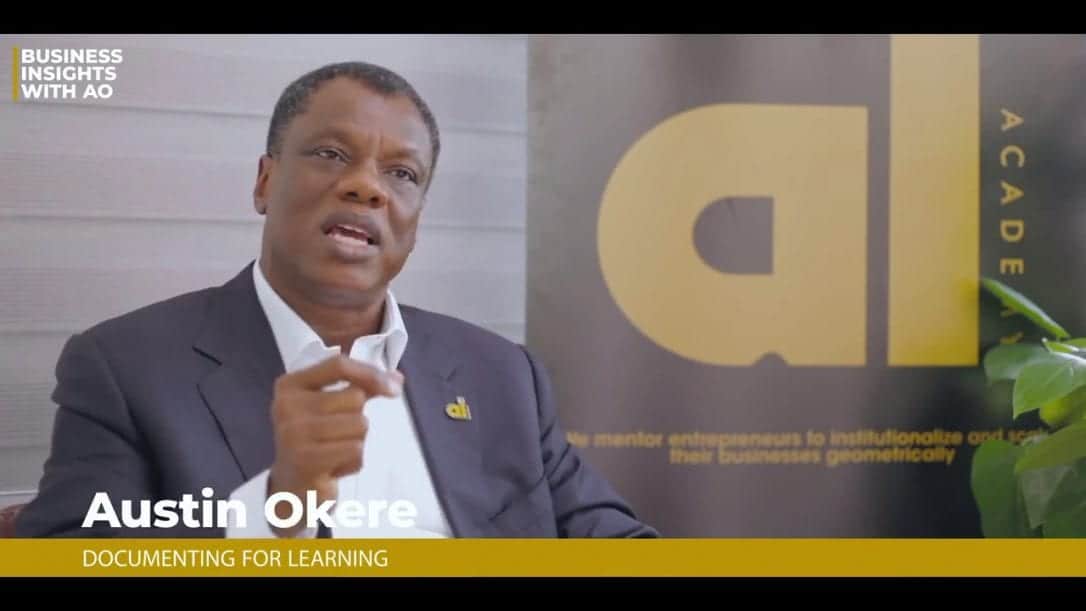
    “If you look at the corporate history of Nigeria, there are many companies that did not transcend the first generation and no one has written about the reason why they failed so we could learn from it…” – In this episode of hashtag#BusinessInsightsWithAO, I speak on the need to document corporate entrepreneurial experiences for future studies. hashtag#ALA – Culled from the wall of my mentor – Austin Okere, Founder, CWG Plc and Entrepreneur in Residence, Ausso Leadership Academy

    While I studied at Harvard business school, every single time we worked on a case study on an American company, I would constantly ask myself how wonderful it would be to actually have a business case written on Nigerian companies.

    How wonderful it would be to know how some big Nigerian companies were founded, what made them thrive, and what made them collapse eventually. I notice with a passion that I could not point to any company that I know that has survived a generation after the demise of its founder.

    I recall the days of Kingsway stores, Leventis stores, SCOA motors, etc. It really hurts to know that apart from Mr. Biggs that has somehow stood the test of time, such businesses that gave us the likes of Cortina from Bata are no more.

    Standing inside any of the Shoprite stores springing up these days, though beautiful, I doubt if I can compare the feelings I get from going into Shoprite with the feeling Kingsway Stores left in me each time my mum took myself and my siblings shopping back in the days.

    Why did they just fizzle away? Is there anything we may learn from them?

    Is there anything the new kids on the tech block learn from rideshare companies that failed recently irrespective of their huge fundings?

    In his book “Why Companies Fail“, Harlan D. Platt opined that A business fails every hour of every day in the United States. He gives reasons as to why companies might fail, and what to look out for as indicators to a failing company.

    As to why companies do not transcend their first-generation, Rei Obaigbo has this to say – ” Data is key in documenting history, most of these corporate corpses were killed and buried by corruption, somewhere even born from corruption. Data exposes corruption, hence the corrupt will constantly fight against the harnessing of data. The want for data will keep coming up, and unless the root problem is resolved, it will keep dying.”

    Sad as it is, I am forced to take the stance of Rei, though I’ll add that most of them must at a point or the other changed their culture and became less customer-centric or they simply did not innovate accurately as and when they needed to.

    So, the question for me is – How do we get Nigeria owned companies to give accurate data of their affairs? Would a private company be willing to through data out there, and would the big companies in the guise of shying away from taxes be willing to give a true account of their affairs?

    And by accurate data of their affairs, I inquire on more than the numbers on the financial statements. I need them to disclose information investors need to put those numbers into context; not just the “how much?” but the “what?” and the “why?” !

    Please if you have a compelling answer to this question do respond by clicking here

  • How To Craft A Vision And Mission Statement

    How To Craft A Vision And Mission Statement

    Most Nigerian companies do not know how to craft their vision and mission statement. Walk into the offices of most small and medium scale businesses in Nigerian and the vision and mission statements that you would see hanging on the walls are effectively useless.

    While the great mission and vision statements inspire loyalty, innovation, and hard work, the statements adopted by most small businesses are mere recitations of what the company does.

    It appears to me that most small businesses adopt mission and vision statements just to be fashionable – an item to be ticked off on a checklist as done, without really considering how strategic those two statements can be to the reputation and growth potential of their businesses. In the real sense of things, these statements ought to be the foundation of the very system that drives the business.

    Unfortunately, these statements are mostly forgotten even before they are hung up!

    When you have strong vision and mission statements in place, they serve as a funnel through which you arrive at decisions and prioritize what needs to be done, what is important and what is not.

    I have to acknowledge, though, that the bad treatment that has been given to vision and mission statements can be owing to the fact that most small businesses do not even understand the purpose they serve, what they mean, and even how they differ from each other, nor how to get one into existence and write it out in a way that makes sense.

    That said, after reading this article, a business owner who is willing to put deliberate efforts and work hard can craft vision and mission statements capture the core idea of the business while serving as a roadmap to where the path his or her company should go.

    If you are ready for the task ahead, a great place to begin is to look at the definitions of the two statements.

    How do you define a vision statement?

    A vision statement is that big idea that the company is working towards as a goal. In the book, Vision: Your Pathway to Victory, Gordon D’Angelo describes a vision statement as “the definable intention from which preparation is formed.”

    Plenty of grammar, I agree. Let’s break it down a bit.

    A vision statement expresses in simple terms, what an organization hopes to become and accomplish in the long term.

    It is aspirational. By the very definition, ‘vision’, it holds that it ought to be a lofty purpose – something that internal stakeholders must stretch to attain, yet completely believe it’s attainable.

    Here are some things to keep in mind when writing a vision statement:

    • It should be future-oriented
    • It should be brief and concise
    • It must be deeply oriented in your core values
    • It must reflect your self-image as a company
    • It must be easy to remember

    Some questions to consider when creating a vision statement include:

    • What are our hopes, dreams, and aspirations?
    • What are the problems we are solving and how does that contribute to the greater good?
    • What change are we bringing about?

    A purpose-driven company knows their big why – which helps them to envision success as a whole.

    What purpose does a vision statement serve?

    Countless researches show that employees of companies who have meaningful vision statements have engagement levels of 68% – 18% higher than average. When employees are more engaged, they are both more productive at their jobs, and effective as corporate ambassadors of the company.

    Since a vision statement sets the vision for the long-term success of a business, you will agree that it is worth taking time to craft a good one that can turn your people into believers and mobilize them to act.

    What is a mission statement?

    While I was studying at Harvard business school, I was taught that to establish a very vibrant company with the prospect for growth, we should start the company with the Mission statement.

    It should be clear to all employees and they should be able to recite it without necessarily memorizing it – they should understand it and align their everyday activities to focus on achieving the goal of the mission statement.

    While the vision statement is future-oriented, a mission is more realistic and present-based and is designed to communicate where the organization is at the present time and what they ought to be doing on an ongoing basis.

    Mission statements are as important to a business as a business plan.

    A mission statement is a broad declaration of your purpose that clarifies (1) What you do, (2) who you do it for, and (3) how you do what you do.

    Apart from capturing the essence and philosophy behind your business in a few sentences, a great mission statement flags what your business is all about to both your internal stakeholders (employees, management, board) and external stakeholders (customers, suppliers and the larger community).

    Your mission statement sets the agenda for the company. It defines what you do, what is at the core of the business and highlights the objectives of the company and the pathway towards which those objectives can be realized.

    It is the most significant contributor to setting the culture of your company.

    Some questions to consider when creating a mission statement include:

    • Why are you in business?
    • Which audience does your business?
    • How do you serve them?
    • What products and services do you bring to the marketplace?
    • What quality and price should your customers expect?
    • What kind of experience do you provide to your customers?
    • What role do you and your team perform?
    • What stands you out from the competition?

    A company can use mission statements to establish a framework for acceptable behavior and performance standards for its people. This can help provide guidance for decision making on an ongoing basis.

    What is the difference between a vision and mission statement?

    To put it in as few words as possible, a mission statement is a summary of what a company is already doing, while a vision statement is the broader goal they would love to accomplish.

    The vision statement focuses on the future and what the company would love to become, while the mission statement focuses on today and what the company is doing on a day-to-day basis in the process of becoming what they envision to become.

    Keep in mind that the primary difference between a mission and a vision statement is the timeline. While sometimes there can be an overlap between the two, the mission statement captures what people do daily for the company to eventually achieve its vision. So, while the vision is the why, the mission is the how.

    Are the two interchangeable?

    Obviously not. This is a mistake that a lot of companies do, but it is not just important, but also critical that a business should have both. One does not work without the other. While the vision statement gives your company a sense of purpose, the mission statement provides meaning to what you do.

    How to write an effective vision statement

    1. Decide who will play a role in writing it: For a small business, you could gather insights from all employees and use that in crafting a vision statement, however, for bigger corporations, you would need to be more strategic than that in selecting those you work with. You may want to host a series of workshops during which you capture the voices of a representative cross-section of your employees and base your vision statement off that. This is important because if employees do not buy into the vision, they will not work with you to carry it out.
    2. Have a look at the vision statement of competitors: Apart from showing you what is important to them, it can also help you to see how you can differentiate yourself from those in your market.
    3. Project ten years into the future: Imagine a world in which your company is either the market leader in your industry or competing very favorably. How will the world and your company look like if you achieved on those goals? That world you see is what should inform your vision statement.
    4. Determine your purpose and market position as an organization: To write an effective vision statement, you need to consider your company’s objective, advantage, and scope (OAS).

    Providing answers to the questions below can help you write an OAS statement that truly reflects your company’s strategy.

    • Objective: “Why do we exist as a company?”
    • Advantage: “How are we different, better or more innovative?”
    • Scope: “What do we need to do and avoid towards achieving our objective?”
    • Describe a measurable goal: Vision statements are achievable. If you need to know when you have achieved it, then it is obvious that the statement better be measurable.

    Consider the hypothetical vision statement: To become number one in the sports apparel industry.

    Is that measurable? Of course, it is!

    27 Examples of vision statements that inspire confidence

    1. Guaranty Trust Bank: “We are a team driven to deliver the utmost in customer services. We are synonymous with innovation, building excellence, and superior financial performance; and creating role models for society.”
    2. Unilever: “To make sustainable living commonplace. We believe that this is the best long-term way for our business to grow.”
    3. Intel: “If it’s smart and connected, it’s best with Intel.”
    4. LinkedIn: “Create economic opportunity for every member of the global workforce.”
    5. Oxfam: “A world without poverty.”
    6. Guinness Nigeria: “To be the best performing, most trusted and respected consumer products company in Nigeria.”
    7. Life is Good: To spread the power of optimism.
    8. Sweetgreen: To inspire healthier communities by connecting people to real food.
    9. Patagonia: Build the best product, cause no unnecessary harm, use business to inspire and implement solutions to the environmental crisis.
    10. Flour Mills Nigeria: “To be the leading food and agro-allied group in Africa.”
    11. Amazon: “To be Earth’s most customer-centric company where customers can find and discover anything they might want to buy online.”
    12. TED: Spread ideas.
    13. Access Bank: “To be the world’s most respected African bank.”
    14. Nordstrom: To give customers the most compelling shopping experience possible.
    15. Google: “To provide access to the world’s information in one click.”
    16. Invisible Children: To end violence and exploitation facing our world’s most isolated and vulnerable communities.
    17. American Express: We work hard every day to make American Express the world’s most respected service brand.
    18. Warby Parker: To offer designer eyewear at a revolutionary price, while leading the way for socially conscious businesses.
    19. InvisionApp: Question Assumptions. Think Deeply. Iterate as a Lifestyle. Details, Details. Design is Everywhere. Integrity.
    20. Honest Tea: To create and promote great-tasting, healthy, organic beverages.
    21. IKEA: To create a better everyday life for the many people.
    22. Cradles to Crayons: Provides children from birth through age 12, living in homeless or low-income situations, with the essential items they need to thrive – at home, at school and at play.
    23. Universal Health Services, Inc.: To provide superior quality healthcare services that: PATIENTS recommend to family and friends, PHYSICIANS prefer for their patients, PURCHASERS select for their clients, EMPLOYEES are proud of, and INVESTORS seek for long-term returns.
    24. JetBlue: To inspire humanity – both in the air and on the ground.
    25. Workday: To put people at the center of enterprise software.
    26. Prezi: To reinvent how people share knowledge, tell stories, and inspire their audiences to act.
    27. Tesla: To accelerate the world’s transition to sustainable energy.

    How to write a great mission statement

    The goal that you should have in mind for this exercise is that at the end of the day, the mission statement would be uniquely yours so much so that if a competitor would want to borrow it, they would have to rework it extensively to get it to fit.

    1. Have a market-defining story in mind: Imagine a real person making the decision to buy whatever it is that you sell. What exactly does the person want? How does the person find you and what does her buying from you do for her? The more concrete and detailed you can make this story, the better. By identifying your buyer persona and how what you do does for her, your mission statement will be grounded and useful to both those who work for you and your publics.
    2. Keep it succinct: A mission statement is a statement and not an essay. This is not the idea behind your creating this brand-building asset. You need a statement that is memorable and that will be easy to reflect on – long-drawn-out essays do not fit that bill. However, still ensure that it captures using a few words, the essence of your business goals and how you go about achieving them. It should clearly signal to your customers, employees, suppliers, and community what it is what you do, and how you are different from others who do similar stuff. Your task here is to communicate your business plan in a few words.
    3. Use vibrant emotive words: Your mission statement should be able to galvanize your people to act every day. Hence, it best serves your purpose to use vibrant, exciting words.
    4. Communicate it: Once you are done creating a great mission statement, your work is only half-done. The other half is to communicate it to your people and have them align their actions with the mission of the organization.
    5. Don’t be afraid of changing it: As your business evolves, it may be necessary to reflect again on your mission statement and see what needs to be changed. The mission statement is not cast in concrete – at best, it is a shifting goal post that captures where the company is headed. Always make sure that the mission statement clearly captures that.

    10 Examples of mission statements

    1. Andela: “to advance human potential by empowering today’s teams and investing in tomorrow’s leaders.”
    2. Flour Mills Nigeria: “To produce and supply products of superior quality and value to the market, thereby enriching the lives of consumers, customers, communities, employees and all stakeholders.”
    3. Facebook: “To give people the power to build community and bring the world closer together.”
    4. Jumia: “Creating a connected digital Africa to improve people’s lives on the continent, thanks to the internet.”
    5. Amazon: “We strive to offer our customers the lowest possible prices, the best available selections, and the utmost convenience.”
    6. Access Bank: “Setting standards for sustainable business practices that unleash the talents of our employees, deliver superior value to our customers and provide innovative solutions for the markets and communities we serve.”
    7. Samsung: “We will devote our human resources and technology to create superior products and services, thereby contributing to a better global society.”
    8. Guaranty Trust Bank: “We are a high-quality financial services provider with the urge to be the best at all times whilst adding value to all stakeholders.”
    9. Cadbury Nigeria Plc: “To serve Nigerians with products of consistently high quality, made readily available at prices which offer real value for the money spent.”
    10. Flutterwave: To inspire a new wave of prosperity across Africa by building payments infrastructure to connect Africa to the global economy.

    Conclusion

    You have seen that crafting valuable mission and vision statements take time and effort. However, the investment is well worth it. Most business owners have found that the process of coming up with thoughtful vision and mission statements is as beneficial, if not more beneficial than the mission statement in itself, as it can help bring about clarity into aspects of what you do that you have not previously given concerted thoughts to. Additionally, the process will help you solidify your concept of what it is you do as a business and the motives that drive you to do what you do.

  • Branding: Selling Effectively In A Crowded Market

    Branding: Selling Effectively In A Crowded Market

    Business is war, so you must come ready. Don’t let your guards down – Be smart. Everyone is trying to be better at their craft, so don’t be caught napping; Refuse to lag or copy the next person. Customers like to buy from brands that establish themselves in unique, special ways. Be that brand.

    Operating in a crowded and highly competitive market can be very tricky. Many entrepreneurs find it easy to run away when the competition seems stiff. Competing in a crowded market as a new entrant especially when there are established brands and businesses can be very intimidating and most times frustrating.

    Many entrepreneurs have mastered the art of everything in entrepreneurship, except one: selling through branding. They have a pass mark in every other thing: determination, discipline, creativity, you name it. But when it comes to branding, most entrepreneurs struggle.

    To sell in crowded markets like Nigeria, you must stand out in the minds of your clients as a go-to company, you must consistently pitch your company as a quality over quantity outfit, and more importantly, pay attention to customer experience above your competitions.

    To stand out in the mind of your clients as a go-to company, you would need to consistently pitch your company as a quality over quantity outfit, and more importantly, pay attention to customer experience above your competitions. – Olufemi Tobi Akinyemi

    It does not matter if your product has the quality that would eventually put an end to global warming or is the best thing since sliced bread (all pun intended) if you cannot sell it in a market where others exist, nobody will buy and you will be kicked out.

    When it comes to entrepreneurship if you do not master the art of sales, it does not matter what great idea you have, you will fail.

    Find Your Niche

    Finding your niche is the first step to successfully selling anything. In fact, becoming an entrepreneur without first discovering and putting a stamp on your niche is a colossal mistake that should be diligently avoided. You need to be very clear about what niche you are playing in as an entrepreneur.Who are you out to serve? Is it children, nursing mums, or is it the single sect? This is simply you defining exactly who your ideal customer is. Finding your niche is important because it helps define how to channel your sales effort. You cannot scatter your sales efforts all over the market, hoping, just like spaghetti, something sticks. That is not how to sell. Learn not to go too widespread with your niche.

    Understand the customers in your chosen Niche

    Once you have identified your niche, please do well to segment your market accordingly within your chosen niche; not everyone is your customer. Be very specific and intentional about who you are set up for. This is the one quick way to win in sales: It is critical to understand your customers. It is only in understanding your customers would you learn how to best serve them. Once you have identified your niche, please do well to segment your market accordingly within your chosen niche; not everyone is your customer. Be very specific and intentional about who you are set up for. This is the one quick way to win in sales It is critical to understand your customers. It is only in understanding your customers would you learn how to best serve them.

    Find out your customers’ pain points

    In entrepreneurship, the more pain you solve, the more relevant you become. The level of the pains you solve determines the value your product or service brings to the customer’s table.

    Find out what your customers really want. This will help you understand them better thereby making selling easy. A customer’s pain point, when soothed, will move him to buy what it is that you are selling. A salesman is essentially a problem solver to customers hence you must understand the problem you are out to solve, and sell it in such a way that no other company would be able to beat you at your game.

    Imagine taking a uber in summer, and on getting into the car, your driver offers you a hot towel and a very cold bottle of water at no extra cost! I bet you would always want to ride with that specific driver if you could choose.

    Leverage the power of groups

    To sell corporate ties, you must position yourself where people in the corporate can be found: To sell makeup, you may have known that beauty parlors are the best stops to find a large number of ladies in need of your product. You have to find out where your clients go, where they congregate, and where you are bound to find a large number of them at the same time. When you sell there, you might not get all of them to buy at once, but you will have a better chance to make sales conversion than any other place you would have visited. Do not walk into a church premise to sell alcoholic drinks, that would be a wrong sales move. A good sales executive understands that positioning is a major key to selling; you would do good to identify other products that mix with or complement yours. For example, if you hawk beans (Ewa Aganyi) in Nigeria, you would do well to find yourself a bread seller.Be intentional about where you apply your sales effort at. Make sure you are selling at the right places and to the right people. It does not make economic sense spending advertisement budget trying to sell at locations or using channels where your customers cannot be found.

    Be distinct; Play a different game

    In a crowded market with a lot of people selling and grappling for a share of the customer’s wallet, only those that are able to stand out from the crowd win. This is why you must learn to be different. Don’t be like the rest; change the game. Find a way to stand out from the crowd. This is the only way you can make headway in the entrepreneurship sphere with respect to selling. Selling is war, so you must come ready. Don’t let your guards down. Be smart. Everyone is trying to be better at their craft so don’t be caught napping. Refuse to lag behind or copy the next person. Customers like to buy from people who establish themselves in unique ways. Be that person.

    Be consistent

    There is no way you can get ahead in business if you are not consistent in your sales effort. Consistency has been said to be a breeding ground for success in every area of life, including selling. To really stand out and master the art of selling, then you must learn to show up every day. Be there seven days a week, making it easier for customers to find you. Truth is, if you don’t show up, customers will switch to those who will. In a crowded market, the last thing you want is to be lost in the hay, or just blend in like others. Be determined to always put your unique voice out there. A customer may not buy the first time, but that doesn’t mean you should turn off the light and quit. Those who succeed in selling don’t give up easily. They know how to dig their heels in and keep pressing further. They are like cats with nine lives: they hardly die.Okay, those are 5 simple tips you can apply immediately to become better in selling. Let me know your thoughts on them and I would love to read more selling secrets that have worked for you. Please share your thoughts in the comment session below.

  • Nigerian Children Could Make Money If Only Parents Teach Them These Things

    Nigerian Children Could Make Money If Only Parents Teach Them These Things

    Teaching your Nigerian child to make money is easier than you may have thought. As a matter of fact, if you do not take the lead on teaching them, society would find someone else to do just that. I have listed the best tips to help you train your child to make money, some of these tips can be combined with conventional schooling.

    Being a father is one of the greatest joy I have experienced. I learned earlier in life that being a father does not make you a dad/parent. Being a dad, however, comes with a lot of responsibilities, responsibilities which some say differentiates a father from a dad.

    Eniola, my daughter, spends most of her time with me, except now that she’s been enrolled in a school to learn other things parents might not be in a position to teach.

    When she became 3, her requests went off the roof; she would ask to have toys and other things I considered irrelevant – at least to me.

    Someday, she came to me as she usually would most mornings, but this time, something was different, she asked: “Daddy, please teach me how to make money.”

    That question threw me off guard, but I needed to give my beloved daughter an answer, so I asked her to have breakfast, and I would teach her once I was done eating.

    You may have heard of stories of young children who already had businesses as early as age 6; some of them are internet sensations, making it big on Youtube and some traditional business owners who had a lovely idea and found a way to monetize it.

    The millionaire in the embedded video was a young 6 year old who made $11 million USD some years back, and was featured to have made $22 million USD last year.

    The majority of such children grow up to become multimillionaires before they turned 18, while others just become ordinary, lost all their wealth, and you wonder how that happened.

    Many child-stories that fit the scenario depicted above abound out there, but such stories are not commonplace in Nigeria. When would we have such an account in Nigeria?

    The good news is: Nigerian kids of all ages can make money regardless of sex, social and economic status of their parents.

    This article is the ultimate guide on how to teach your kids to make money.

    I wish I knew some of these things before Eniola asked me. Unlike me, you do not have to do the hard work anymore, follow this guide, and you would have given your kid(s) the opportunity of becoming the next Nigerian kid millionaire.

    Steps To Teach Your Kids To Earn Money

    1. Let them know that there is a cost to everything
    2. Teach them the importance and use of money
    3. Teach them to have savings
    4. Identify their natural talents
    5. Teach them the value of work
    6. Teach them charitable giving
    7. Teach them to monetize their natural talents

    Let Them Know That There Is A Cost To Everything

    Kids generally love to ask for favors – toys, and any other indulgences. Do not see that as a problem rather see such moments as an opportunity to teach your future millionaire a thing or two about the cost associated with such requests. Tell your kid gently that you cannot afford to buy such now and let your kid know that it is okay to be turned down.

    At other times, however, pick one instead of two and let your kid know that you could only afford one, and you would come to get the other when you make or earn enough money to provide what the kid wants.
    Your selective refusal to grant such requests for gifts would eventually send the message that there is a cost associated with things and you need money to offset such costs.

    This move builds determination in kids; it helps them want to know what it takes to be financially independent. Your child would want to make his/her own money to satisfy the desire for toys.

    Teach Them The Importance and Use of Money

    Ever wondered when kids genuinely get to understand what money is and used for? My nineteen months old daughter understands money – I taught her from an earlier age; she sees me taking money and exchanging it for items we buy from the grocery stores around us. My daughters learned to pick what they needed at the store then move to the check out point, wait in queue for their turn, and pay for the items picked.

    Take your kids to go shopping; but ensure to prepare them for the experience, you could ask them to get some money from their savings if you must. Whatever you do, ensure to tell them that they are going to the store, and payment is the item you exchange for whatever they would pick at the store.

    Teach Them To Have Savings

    Financial experts all agree that saving is one of the building blocks of building wealth. A lot of people find it hard to save; some due to their poor finances, and others because they were not taught how to save.
    So, teaching your kids how to save is a major legacy you would have bequeathed on the child.

    The key to teaching a child to save is to teach them to learn that delayed gratification is excellent. Intentionally hold back on buying things they want, tell them that you do not have money – It is essential to teach children at this age that they may have to wait at times for what they want.

    Here is a straightforward but effective method of teaching them how to save:

    Make three glass jars available – each labeled “SPEND,” “SAVE,” and “SHARE.” Every time you give your child money or the child receives money, whether from family members or as payout for doing chores around the house like arranging toys, etc.

    Divide the money into three equal parts and put them into the jars. Have him or her use the sharing jar for things to be bought and shared with siblings, family, or as an outright gift for someone else. Let the child use the spending jar for items craved for.

    Whenever your child requests for something, use the money in the spending jar and let him or her take note of the amount left for spending. The savings jar should only go for items that are set as goals: something costly, especially toys.

    Identify Their Natural Talents

    This is tricky – We mostly wish our kids have the talents we do not have but wish we did. So we send them for training to acquire those talents we want them to have. The downside to this is that the child grows up insecure, wanting to please people but never achieving anything significant – mostly.

    So How Can You Identify Your Child’s Own Talent?

    The answer is simple – Be patient and watch for what your child loves doing, what activities take his or her time, and once you find out, do not try to interfere immediately, set them free.

    Once your child is persistent on certain activities, give lots of time for the child to self-learn. You could help nurture by sending the kid to a school or a coach that could help in systematically developing your child’s talent.

    Teach Your Child The Value of Work

    Children often have things done for them. Unfortunately, most kids grow up believing that other people would always get things done for them; they grow up with maids at their beck and call and all they need to do is cry to seek for attention.

    As a parent, you must teach your child that there are dignity and a lot of reward in getting work done. Make them tidy up after they mess up the room, and at certain times, reward them once they clean up after themselves.

    Teach Them Charitable Giving

    It is best practice to teach your kids early in life that if they want to feel loved, they first must give love. Teach them to treat others the same way that they would want to be treated.

    In life, there is always that one person other people treat badly, someone bullied, someone looked down on. Getting your child to identify such people and be charitable towards them is a great value to teach your kids. Empathy is an art that must be learned. Teach your kids early in life and that would surely open the right doors when needed.

    Get your child to find ways of spending the “Share” Jar appropriately.

    Teach Them To Monetize Their Natural Talents

    Everyone out there is gifted a talent or the other by the creator. Of what use is the talent if not monetized?

    As a parent, your task is not complete if you do not know how to teach your kids to monetize their talents.

    Suggested Reading – How To Start A Blog and Make Lots of Money in Nigeria

    Teach Them To Fight For Whatever They Want

    You don’t always have to be first. Sometimes all you have to do is be the last person still trying. When learning to walk, children often fall, they cry but they still get up and try anyway.

    So why should life be different? People tend to bring down a child that does not excel academically as others are. Please do not fall into this trap as a parent; take a look around you, and you would actually see that true success does not always come from academic excellence. Teach your child to stand up fighting always – no matter how hard or how many times life deals a bad blow.

    I do hope that we would someday change the narrative on our children not being at per with their foreign counterparts – American, European, British, Chinese, and others.

    My next article will be on specific things parents could train their children on and monetize for the Nigerian market worldwide. Kindly share this post to help us get better parenting for our children.

    Suggested Reading: Top 500 Small Business Ideas For The African Entrepreneur

  • Making money online or offline – 3 Simple practical steps – ExpertsNG

    Making money online or offline – 3 Simple practical steps – ExpertsNG

    Making money online or offline, isnt’t as difficult as many may think.

    Would it not be satisfying to know how to make money fast and smart (either online or offline), at least know how to make it smarter than your friends, family, and every other person in your circle of friends?

    What if I told you that making money is not as hard as we have been conditioned to believe?

    Allow me to take you back memory lane to when you were a child. I bet that at some point, especially when you thought that money was made from paper, and since papers were made from trees, you probably had looked up at a tree and thought… If money is indeed made from paper, surely, you could make money grow from trees (I honestly did)!

    Or perhaps, you heard those words “Do I grow money on trees?” from your parents on asking for a toy or an extraordinarily expensive cloth or shoes. Perhaps, for you, it was pondering over the idea of growing money on trees.

    Over the years, I had pondered on that statement, and also the idea of being able to grow money on trees; being able to practically go to a tree in my compound and just take money every time I needed it. Although it might seem an impossible task that is what it is.

    So in actual fact, we do pluck money off trees, money does grow on trees. You just need to know which tree, and how to get money off it.

    making money

    The 3-step guide to making money fast and smart

    1. Understand yourself
    2. Identify opportunities
    3. Build a company around a product or service to make life better for at least one person

    Bonus Tip: Put yourself and the product out there so the people that need it can find you.

    1. Understand yourself

    I once read on a friend’s Facebook wall that “It is by admitting who we are that we get what we want!”

    For me, we are not all forged in the same fire, so what works for some may not necessarily work for me. My understanding of this fact has constantly guided my decisions through my entrepreneurial pursuits. I do not undertake any venture without trying to acknowledge my strengths and weaknesses. This most often leads me to the question of WHY.

    Understanding the reason behind your pursuit of a goal would most times determine the level of push you would be willing to give such goals, it determines also the level of resistance you may be willing to put up with.

    So, the question is why do you want to start a business?

    In entrepreneurship, it is always about cash or king.

    Cash – Are you going into business to try and make more money for yourself? or    King – Are you going into business because you want more freedom and control of your time?

    Read more on the concept of Cash or King.

    So understanding the reason why you want to go into business or why you would want to make money is a key to knowing the best route you’d take to at least have a better chance at making money.

    Once you have the reason established, the next thing is to ask yourself some very sincere questions about yourself, your strengths and skills; the answers to the under-listed questions would help you figure out the type of business you should venture into.

    The questions are:

    • What are your skills?
    • What do you love doing naturally, where does your passion truly lie
    • What drives /motivates you to take actions
    • Where is your area of expertise?
    • How much capital do you need?
    • How much capital do you have – financial, social and political?
    • Do you truly understand what it takes to be an entrepreneur?
    • Are you truly ready to be an entrepreneur?

    Your ability to answer the questions above as sincerely as possible would go a long way in setting your foundation – please be honest.

    Identify Opportunities

    As simple as the term may sound, it is the single most important aspect of any money-making pursuit. I said earlier that the best form of money-making practice is to look for problems you can solve and get paid for. Identifying opportunities is at the very core of what you have to do to keep making money, But if you do not understand how to convert problems into opportunities or identify opportunities where others see challenges and problems, then you just may not be a good entrepreneur.

    So how can an entrepreneur identify opportunities?

    Luckily, with some training, everyone can identify opportunities.

    Following the under-listed steps will help anyone find and identify business opportunities.

    • Listen to yourself and identify the pains you have on a daily basis going about your normal work-life schedules.

    Almost every innovation out there today came about as a result of an entrepreneur getting frustrated with the way things were done and sought to make them better.

    The very first step in identifying opportunities is to listen to yourself and understand the pain you go through on a daily basis. Then, ask yourself if such pain is common to others. If it is, then you may just be on your way to identifying a money-making opportunity.

    • Listen to your potential and past clients

    Another sure way to unlocking opportunities is to target potential customers and listen to their needs, wants, challenges and frustrations within your market space or industry.

    Find out and understand the products and services they use currently and those they have used before. Understand what they like and dislike about such products and services, understand why they came to you?

    What were their objections to those services and products, understand their objections to your products or services? This will help you to find opportunities to develop more tailored products and services, hone your target market, identify and overcome common objections. It could lead to either a service or product innovation in your current industry.

    • Understand your competitors

    It is a very good practice to always understand what your competitors are doing or what they are not doing. Do a little competitive analysis to see what other startups are doing, and more importantly, not doing? Ensure that you understand what makes customers go to them over you or others.

    Read more on competitive analysis and strategy here.

    Analysing and understanding your competitors ability to vie, their strengths and weaknesses would help you identify key business opportunities that you could leverage to expand your market reach and develop your products and services.

    By all means, please shop from your competitors, no better ways of learning from them than actually going through their sales process as a paying customer.

    • Understand and leverage technological trends

    It seems half of the people trying to become successful these days expect immediate results with little to no effort; such practice may have worked some years ago, but this is 2019 you need to work HARDER and be SMARTER than your competition.

    Technological advancements today favor only those who are willing to study, learn and apply what they have learned to problem-solving. Technology is making it possible for people to multi-task, work smarter, etc. The problem, however, is that not everyone is technology savvy, so as an entrepreneur trying to make money the smart way, your best bet is to learn how to leverage technology and by that act, you would have enhanced your possibility of making money.

    • Plan your business and write it down to improve your chances of success.

    It is always a good idea to have a business plan to help guide you through the rigorous process of starting your business. A well-structured plan can help to improve your chances for success.

    Unfortunately, most entrepreneurs these days do not see the need for writing a business plan, they consider it too expensive a task to perform; a waste of time and money. Due to this misconception, they go into business blindly.

    Barely committing sketchy details of their plans to mind, but unknown to them, having a well thought out, well written and articulate business plan would actually help them start up faster and smarter.

    A business plan can help you gain clarity, focus, and the needed confidence to put your money towards the achievement of your goal. A plan does not need to be so elaborate, what is needed is clarity and to ensure that major aspects, especially finance are looked into.

    Majorly, a business plan helps bring your business to reality; writing your goals, strategies and action steps, gives you a helicopter view of what you intend going into, and gives you the means to make adjustments where necessary.

    Essential elements of a good business plan

    According to Sequoia capital, the under listed is the minimum expected component of a well-written business plan/pitch

    1. Company Purpose
    2. Problem
    3. Solution
    4. Why Now
    5. Market Size
    6. Competition
    7. Product
    8. Business Model
    9. Team
    10. Financials

    At the least, a good business plan should give answers to the following questions:

    •  
    • What is my product or service?
    • What pain am I solving
    • Who are my prospective clients/customers?
    • What value am I offering my customers/clients in exchange for their money?
    • Are their enough people with the problems that I am trying to solve?
    • Is the market ready for such a product or service?
    • Do I have the means and skills required to get me off the ground successfully?
    1. Build a company around a product or service to make life better for at least one person

    As humans, we would rather pay a professional to fix something that causes us pain, more like buying a pain killer, than spend money on enhancements, beautifying stuff, etc. More like spending money on multi-vitamins.

    If you could build your business around something that makes life better and easier for someone, something that fixes their pains; service or product that fixes a problem for your customers, they’ll thank you for it, with some willing to pay a premium.

    Follow these basic steps to help you get started with building your company

    • Legalise your company
    • Write out exactly what you are set up to do, in not more than a sentence and truly understand it
    • Employ a staff or take interns to complement your skills
    • Do not be tempted to rent an office, work with what you have
    • Train your staff/interns and let them understand your mission and vision
    • Start producing your product or rendering your services

    Thank you for reading. I would love you to leave a word or two on the comment section below, perhaps, others may learn more insights on this topic from you too.

    Bonus Tip: Put yourself and the product out there so the people that need it can find you

    You are definitely losing some money If you do not find ways to put your product at least 7 times in the face of your potential clients weekly. Your potential clients must learn to trust you, and the best way to gain trust these days is to be consistently at their faces with your value propositions.

    Leverage the social media and you would have increased your chances of success by at least 35%.

    Here is a list of some tips/tasks you can carry out online to start making money

    • Make money by completing surveys Online
    • Make money blogging or vlogging
    • Make money online through trading in Binary options
    • That takes about 6 months for an article to start ranking on Google. So normally, on the average 3 to 6 months is the initial investment time you would need to put into your blog before it starts receiving some traffic, though there are methods to help you improve on your rankings, click here for tips on that.
    • Once it starts receiving traffic, you could make money from the following sources:
    1. Selling products or services
    2. Online advertisements from companies like Google – Adsense, and many others out there
    3. Affiliate marketing – Amazon affiliates, Jumia affiliates, etc
    4. Sponsored posts
    5. Offer Your Services on Fiverr to Make Money Online Without Investment
    6. Make Money as a Virtual Assistant – did you know that you could actually set up a company of virtual assistants and get paid
    7. Create content for Others
    8. Create and sell courses online for people
    9. Offer your services on sites such as fiverr.com, Upwork, etc for a fee
    10. Make Money by Testing Websites and Apps
    11. Make Money from YouTube Videos
    12. Start and make money from a niche Website online
    13. Take very good photos and videos and sell them online on stock sites such as Shutterstock

    So tell me, was this article on Simple practical steps to making money online or offline of help to you in any way, what would you rather change on the article and finally have you taken the first step towards starting your own business?

    You could read our high ranking articles:

    Please put your answers in the comment section below to help me make this blog better and also help others out there.

    By the way, are you a Nigerian, and have you worked with or know some highly skilled experts (Tailors, Auto mechanics, Barbers, Chefs, etc) in Nigeria? Please recommend them here to increase their online visibility and give other people the opportunity of hiring them too.