“It is with the blessings of the Almighty, my family, colleagues, the support of my community and the backing of my conscience, that I announce the launch of the Abdul Samad Rabiu Initiative, with an Africa Fund endowment of USD100million every year starting from this year, 2021; USD$50million to Nigeria and USD$50million to the rest of our beloved continent. Over the years as a corporate, and through the BUA Foundation, we have been actively involved in corporate philanthropy in various sectors – from health, education, community development, water & sanitation, sports, and even more recently, our work on COVID-19.”
Those words marked the beginning of yet another initiative aimed at improving the African continent.
A similar gesture was launched by yet another Nigerian Billionaire in the person of Tony Elumelu, in 2015, with an annual grant of $100 million to help 10,000 entrepreneurs over 10 years.
Though, with a focus on social development, the fund (ASR AFRICA) is made up of $50m to Nigeria, and the rest $50m to the rest of the continent.
The funds are specifically geared towards improving education, health and other social development needs across the continent.
“Our broad focus is equipping facilities, our researchers, healthcare practitioners and community-level service providers, with the aim of providing sustainable solutions for generations to come.”
The ASR Africa Initiative also announced grants of N1billion each to six Nigerian universities across Nigeria’s six geopolitical zones.
These grants would go toward the initiation and upgrading of infrastructure, where applicable in the benefitting universities, namely the Ahmadu Bello University, the University of Maiduguri, the University of Nigeria, the University of Benin, the University of Ilorin and the University of Ibadan.
These grants, according to Rabiu, would be directed to projects that will be delivered by the ASR Africa Initiative for the project duration.
He further noted that “as the world tries to claw its way back to business as usual, the Abdul Samad Rabiu Initiative’s Africa Fund for Social Development & Renewal aims to be a modest reminder to us all that until our health, education and other development issues are fixed, business as usual in these times, means business as brutal. We pledge to continue to do what we can to support ongoing efforts by various governments to bridge the development divide across Africa.”
With these initiatives triggered by Nigerians, no doubt, the African continent is on its way to being the true bride of the world.
This article is a collection of the top small business blogs in Nigeria, with specific reasons on why you should follow them in 2022.
Small business blogs the likes of Forbes, inc, Small Business Trends, etc. are valuable assets to any right thinking entrepreneur. The information on such platforms is highly valuable.
In Nigeria, we have relatively solid small business blogs like entrepreneur ng, smedigest, nigeria business magazine, business grants nigeria,
Though other countries read from some top business blogs in africab, but Nigerians hardly read blogs on small businesses; they would rather see a video on small business on Youtube. This is due to the fact that mostly, such topics usually turn out to be clickbait, flooded with adverts and no real content. Or at the most the post doesn’t really relate to the Nigerian business climate.
A lot of blogs use the word business to cover up diverse sectors of occupations, yet offer nothing in content to help small business owners.
This article is a selection of what I consider powerful business blogs in Nigeria. Each blog is categorized under a particular business sector.
1. General Business Blogs for All Kind of Business People
Let’s start with our intraday activities. These blogs provide the latest business-related news and gist. Information is relevant to business growth, and these blogs in Nigeria give full gist on what is going on.
This platform ranks top for me as one of the top business blogs in Nigeria. The way I see it, it could stand the test of time. Just like Quora, it’s a user-centric platform. Individuals could ask business-related questions and other affairs, and get responses from people well knowledged in that field. I see it as a platform that would strive if more users engage
I find that Medium is another powerful hub, and so I’ve included it in the ranks of top business blogs in Nigeria. Here’s why: a bunch of individuals publishes their personal notes on Medium, which gives you access to authentic experiences. You get access to a minimum of three Premium articles per month but can continue reading other free articles.
(The Best Blogs For Entrepreneurs You Should be Reading)
Technically almost 90% of Nigeria’s population are entrepreneurs. Don’t own a business yet, or you plan on starting one, then check out any of these blogs; the third on the list has been the secret weapon to most entrepreneurs, in and outside Nigeria.
Just as the name signifies, you get open to a wealth of information that could help you upscale. What really impresses me with this platform is its categories of information. You find ways to apply for business loans, student loans, or any other kind of relevant information that is helpful in terms of loans.
They have got career update-based HRs and Job openings from different firms. They also write on business ideas. peradventure you already have some funds but need business ideas makemoney.ng is just the right place for you. So what you are waiting for, click on the link to start making some money. Smiles.
InvoiceNG provides free and timely business resources and insights that help businesses grow and scale. This is why it ranks as one of the powerful business blogs in Nigeria. The platform has tonnes of information relating to different areas of modern business, inclusive of Entrepreneurship, freelancing marketing, and others.
Small Business Digest is powered by InvoiceApp Technologies Ltd. an online invoicing software provider for Business Owners in Nigeria. One unique thing about this platform is that it is quite open to guest posts.
Well, you won’t get paid, but you would be showcased by placing the bio of your website or social media pages on each article that you publish on the platform. So if you are also thinking of being an article writer invoice.ng is a good platform to showcase your work.
ExpertsNg focuses on providing expert opinions on a varied number of businesses and business tools. The vision of the blog owners is to build a business resource platform where Nigerians business owners and entrepreneur, in general, can always find the tool, expert, or experts insights to their daily entrepreneurship needs.
With its mission focused on being the business resource authority on the Nigeria business environment in a few years, the ExpertsNG blog is a must-follow for Nigerians and businesses owners seeking investment opportunity in Nigeria.
ExpertsNG takes you through the required procedures for startups, self-development, and strategies for developing a sustainable business. You can also consult with experts who provide crossrange solutions for small businesses.
Indeed, the ExpertsNG Blog is one of the top 10 small business blogs in Nigeria that offer true value.
Insight.ng is a multi-niched blog that focuses more on business, entrepreneurship and and the entrepreneurial lifestyle. It is a good place to read articles on business development, ideas and innovation. The blog also comes in handy when you aren’t working, want to read lifestyle articles that addresses you specifically as an entrepreneur.
Techpoint reports the happenings in your backyard. In their words, they bring local news going where the rubber meets the road in local technology and start real conversations about the startup ecosystem and how technology impacts the lives of real people and businesses. It also helps you find startups in Nigeria.
Ventures Africa is an online platform for news, analysis, and discussion about African business, policy, innovation, and lifestyle. For a blog, they’ve done a lot to champion the evolution of Africa through stories that explore the opportunities and complexity of our continent and the African Diaspora.
This platform focuses on promoting entrepreneurship. You can also find unique and inspiring articles are shared on UtibeEtim.com and tips on business and technology too. You will find articles on business plans, feasibility studies, web development, social media marketing just to mention a few.
How would I not talk about NGOs. NGOs are really important in the society as it connects people with the passion and drives to make an impact with the people who are willing to fund any project. Fundsforngos has proven themselves worthy in terms of providing guides in starting an NGO, necessary news, and resources.
SmartGeek keeps you up to date on news, from popular & trending stories in technology to movies, games, marketing and SEO, phone reviews and lot more.
You can definitely find some random topics on this platform, from iPhone prices and product reviews to biographies on popular businessmen and women.
Lastly, this article is that it is based on my opinion and scattered data collection. I believe it does justice to the top 10 powerful blogs in Nigeria and why you should follow them. I even included a few extras.
Conclusion
Pulling out a list of the Top 10 small business blogs in Nigeria is no easy feat. Some may call it a bit subjective and sentimental, and they may be right.
What I however, promise you is that the list is solid, and it does contain some, if not all of the Top 10 small business blogs in Nigeria.
Although highly similar to dropshipping, the mini importation business differs in many ways – mostly in the logistics involved and the process of fulfilment of the order from the seller to the end-user.
In both cases, importation takes place, however, with the mini importation business, the seller would make money by strategically keeping inventory and controlling the cost of sales, but with dropshipping, inventory could be counterproductive.
A Typical Dropshipping Model. Image Source: ExpertsNG
That being said, here are the major steps that can help you go into Mini Importation as a profitable business in Nigeria.
Steps To Guarantee Success in the Mini Importation Business
Like any other commercial ventures, the steps that you must take to be successful at being a mini importer are:
Identify and understand your target market
Know their pain points and buying patterns
Understand Order fulfilment
Niche out – Chose a Niche that You Can Be The Best At
Carefully Select Your Partners along Your Value Chain
Your product suppliers
Your Shipping partners
Your Clearing agents
Your fulfilment partners
Get Adequate Funding
Understand Ways to Pay for Your Goods from Nigeria
Identify the Best Way to Reach Your Proposed Clients
Understand The Available Sales Channels and Place yourself and your Products on the Right Sales Channels
Promote Your Products and Services
Leverage on Digital Media
Maintain an Excellent After-sales Support System
Create a Brand For Yourself and Product
Maintain International Partnerships of Manufacturers, Suppliers, and Freight agents
1. Identify and Understand Your Target Market
To build a solid foundation for your mini importation business, you must first identify who your typical customers are and tailor your marketing pitch to suit them accordingly.
There is no point in spending millions of Naira on advertisements that resonates more with the elites if your target market is the common masses.
To understand the steps needed to identify your target market, kindly visit this highly rated article – How to Define Your Target Market
Business owners assume that the customer often knows what he or she wants. The reality, however, is that though the customer is hardly wrong, he may not always be right – he hardly ever knows what he truly needs.
All that a customer truly wants is to solve a pain point; it is your duty as a business owner to understand it, and also get it resolved.
You must understand that your customers don’t often care about your products or services, but about the problems you are solving for them – Their pain points.
Your customers tie their loyalty to the value that you provide to them by solving their problems.
And the problem-solving experience that you give them is, in fact, a big part of what makes them loyal to your brand.
Customers don’t just buy, their choice of how and when to buy from you is determined by forces mostly beyond the customer’s control. Such forces come together to dictate the buying pattern of customers in a chosen market. Buying patterns are often defined by the frequency of certain activities, timing, quantity, etc.
These patterns are determined by factors such as:
Where someone lives
Where they work
How much money they make
What they enjoy and prefer
What their friends and family recommend
What their goals and motivations are
The price of the product or service they’re interested in (and any active sales or discounts)
From home-based entrepreneurs to CEOs in big companies one rule is commonly kept close to heart: Keep your customers happy. To do this, one must either master the complicated process of order fulfillment (which could take up 90% of your time) or simply choose a fulfillment partner who can do it all for you.
Order Fulfillment is the delivery process used to move a product from its point of sale to the hands of the customer. Some people describe it merely as the act of distribution and shipping (also called logistics) but this is not always the case.
In a much broader sense, Order Fulfillment also refers to the way that a firm responds to its customers and the steps they take to ensure that sold products are delivered to the consumers correctly within the tightest time frames. Source:The Logistics of Logistics
2. Niche out – Chose a Niche that You Can Be The Best At
Choosing the best products for your mini importation business that investors and customers are likely to buy into isn’t easy. One major success factor in the mini importation business is to distinguish your brand from the thousands of other businesses competing against you every day.
Certainly, you want to do your due diligence in selecting a viable niche business, but it’s better to get up and running than to wait around.
Having the best sincere answer to the following questions will help you in determining the best niche to choose:
What are your interests and passions?
What are your talents and what skills are you good at?
Out of the above talents and skills, what do you enjoy doing most?
Of those talents and skills you enjoy, what do people need?
From the above needs, what will people pay big money for?
Finally, be sure to know your numbers and select the best niche based on the best numbers. Follow your head and not your heart.
3. Carefully Select Your Partners along Your Value Chain
Your product suppliers
Your Shipping partners
Your Clearing agents
Your Local fulfilment partners
In the mini import business, there are certain partners that determine to a large extent your level of success or lack of it. For example, the Internet is filled with a lot of fraudulent suppliers listed all over the Internet and scheming unsuspecting buyers of their hard-earned capital.
It is essential that you identify and partner with reputable suppliers and service agencies down your value chain.
Look out for and source your suppliers with the following online marketplaces –
Look out for and source your reputable Shippers with the following online marketplaces –
DHL
FedEx
DB Schenker
R+ L Carriers
UPS
YRC Freight
DTDC
Blue Dart
When choosing your shipping partner, ensure to choose based on the underlisted criteria, some shippers would offer door to door delivery for you and also help with clearing your products.
Funding is one major problem with the mini importation business, like any other business out there, your level of funding determines the capacity of goods that you are able to trade on. The current government in Nigeria luckily has put in place several funding opportunities that any Nigerian business or entrepreneur might leverage on.
You need to pay for your goods, mostly in foreign currencies and in most instances the USD. A look at these articles will help you with your funding needs –
5. Understand Ways To Pay for Your Goods from Nigeria
Regardless of the fact that the world, through technological innovations has become a global village with inter-continental trades taking as low as a few milliseconds to initiate and conclude, sending and receiving money from international clients had until recent times been a nightmare for Nigerians; most payment platforms only allowed individuals and businesses to receive money in Nigeria through unified platforms and as such made it extremely difficult for clients to remit payments directly to the accounts of Nigerians.
A major downside to such arrangements is a hindrance to instant fulfillment as the Nigerian needs to either go to platforms that rendered money transfer services; these services did not, however, solve the challenge of instant fulfillment, a major prerequisite to a successful e-commerce venture.
Luckily, Nigeria now has a lot of payment systems opening up their markets to Nigerians to operate full payment transfer features. Some of these are homegrown and some are international. However, of all the available payment systems, Paypal remains the most popular and most secure.
Up until recently, Nigerians could not enjoy the full benefits of the Paypal platform. There was no provision for receiving funds; this was due to the effect of massive corruption and money laundering by Nigerians. The resulting effect of this is the massive proliferation of the payment transfer market in Nigeria by many other players; equally good in their service offerings and low on charges too.
Luckily for Nigerians, though the most popular, PayPal is not the only payment gateway option available for online financial transactions. There are several of them, some home-grown and indigenous to the Nigerian market, yet there are many international payment gateways that have opened up their market to Nigerian businesses.
Below is a list of payment gateways available to Nigerians:
Understanding the various marketing platforms available to most drop shipping business owners in Nigeria; their merits, demerits and distinguishing features would help you make the right choices. Consider reading up on how to sell in a crowded market like Nigeria – click here
Online:
A Nigerian retailer may choose to have a website or blog to market his or her products. A sample of each item will be displayed. You do not need to purchase a sample of the product to achieve this if you do not have a personal need for the product(s). You can simply get a sample from the manufacturer/wholesaler/another retailer.
Catalog:
As a Drop Shipper, you can keep product catalogs for the purpose of marketing. This does not necessarily require a physical shop. Catalog marketing can happen where two or more people meet for any type of meeting/activity.
Physical Store:
You can have physical samples of the products for customers to view and make informed choices. However, you do not keep an inventory. This approach can also be beneficial to small retailers who sell only small quantities; whenever they have large demands for their products, they can use the Drop Shipping method to meet their client’s needs with ease.
Online Auction Sites vs Internet Retailing:
A seller can use online auction sites such as E-bay or other online retailers like Amazon, Jumia, Konga, Jiji, and the likes to market a product without having stock. Once, an order comes in, the retailer can ship directly from the wholesaler to the client in need of the goods.
7. Promote Your Products and Services
Coming up with a new product or service especially on International trade is a lot of work; unfortunately coming up with ideas is just a part of it all —launching, building the right structures and promoting it is the other half of the equation. You could be offering the best product or service around, and yet not known by your focus market if you don’t promote properly.
A lack of the right marketing, positioning and promotion will make you lose out on opportunities or even end up losing money down the line. With so many businesses pivoting their products and services, the competition is quite real and the best way to stay in the race is to spend some money promoting your goods and services accurately and effectively.
Here are some tips on how to promote your mini importation business – 20 proven tactics to market a product:
On leveraging digital media, I do not expect you to have the skills of Digital Media Marketing experts like Neil Patel. However, a drop Ship retailer might advertise a product using different media. However, digital media is a big plus in the Nigerian market space, because you can reach farther. It is a common belief that all classes of people in Nigeria are on social media (rich, average, poor, educated, and uneducated).
Paying for targeted adverts on social media such as Facebook, Instagram, LinkedIn, a blog or SEO optimization for some keywords on search engines will definitely create the needed awareness for your business.
9. Maintain an Excellent After-sales Support System
Your customers are the most important assets of your mini importation business. You must ensure that you try your level best to satisfy your customers for them to come back again and again.
After-sales support system refers to various strategic processes which ensure that your customers are satisfied with the products and services that you offer them.
After-sales service makes sure products and services meet or surpass the expectations of the customers Invest in building an excellent system.
In the mini importation business, the needs and demands of the customers must be fulfilled for them to spread positive word of mouth. In the current scenario, positive word of mouth plays an important role in promoting brands and products. Take every complaint from your customer as a new opportunity to learn what may not be working and needs some improvement on or outright change.
10. Create a Brand For Yourself and Product
New Businesses are opening almost daily; just as some businesses are exiting the scene. Several others are doing what you do. And guess what? Your target audience is humans who can only take in so much information. So, how do you ensure that you are the first to come to mind whenever they think of the products or services you provide? Simple – you need a memorable brand identity.
As many businesses all over the world try to get noticed by people, there is no denying the place of strong brand identity in the mix. And for a small business like yours, you need good branding to help your customers and prospects to remember you after first sight easily. You need a memorable brand identity.
Maintain International Partnerships of Manufacturers, Suppliers, and Freight agents
One consequence of market globalization has been the growing incidence of collaborative ventures among companies from different countries. Small and large, experienced and novice, companies increasingly are choosing partnerships as a way to compete in the global marketplace. Motives for international collaborative ventures are varied and complex, including a desire to leverage resources and assets, retain flexibility, reduce risks, gain speed, and capitalize on each partner’s strengths.
Seeking global partnerships is essential in some fields to compete with the growing market. It is so important to meticulously choose the appropriate partner. That cannot be done without the help of foreign insiders that know the local market in the target countries.
Conclusion:
The Mini-importation business still highly profitable And you can make it big if you follow the steps in this article.
Most often we get to that point where we need extra push to get a business moving, or just need that extra money to keep us afloat until that break through comes. At some of those times, getting such quick loans from friends aren’t all that what we may want to consider – At such instances, we loathe the ideas of walking into a bank.
Luckily, we have some apps and online platforms in Nigeria that would be willing to give out such cash breaks without so much of a collateral that would demand for your head.
Attached is a video that I recommend; it has most of the tips that you need to know before you go for any of these apps.
https://www.youtube.com/watch?v=HDOzHtLa36s
In no particular order, listed below is a list of some of the best loan apps in Nigeria that can help you with that fast loan without collateral. All you have to do to get a loan is to get a smartphone, some data/network access, download any of the listed apps anytime.
No Paperwork needed, No Guarantor. No Collateral; and it is 24/7 Available.
There, you have it, the list of the best loan apps in Nigeria.
They have something in common, which is the fact that they are all money lending apps. However, they are slightly different from each other in terms of interest rate, amount offered, speed of delivery, mode of payment and target market (individuals, businesses or both).
Almost everyone has had those moments when they needed a money lending app to settle a personal or business need – You needed a fast cash.
No one wants to go through that stress of filling papers upon papers and having to look for collaterals to get loans from banks. Not in this era of instant gratification.
Thanks to the recent boom in the Nigerian Fintech industry, there is a rise in the number of apps that borrow money in the country. That means individuals and business owners can now access quick loans for personal use and business development.
So, it’s good news for everyone as there are now several money lending apps that you can download and get a loan from within minutes.
No collateral. No paperwork. No stress. All from the comfort of your home. And very reasonable interest rate.
Arguably the most popular of the lot, Branch is an easy to use app to borrow money in Nigeria. Are you thinking of getting “money at the speed of life”? This is what Branch represents.
The loan app says they are committed to “building a new frontier of finance — where banks aren’t physical, paperwork is obsolete, and possibility is the end game.”
From application to loan dispensation, the entire process of getting a loan from Branch money lending app starts and ends on the Branch mobile app.
While Branch doesn’t require any form of collateral to process your application, they look out for the following:
Your handset details
Repayment history
GPS data
Contact lists
SMS logs
The above are measures the loan app put in place to enable you to pay back loans taken.
How to get a loan from Branch app
The process of getting a loan from Branch is relatively easy and straight to the point.
Download the Branch app from the Google play store
Create your account by filling a form in less than 30 seconds and submit for a review
Apply for the loan that would solve your need and which you can conveniently payback, and have it delivered to your bank account within minutes
Payback your loan on time to unlock larger loan amounts in subsequent applications
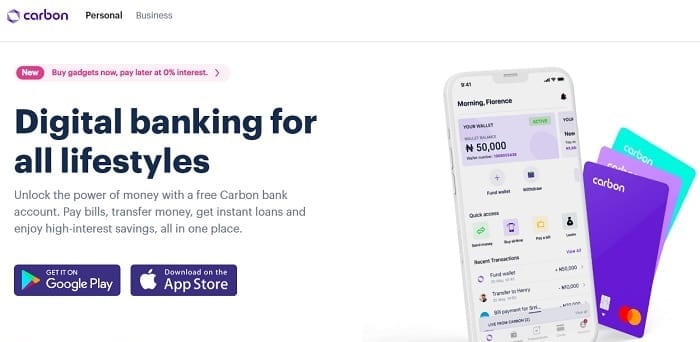
Formerly known as Paylater, Carbon is a digital banking app that also gives out loan to individuals and businesses. The app provides all sorts of exciting financial services, including savings, investment, payments and so on.
Hence, Carbon is more than an app for borrowing money; it is an app that offers “digital banking for all lifestyles”. However, for this post, let’s focus on its loan feature.
Insured by NDIC and certified by the Central Bank of Nigeria (CBN), Carbon loan does not require any form of collateral, neither would you have to fill any form. The entire process is online, and you will receive your loan within minutes.
How to get a loan from Carbon app
Download the Carbon app from the iOS app store or Google Play store
Register in few minutes by providing a few details about yourself
Go ahead and apply for loans
Your loan would be sent to your wallet on the app from where you can use it for different transactions. You can also send the money from your wallet to your bank account so you can withdraw it.
Payback your loan on time to unlock higher amounts. Also, you stand a chance of getting 10 – 100% cashback when you pay back your loan on time.
PalmCredit is another mobile app that gives Nigerians easy and convenient loan. Boasting of being “Nigeria No. 1 online loan…”, the money lending app offers flexible loans with reasonable interest rates.
As with most other loan apps, paying back your loan on time on PalmCredit helps you to update your credit score. The implication of that is you get higher offers when next you apply for a loan.
Some of its unique fixtures include offering up to 100k loan with a daily interest rate of 1.2%.
How to get a loan from PalmCredit
Download the Palmcredit mobile app from your app store
Register and set your account in minutes
Apply for a loan
Get approval within minutes
The loan is disbursed to your bank account
Interest Rate: 14% – 24%
Loan amounts: ₦2,000 – ₦100,000
Loan terms: 14 – 180 days
Target market: Individuals
Okash
A product of OPay, Okash is another loan app that offers loans to Nigerians. The app is committed to increasing access to loan facilities to the underserved section of the society.
You get loan decisions on Okash within seconds, and once your loan is approved, you’d receive funds within 5 minutes.
For your first loan application on Okash, you can’t get more than ₦10,000. The money will increase in subsequent applications, especially if you pay back your loan on time.
Okash loans are provided in partnership with Blue Ridge Microfinance bank; hence you can pay back your loan via direct transfer to Blue Ridge Microfinance bank account (Zenith Bank Account No:1130085518)
How to get loan from Okash
Download and install the Okash app from your app store
Register an account
Select the product or loan amount you’d like to apply for
Provide necessary information and submit your application
You may get a call for verification after submitting your application. Ensure you provide the right information
E-sign the loan agreement after approval
After this, the approved loan will be dispensed to your registered bank account
Interest Rate: 23 – 35%
Loan amounts: ₦3,000 – ₦500,000
Loan terms: 7 days – 365 days
Target market: Individuals and businesses
Fairmoney
Fairmoney is a money lending app for Nigerians where you can get a loan within 5 minutes. You know this is a big deal if you’ve had to wait for days to get a loan from your bank.
Fairmoney is not just a loan app, by the way. The app also provides some essential financial solutions such as airtime recharge and payment of bills.
The primary requirement for a Fairmoney loan is your BVN, and you can get as much as N500,000. And you can spread repayments in multiple instalments for ease and flexibility.
How to get a loan from Fairmoney
Download the Fairmoney app from the Playstore
Signup with your phone number and create your PIN
Click apply on the home page
Answer the few questions provided
Get a loan offer
Choose amount and tenor
Accept the loan offer
Provide bank details where you want your money sent and get it within minutes
Interest Rate: 10 – 30%
Loan amounts: ₦1,500 – ₦500,000
Loan terms: 61 – 180 days
Target market: Individuals and businesses
Aella Credit
Aella Credit is a fintech app that provides such services as payments, investment, and loans. The app makes it “super easy for anyone to borrow, invest and make payments” without excuses.
The money lending app even offers affordable insurance services for its customers. Now, that’s something different compared to others in the list.
For Aella, the end goal is to provide financial inclusion for all, irrespective of social class or profession.
How to get a loan from Aella Credit
Download the Aella app from your app store
Create your account by filling out your details in less than a minute
Answer some quick questions to update your profile
Click the “check eligibility” button to see if you qualify for a loan and how much
Apply for the loan, and it will be sent to your provided bank account within minutes
Payback your loan on time
Interest Rate: 4 – 20%
Loan amounts: ₦2,000 – ₦1,000,000
Loan terms: 1 – 3 months
Target market: Individuals and businesses
Blackcopper
If you are thinking of an app where you can borrow money to grow your business, then checkout Blackcopper. The app is committed to keeping “the wheels turning for your business”.
Aside from giving quick loans to individuals and businesses, Blackcopper also has investment opportunities for its users. Sign up to benefit from either of the two services the app offers.
How to get a loan from Blackcopper
Download the Blackcopper mobile app from Apple store or Google Play store
Register your account by providing the required information. Secure your account by verifying it via mail
Access Quick loans for your business needs or access investment opportunities on the app
Interest Rate: As low as 3.74%
Loan amounts: ₦500,000
Loan terms: Up to 6 months
Target market: Individuals and Businesses
FAQ
What are the main eligibility conditions precedent to loan
1. You must bee between the ages of 22 – 59 years old2 2. Have a verifiable source of income 3. Live and/or work in cities where we operate 4. Have a savings or current bank account with any commercial bank
What are the required documentation to apply for a loan, using any of the loan apps?
You need your bank statement, a government issued ID card and utility bill (optional).
Branch offers loans from ₦1,000 to ₦200,000. Loan terms range from 4 – 40 weeks. Interest ranges from 15% – 34% with an equivalent monthly interest of 3% – 21% and APR of 33% – 261%, depending on your loan option.
Conclusion
Accessing loans for personal needs and business development is no longer so much of an issue. However, resist the urge to get a loan when you don’t need one or don’t have a clear plan to pay back.
Also, take your time to study these money lending apps’ terms and conditions before submitting your application for loans. Be sure you agree with these terms to prevent future regrets, especially in terms of the interest rate.
Do you know of other loan apps with amazing offers and excellent services? Share in the comments.
It is no longer news that a single stream of income can no longer sustain anyone, especially if you live in a country like Nigeria. Home based businesses are becoming commonplace, as people now prefer to work from home. So having a list of top Home based business ideas is a goldmine.
It would help if you had multiple income streams to meet up with the ever-growing demands; daily needs, bills, utilities, and the ever-increasing cost of living.
Though almost everyone would love to have multiple income streams, not everyone has what it takes to pull it off.
Many would-be entrepreneurs have abandoned their dreams of owning a business or a side-hustle because of the fear of contending with business necessities such as capital, rents, utility and start-up inventory.
This article will show you 7 home-based business ideas that you can start and earn much money from especially in this post-COVID 19 era.
1. Home Based Business Idea 1 – Sell Knowledge:
Selling products online is a great way to earn extra income. There are several different methods you can use to sell products online. One of the simplest options is to set up an eCommerce store using platforms like Shopify, Bigcommerce, Volusion, or Magento.
These platforms allow you to easily manage inventory, track orders, and accept payments.Consumers are hungrier now than ever to know why and how things are done, and they are only buying from those who tell them.
One of the best home based business ideas to start is to sell your knowledge and skills.
Come to think of it; there is something you know so well that others are willing to pay to learn.
Most marketers and business owners forget that what clients genuinely want is answers to their questions; more like solutions to their problems. And if you are answering their questions, you are the solution to their problems; and therefore their number 1 choice.
Sites like Udemy give knowledgepreneurs a platform to convert their knowledge into courses to sell and make money.
Can you cook, dance, sing, write, teach, draw, paint, bake? You can write an ebook on virtually anything and self publish. The year 2020 opened up the era of remote transactions in a unique way, seize the time; it is the best time in to be a knowledgepreneur.
Identify what your friends often call you on. Those things they always draw on your experience in, break them down into simple concepts, write them down, publish them as an ebook or a video course, and start selling.
All you need to start up a Knowledgepreneur business are:
A skill – an area or aspect of life you are knowledgeable in
Your smartphone or computer to record the course
Finally, the internet to upload and promote your content to your friends and family.
2. Home Based Business Idea 2 – Social Media Manager
Do you have a growing social media presence of your own, with a sizeable active following, and you know how to replicate your success?
If you are someone who enjoys surfing the net and actually have the flexibility to spend a lot of time on social media, there is one way you can start earning from what you love right from the comfort of your home – Become a social media manager.
A lot of businesses, corporate organizations, and busy professionals, are trying to build their brand and businesses online; thus there is an ever-increasing need for a social media manager. What is not so increasingly present are the social media managers.
As a social media manager, your job includes creating content, email marketing, community management, graphics design, developing or implementing digital strategy, run sponsored ads, help the business convert followers and so much more.
With this as a side-hustle, you can become a boss of your own, set your prices, make 6 figures monthly, work at your terms and you can pick who to work with and the good news is so many businesses need social media managers to keep their business running.
The next time you find yourself spending hours on social media, burning your data, maybe you could discipline yourself to learn some of the basics of social media management and start earning from your passion from the comfort of your home.
3. Home Based Business Idea 3 – Freelance Writing
Freelance writing means writing for money while working on your own and not being employed by an organization. It is an exciting business to start if you enjoy carrying out research and writing.
You could become a content creator for blogs, write articles for individuals and organization. You can also set up your account on freelancing sites like Fiverr, Upwork, and other such websites, where you could get paid for your services.
All you have to do is to pitch yourself as a writer, get testimonials from some clients, make your money and keep writing – all from the comfort of your home.
4. Home Based Business Idea 4 – Affiliate Marketing
Have you ever received a call from a friend asking for a recommendation on the best place to make a purchase? What did you do in that instance? Without thinking, you scan through your mind and recommend based on your personal experience.
Every single day, people buy stuff recommended to them. You bought that car because you saw someone use it, you use your phone because someone said something great about it – it could even be from the advertisements.
Without knowing it, you have been an affiliate marketer. The unfortunate news, however, is that you have been getting zero commission for your efforts.
Instead of sitting on the fence, you could turn your love for products into a business. Welcome the latest affiliate marketer!
There are different products and services you can promote and earn a decent commission on.
It can be online courses, products, and services. You don’t have to create the product; you don’t have to have sleepless nights creating slides and recording the class. All you have to do is tell people how amazing the product is and earn a commission.
5. Home Based Business Idea 5 – Home-based Chef
Many busy professionals love a good home-cooked meal. Still, they don’t have the time to make such mouth-watering delicacies they so desire: creating a huge gap and business opportunity for the business-minded individual.
If cooking is your passion and you’ve acquired the skill of making sumptuous delicacies, you can fill in this gap and start cashing out.
You don’t need to operate a traditional restaurant to earn money out of your culinary skills. You can use your regular kitchen utensils to prepare meals right from the comfort of your home, package them neatly, and deliver to paying customers.
You can start with friends and family and once they are satisfied, trust them to become your ambassadors.
6. Home Based Business Idea 6 – Backyard Farming
You can convert the extra space around your home to farmland where you can cultivate vegetables and other crops. One of such home-based farming that performs well is snail farming.
During the rainy season, my mum converted the extra space in our home to grow corn, beans, yam, groundnut, and okra and after 3 months, we have hundreds of maize to eat and sell.
In my case, I farm snails. Snail farming does not need much capital to get you started, and the returns on investment in snail farming are huge.
Suppose you’ve got extra space around your home. In that case, you could consider turning it into a mini farm and cultivate homegrown crops for personal consumption and sale.
You would be shocked at how many things that a Nigerian might go into and make lots of money from, in Nigeria.
7. Home Based Business Idea 7 – Hairdressing And Beauty Services
Everyone is so concerned about their physical appearance, especially women, with the changing lifestyle of people brought about by the COVID-19.
With the current stay-at-home trend, many people now prefer to have their services rendered to them at the comfort of their homes. These include getting their hair and face done.
If you possess this skill, now is not the time to think about opening a salon, you could quickly begin to provide home service to your clients and get paid for it.
Home Based Business Idea 8 – Start a Book Club
If you love reading books, then starting a book club with friends is a great way to make money while sharing your passion. You can either charge each member a monthly fee or offer members free access to your library. Either way, you’ll need to find a good location for your group to meet. Consider renting out a room at a local coffee shop or having meetings at a community center.
CONCLUSION
You have no excuse to be broke. Start generating wealth even from the comfort of your homes.
As a business owner, depending on the structure of your company, there are basically two ways to effectively pay yourself-
Salary – The typical salary payment method
Owner’s draw – Where the owner takes a percentage from the company’s profit
I believe that entrepreneurs hardly make more money for themselves than what they would have been paid in salary if they worked for someone else. I’ve had to, therefore, ponder on whether the path of entrepreneurship is worth the accompanying stress on the individual, and if it wouldn’t be better to seek a more secure job and earn a salary as a 9-5 player.
Ironically, anyone who hasn’t been into entrepreneurship may romanticize the idea of being one, especially due to the often seemingly glamourous lifestyle of most CEOs which often paint the picture of large take-home salaries and benefits.
What may not be apparent to many on the other side of the divide, however, is the work; sacrifice and other below the belt punches that entrepreneurs often receive to keep their businesses running.
If my belief is right, it, therefore, means that entrepreneurs must be motivated by other factors other than salaries.
But talking about salaries, I am often bewildered by how an entrepreneur’s worth should be determined, in terms of salary. For all the harrowing ordeals that entrepreneurs put themselves through, there must at least be a method for calculating the adequate compensation that an entrepreneur should pay himself as salary.
Unlike the corporate world, where you have the opportunity to discuss your salaries and other compensation packages with potential employers before you accept to be hired, setting your salary as a business owner is more complicated.
Whatever the figure you choose to pay yourself as an entrepreneur, one thing is sure – your number must put into consideration the importance of maintaining a healthy cash flow to keep your company in business. You must also ensure that you pay yourself only from your profit while being fair to your employees and investors if you have any.
Advantages of Paying Yourself as a Business Owner
It Helps To Keep The Business Running When The Owners Are Paid
It Helps Improve Investor Confidence on The Business
It Helps With Tax and Accountability
Here are a few things to consider when setting your salary:
Determine How Much Your Business is Worth
Determine What Your Position is Worth
Consider The Legal Structure of Your Business
FAQ on Paying Salaries
How Can a Business Owner Pay Salaries With a Negative Cashflow?
Regardless of what is happening with your financial figures, employees want to get paid. Maintaining a healthy cash flow isn’t always an easy task for most business owners and entrepreneurs. As a business consultant, I’ve helped my clients beat this pressing need for positive cashflow by introducing them to stop-gap measures like establishing a Business Line of Credit and at times help in securing short term loans.
Should A Business Owner Take Salary With a Negative Cash flow?
No, it is obvious that once you take salaries as a business owner during a negative cashflow period, you would not only hurt your cash the more, you would also hurt the morale of your employees.
In South Africa, there’s been a spike in the solar electricity franchise, but there is a Nigerian franchisor, Tonye Irims who is working on making solar electricity cheaper and more available to South African residents.
Research by Bloomberg NEF revealed that “wind and solar energy are now the least expensive forms of power in two-thirds of the world”. The world is beginning to embrace solar energy as the next environmentally friendly way to generate energy for domestic and industrial use.
Tonye has always been passionate about affordable and quality electricity. It is the primary reason he left Nigeria 26 years ago. He is currently working on enhancing the prospect of solar electricity, and expanding his solar electricity franchise, WiSolar to other African countries.
In 2011, Tonye failed at an attempt to launch FriendsChip, a payment app in the United States of America, and he had to return to South Africa.
He started WiSolar in the South African winter of 2016 by putting together solar electricity in his house after many experiences of being cut off the electricity grid with hefty reconnection fees. In November of 2016, WiSolar started operations
Like many startups, WiSolar has faced and is still facing a few business challenges. Tonye and his team were thrown out of their first store in 2017 due to unpaid back rent. They were only able to do 3 installations in their first year of business and were kicked out of their office because they couldn’t afford to keep up with the rent.
The dark days continued to the extent that in the same 2017, Tonye wanted to sell the store branch for as low as R120,000 (USD 8,000) but couldn’t get any willing buyer.
Despite the many challenges Tonye faced in scaling WiSolar, he decided to give it another shot with R60,000 seed capital he got in 2018. Things didn’t take off until February 2019. WiSolar got its first paying client in February 2019, and ever since then, the company has been growing financially, and in manpower.
WiSolar is currently looking to add over 100 work-from-home jobs in 2021. It will help boost the labor market in South Africa after the adverse effect of Covid-19.
As a growing company, WiSolar is faced with a few challenges. Providing electricity at a cheaper rate isn’t cheap, and it will take adequate funding to keep the business going. Another problem is getting the right people on the team. The vision of creating 100 work-from-home jobs next year will see to it that the right people will be employed to fill the vacant positions.
WiSolar is on a mission to roll out prepaid electricity for variable loads for as low as R0.78c per Kwh. This is in line with their vision to provide affordable solar electricity to every household in South Africa and Nigeria.
WiSolar recently received two awards in the 2020 MEA Business Awards for Client Service Excellence, and The Most Innovative Clean Energy Company – Africa. The recognitions are pouring in, and in the nearest future, they’ll be competing with international companies in the solar electricity industry.
Tonye disclosed that he’s very keen on breaking into the Nigerian solar electricity market. The plan is to make solar electricity cheap and available for Nigerians for as low as N20 per Kwh, which is cheaper than what the average Nigerian spends on electricity per hour.
Untapped business is another name for societal needs that are yet to be met by market players. There are demands for such products and services, but very little supply is available to the market. That means there is a significant gap in the market.
In most cases, due to the shortfall in the market, such businesses are always very lucrative, especially when the market demand is still significantly high.
So, as a business owner in Nigeria, I would pay attention to this article as it contains a list of businesses in Nigeria with many people seeking more coverage.
This article gives you access to some highly lucrative yet untapped business ideas in Nigeria.
Having a lucrative business in Nigeria can be very exciting, especially when such a business is very lucrative and unsaturated – welcome to the land of the untapped market segments in Nigeria.
I have grouped these businesses into sectors for easy identification.
One of Nigeria’s most recurrent campaign promises by all the administrations post-military era has been the “Improved Power Supply” project. And from all indications, politicians would include it in the 2023 elections campaign promises as it has remained an unmet promise.
Nonetheless, as an entrepreneur, such an unmet need creates a much-needed business opportunity to explore and make a good return on investment, especially in an industry such as energy – an industry with many clients.
Reports by Electricity Generating Companies reveal that the average power supply in Nigeria is 3,851MW, which is not even enough to serve Lagos effectively.\
All that tells you is that the power problem in Nigeria is not changing anytime soon, and the scenario leaves us all with alternative power sources for homes and businesses.
Some alternative energy sources that you can use in your homes and businesses include renewal energy sources such as biofuels, solar power, wind energy, biomass energy, etc.
The market for renewable energy is enormous, with Solar Energy taking the lead here in Nigeria. Asides from Solar, you could participate in the biofuel market, which doesn’t require much capital to get started and promises a very high return on investments.
Here are some of the ways you can be a part of the renewable energy business:
Solar Powered:
The assembly and installation of solar installations
Sales of solar panel parts
Solar panel maintenance
Sales, installations and assembling of other peripheral equipment such as inverters, charge controllers, etc.
The four items above make up the core businesses in the solar panel industry, and market entry requirements for any of them is pretty low.
Estimated Capital for Alternative Power Source for Homes
N3,500,000
Projected ROI on Alternative Power Source for Homes
The projected annual Return on Investment for a solar power installation business is over 190%.
A United Nations report estimated that over 11 billion tons of waste are collected all over the world generating $140 billion. And since Nigeria is a developing country, we are definitely a significant producer of wastes.
In Nigeria, about 50 billion plastic bags are used every year
Every hour, approximately 200,000 plastic bags are land-filled
A family of four uses an average of 1,500 plastic bags in a year
At least 267 different species of marine life are adversely affected by plastic pollution
225 million tons of non-biodegradable plastics are produced annually worldwide that destroy our environment continuously
A single-use plastic bag has an average life span of 12 minutes, and destructive span of about 1,000 years
This business, though seemingly dirty, has what it take to make you immensely rich as not so many are looking its direction.
What most people don’t know is no waste is absolute waste. Animal dung are used as fertilizers; plastics and polythenes can be recycled to make other plastic products. So, the next time you see those plastic drink bottles and the rest in your gutters, what you are seeing is…
You can become a part of this industry in three different ways:
Imagine having a 9-5 job in Lagos Island and living in Lagos Mainland? You have to live home very early in the morning and return home late in the night, every day.
Now, that’s what an average Lagosian is going through. And the story is almost the same in Abuja and other major cities in the country.
This means that an average working-class person in Nigeria doesn’t have enough time to cook breakfast or dinner. That leaves them with the option of eating out.
There are several options for them when it comes to eating out. The famous eateries with unnecessarily expensive food; the mama put with cheap food but not so clean environment, and then there are food trucks that seem to balance it all but then, it’s relatively scarce.
And that’s why it’s one of the untapped business opportunities in Nigeria that you should consider.
There are varieties of food options to consider for this business. You can choose to do softcore such as coffee, snacks, tea and all. Or you can go all-in by doing Nigerian meals such as jollof rice, fried rice, yam and egg, indomie noodle and so on.
But I can’t cook. Honestly, that’s the least of your worries in 2020. You can take a short course on cooking the meals you intend to sell. Or watch a couple of Youtube videos and experiment a couple of times.
The location of your business should influence your choice of food.
And talking about location, it’s essential that this business is located around industrial or work environment, and not residential areas for obvious reasons.
One of the most exciting parts of this business is that it is cost-effective in the long run. You can cut by almost 70% because you don’t need to make sitting arrangements so you’d need less space.
Estimated Capital for Foodtruck or Container Business
One of the most exciting parts of this business is that you’d rarely run out of funds because the government is always willing to support agriculture and so are banks too.
Nigeria may be a giant of Africa in many things but not agriculture, at least not anymore.
The world has evolved in terms of agriculture, and Nigeria has a lot of catching up to do. And that’s where you come in with your organic farming.
There is a high demand for organic food worldwide. So, let’s go farming.
Do you know you can build a website from scratch and resell it? Well, yeah, you can. That’s what website flipping entails.
Online is the new market, and every business is trying to build its store there. They obviously need websites and would be willing to pay a reasonable amount for it.
Now, this involves being tech-savvy and having some coding skills. So, if you know your way around coding and can successfully build a website, this is for you.
You can make up to 300% of the money spent on creating a website from selling it. Now, that’s a lot of money. But as lucrative as this business is, it is up there as one of the most untapped business ideas in Nigeria.
Some sites make it easy and fast to flip websites when you’re done building. Afternic, Freemarket and Flippa are among the popular ones.
For those that can’t write codes, you can still create WordPress blogs and resell. Yeah, you don’t need to be a web developer to create WordPress blogs. A couple of Youtube videos or maybe a short course is all you need to get started.
Estimated Capital for Domain or Website Flipping
N2,000 – N200,000
Projected ROI on Domain or Website Flipping
N400,000 – 1,000,000 over time
Most lucrative business ideas in Nigeria
This is a list of the most lucrative businesses in Nigeria between the years 2010 till date. What is also most fascinating is that these businesses are not just lucrative, they are also fast selling.
Oil and Gas business
Logistics and Mail Distribution
Petrol Station
Cooking gas business
Kerosene business
Snake farming
Cattle farming
Palm oil business
Cassava farming
Poultry farming
Snail farming
Food Franchises
Local restaurants
Foreign and intercontinental restaurant
Food supply business
Blogging Business
Real Estate business
Furniture business
Hotel business
Transportation business
Social media marketing
Fashion business
Online Video business
Dry Cleaning business
Pure water business
Dropshipping business
Conclusion
However, we still have others like the under listed businesses that are also yet to be overcrowded:
Note: The capital and ROI, as mentioned in this article, may vary based on location and business preferences and expectations. Do well to carry out more market research before you begin the business.
(CNN) — It took two years to build, but the entire construction process for a huge new ship from P&O Cruises can be viewed in just over a minute thanks to this incredible timelapse video.
The mesmerizing footage shows the many sections of Iona, the largest ship ever built for the UK cruise market, being put together piece by piece at the Meyer Werft shipyard in Papenburg, Germany.
During the final moments, the 185,000-ton vessel, which has a 5,200-guest capacity, can be seen leaving the shipyard and taking to the water. Measuring 345 meters (1,132 feet), Iona is powered by liquefied natural gas (LNG,) and consists of 17 guest decks, 13 entertainment venues, four swimming pools, including an infinity pool, and a gin distillery.
The National Bureau of Statistics on Monday said that the federal government generated a total sum of N424.71 billion from the Value Added Tax (VAT) in the third quarter of the year (Q3 2020) compared to N327.20 billion in Q2 as well as N275.12 billion in Q3 2019.
According to the sectoral distribution of Value Added Tax (VAT) data for Q3 2020, which was released by the National Bureau of Statistics (NBS), the figure represented a 29.80 per cent or N97.51 billion increase in VAT collection month on month and 54.37 per cent or N149.59 billion increase year on year.
Other manufacturing generated the highest amount of VAT with N47.07 billion and closely followed by professional services, which posted N44.01 billion as well as commercial and trading, which recorded N21.18 billion.
Mining generated the least and closely followed by textile and garment industry and pharmaceuticals, soaps & toiletries with N64.50 million, N346.27 million and N386.16 million respectively. According to the NBS, out of the total amount generated in Q3 2020, N214.66 billion was generated as Non-import VAT locally while N115.34 billion represented Non-import VAT for foreign. The balance of N94.70 billion was generated as Nigeria Customs Service (NCS)-Import VAT. According to the report, revenue from banks and financial institutions during the period under review totalled N6.87 billion; breweries, bottling and beverages N15.83 billion; hotels and catering N2.14 billion and federal ministries and parastatals N6.37 billion.
Others are state ministries and parastatals N19.64 billion; properties and investments N1.07 billion; transport and haulage services N11.86 billion and gas N1.12 billion.
Other contributors to VAT included Local Government Councils N567.97 million; pioneering N1.13 billion; oil-producing N11.54 billion; oil marketing N3.08 billion and conglomerates N1.74 billion.
Agriculture and plantation contributed N1.01 billion to VAT, automobiles and assemblies N8,8.34 million; building and construction N2.93 billion, offshore operations N1.41 billion and publishing, printing, paper packaging N473.09 million.