Category: NEWS

  • CBN says businesses in Nigeria must accept eNaira

    CBN says businesses in Nigeria must accept eNaira

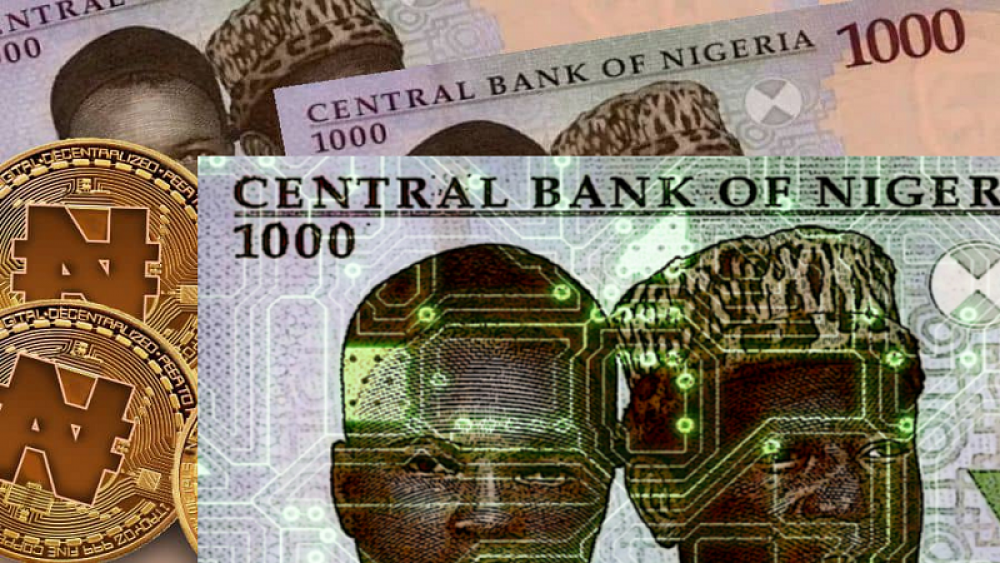
    The Central Bank of Nigeria (CBN) Director of payment system management, Musa Jimoh, disclosed during an interview on Channels TV’s ‘Business Morning’ show Monday that Nigeria’s digital currency, eNaira, is a legal tender just like the naira that must be accepted by all merchants and business outlets as a form of payment in the country.

    “Today, anywhere you present naira to pay, compulsorily it must be accepted because that is our fiat currency. So, the same way naira is accepted that you can’t reject it, is the same way eNaira must be accepted,” Jimoh said.

    While urging Nigerians using android and iPhone mobile devices to download the eNaira wallet from October 1 from the application stores respectively, Jimoh said the CBN will bear all liabilities of the digital currency.

    “The liability of the eNaira money is directly on CBN which is similar to the cash you hold. The liability of the cash you hold today rests with the CBN. So, it gives Nigerians the opportunity to bank with CBN,” Jimoh said.

    Read also: Nigeria Announces Own Digital Currency eNaira in Partnership With Bitt

    Asked if Nigeria is ready for the eNaira implementation due to the technological challenges in the country, the official said that he does not expect it to pose any serious problem.

    “ENaira is a journey. We don’t expect that on October 1, all business merchants in Nigeria will accept it. We don’t even expect that come October 1, all Nigerians will have eNaira. It is a journey. It will continue to grow,” he said.

    eNaira and the CBN

    He added, “remember there was a time in this country when you had to practically beg business outlets, merchants and others to accept POS transactions. But we have come to a point where traders now beg for POS terminals.”

    Jimoh noted that one of the benefits of the eNaira is that it would save the cost of printing new naira notes, and that charges incurred while transferring funds would be lower for those using the eNaira.

    “Today the cost of producing the naira and coins is very high. It costs money to print naira in this country. Now, the minting of eNaira is electronic, so it reduces cost,” he said.

    When asked why the CBN chose a foreign firm to collaborate with on this, Jimoh said it had to do with capacity.

    He said Bitt Inc. which will handle the project, had done similar projects for other countries and already had the capacity and experience, but that the company would be registered and managed in part by Nigerians while the technological aspect would be handled by the foreign arm.

    “What we did is to partner with an entity that has done it, that has that experience because we know that eventually, the system is going to run in Nigeria.”

    “So, we also want to domicile some responsibilities here. So, the arrangement is such that you are going to have a Nigerian incorporated company, Bitt Nigeria, which will be running the system,” he added.

  • CBN governor says abokiFX owner, Olumide Oniwinde, will be prosecuted

    CBN governor says abokiFX owner, Olumide Oniwinde, will be prosecuted

    Coming out of the recently concluded MPC meeting by the Central Bank of Nigeria (CBN), the CBN Governor, Godwin Emefiele Friday, September 17, 2021, referred to Olumide Oniwinde, the owner of abokiFX as an illegal FX dealer who will be prosecuted for acting against the Nigerian economy.

    AbokiFX is a website that publishes the parallel market exchange rate of the Naira against other currencies of the world on a daily basis.

    According to the governor, Olumide Oniwinde started abokiFX in 2015 and has since milked the economy by taking position, while manipulating the exchange rate. “The CBN act section 2, does make it clear that only the Central Bank can determine the value of the naira, and yet a single individual living in England continues to manipulate the exchange rate and make huge profit which he withdraws through an ATM in London,” Emefiele said.

    Read also: 5 ways we think work will change

    He stated that abokiFX has been filing the same figures of 1,000 pounds in its financial statements for the past four years, but Oniwinde and the company has over 25 bank accounts in Nigeria with about 8 banks both in naira and dollar with significant turnover.

    He also confirmed that the apex bank wrote a memo to banks to provide the information about abokiFX as he stated that the CBN has been studying the activities of abokiFX in the last two and half years.

    “There was a particular time I asked our colleagues to call the so-called owner of abokiFX, that we want to understand his model and how he came about advertising those rate, we find him as someone, a Nigerian who lives in England and conducts this nefarious activity on our economy.

    “It is economic sabotage and we will pursue him, wherever he is, we will report him to international security agencies, we will track him, Mr Oniwinde, we will find you, because we cannot allow you to continue to conduct an illegal activity that kills our economy.” Emefiele said.

    Emefiele reiterated that their preliminary findings suggest that the website was built and is being used purely for the purpose of foreign exchange manipulation and speculations. “They get naira loans, use to purchase dollars, take a position, change the rate over a given period, sell the dollars they purchased and make a profit, this is completely illegal, unacceptable and we will pursue them,” he explained.

  • 100 days of Twitter ban: Small businesses collapse, others struggle

    100 days of Twitter ban: Small businesses collapse, others struggle

    100 days after Nigeria banned Twitter, the microblogging platform has lost about 23.44 per cent out of its 25.52 per cent market share before the ban. This is as other social media platforms like Facebook and Instagram gain massively from Twitter’s losses. According to Statcounter, a global social media statistics platform, as of May 2021, Twitter had a market share of 25.52 per cent in Nigeria, but this has drastically reduced to 2.8 per cent as at August 2021.

    This is as Netblocks, a watchdog organisation that monitors cybersecurity and governance of the Internet, said since the ban, the country’s economy has lost over ₦217 billion. The platform said it relied on the booking institution method which uses development indicators, approximated digital economy extent of 0.05 and classic free app GDP impact technique to arrive at its conclusion. 

    But, the economy is largely driven by small businesses and those who have incorporated Twitter into their operations are suffering from the ban.

    According to the president of the National Association of Telecoms Subscribers of Nigeria (NATCOMs), Chief Deolu Ogunbanjo, many small businesses have collapsed and there are huge job losses in the country.

    Nigeria’s president, President Muhammadu Buhari said the ban would be reversed after having reached an agreement with the social media company on a number of issues. But, there are no developments in that light and, it seems the ban will continue until the end of the year.

    Businesses, especially Small and Medium-scale Enterprises (SMEs) and governments at different levels continue to bear the brunt of the suspension as the economy continues to take a hit.

    In its report, NetBlocks revealed that each hour of the suspension costs Nigeria $250,000 ( ₦102.5 million), bringing the daily loss to ₦2.46 billion.

    “Many small businesses have collapsed and there are huge job losses after 100 days. We appeal to the government to have a rethink. 

    “With the COVID-19 Delta variant now escalating in the country, the government should not deprive people of access to social media, especially those who get their daily information from the platform. Some peoples’ lives are practically online, so, the government should not kill that space.

    “We appeal to them to bring Twitter back as fast as possible so that the economy can bounce back as well,” Ogunbanjo says.

    RELATED ARTICLES

  • How to Access Twitter in Nigeria: Top 10 VPN in Nigeria

    How to Access Twitter in Nigeria: Top 10 VPN in Nigeria

    Following what many have described as the “illegal ban” of Twitter in Nigeria, most Nigerians have now turned to VPN to remain connected to the micro-blogging platform. You’d recall that the federal government of Nigeria, through the minister of Information and Culture, Lai Mohammed, suspended the activities of Twitter in Nigeria and directed Nigerian network service providers to withdraw access to the platform.

    In case you missed it, here is an attempt to summarise the events that led to Twitter suspension in Nigeria.

    Why Twitter was banned in Nigeria?

    In 2020, young Nigerians mobilised themselves via Twitter to organise a massive protest against police brutality. This was following several cases of police profiling, extortion, brutality and general unprofessional conduct usually targeting young Nigerians.

    Twitter played a crucial role in this protest that President Buhari later described as an attempt to seize power from him. His administration did not find it funny, and their reaction as expected was around how they could control social media. Make that the remote cause.

    What would later become the immediate cause was the decision of Twitter to delete the tweets by the official Twitter account of President Buhari following several complaints by Nigerians. The tweet was said to be distasteful and a form of hate speech against a section of the country.

    Also Read: How to Sell Yourself as a Content Creator

    Within 24-48hours after President Buhari’s tweet was deleted, Twitter was banned in Nigeria, and that’s why you now have to read this.

    What is VPN and How does it work?

    Simply put, VPN makes it possible for people to access the internet securely. Meaning Virtual Private Network, the tool allows users to have protected connection to websites and applications.

    What VPN does is it disguises your IP address such that the website or app you are using can’t accurately monitor your activities, steal your data or track your location.

    When you connect to the internet through a VPN, you make the VPN your data source. This way, not even your Internet Service provider can tell which websites or apps you are visiting.

    Is VPN new to Nigerians?

    Well, for many Nigerians, the ban on Twitter is their introduction to VPN. However, a handful of Nigerians have had to use VPN for various reasons before now. Some Nigerians have had to use it in the past to access platforms that were otherwise not accessible to Nigerians such as Spotify (which later opened in Nigeria) and Netflix (to access shows or movies available to other countries).

    10 VPNS You Can Use in Nigeria

    Whether to gain access to platforms of your choice or to continue accessing Twitter, there are loads of VPNs you can use in Nigeria. However, it can be quite challenging to choose from the hundreds of VPN out there. Also, there are data concerns with some of the VPNs.

    Therefore, we have put together a list of 10 safe and effective VPNs for you in Nigeria. Some are free and others are paid for.

    • Nord VPN

    NordVPN can be downloaded from the Nigerian App Store, and its speed is considered one of the fastest compared to others. It’s not free but quite affordable at just $4.89/month. It has a total of 5,200 servers in 62 countries.

    Also, NordVPN has a unique feature which is called VPN chaining. Using VPN chaining, your traffic is routed through two servers, each encrypting data twice. Although helpful for security, this feature slows down your connection.

    • Proton VPN

    Proton is available for free with limited services. But to better enjoy Proton, you can upgrade to premium.

    Proton is arguably the best among the free subscriptions VPN available. Unlike NordVPN, ProtonVPN’s first subscription tier is a free VPN offering, with three VPN servers (Japan, Netherlands, US). The VPN boasts 1,246 servers in 55 countries.

    Unlimited browsing bandwidth is offered through its free subscription but with slower internet speeds. Compared to most other VPN providers, it only supports one connected device at a time and only provides a small number of server locations. 

    • TunnelBear

    VPN services are available both for free and for a fee on TunnelBear. With the free version, you are only allowed 500MB bandwidth per month.

    The connection speed is decent but isn’t as fast as NordVPN. Users have fewer options with 22 servers deployed across 22 different locations.

    TunnelBear is a good option if you rarely use the internet.

    • Windscribe VPN

    The Windscribe VPN includes a free version and 10GB of storage each month, just like TunnelBear. The use of the service is secured and safe. You can use it on a wide variety of devices and streaming services. Currently, it has 180 servers across 63 countries.

    • IPVanish

    IPVanish stands out due to its ability to allow unlimited simultaneous connections. The VPN has 500 servers located in 55 different countries.

    It does not have a free version. A year’s subscription costs $77.99, or $10 per month. And if you would prefer to pay for three months, you can do so for $26.99.

    Customisation is limited, and its privacy policies are a bit confusing.

    • CyberGhost

    There are more than 15 million users of CyberGhost, which has been around for years. It has over 6,000 servers in over 100 locations in 90 countries. Compared to all other VPNs, that’s a huge number.

    Unlike some other VPN services, CyberGhost supports nearly every device out there, but it is pricey. There is a monthly charge of $12.99, a six-month charge of $47.94, and $49.50 for eighteen months. In addition, students are eligible for a student discount, the cost of which is $2.75 per month, and you’ll be required to sign a year-long contract.

    • Psiphon

    Since it does not require an email address, this VPN stands out from the crowd.  The free app is available on all platforms (except macOS, Linux, and routers) and can be used immediately. The code is open-source, increasing transparency.

    The only downside is that because it’s free, it has a very restricted server network – just a few over 20 countries. 

    Also, compared to other alternatives, it’s slower. Netflix and torrenting are not supported.  This tool explicitly claims not to be a privacy tool.

    In addition to being supported by ads, Psiphon also shares statistics with sponsors to determine whether their sites are visited frequently and from which countries. A further breakdown is provided by sponsor, date, and region. After 60 days, Psiphon will delete all data collected.

    • SurfShark

    It has been roughly a year since Surfshark launched. SurfShark runs reasonably fast. It offers a private and secure connection, and it’s available on a variety of platforms.

    In more than 61 nations, it has more than 1,000 servers. This is an extensive network for a relatively new service provider and something many VPN providers haven’t yet accomplished despite years of service.

    SurfShark can be used on unlimited devices and is priced at $2.49/month for two years.

    • Private VPN

    A great all-rounder, PrivateVPN offers high speeds alongside excellent privacy. Streaming is made possible by the reliable connection and the ability to unblock sites like Netflix. Torrents can also be accessed with it, and it works pretty well in China.

    Even though it only has around 200 servers, this is still quite an excellent option. The lowest price per month is $2.08.

    • HotspotShield

    The VPN has a free version, but it’s essentially a premium VPN. Its free version comes with a 500 MB daily traffic limit. That’s not bad compared to some other VPNs with a similar approach.

    Conclusion

    So, here are the top 10 VPNs you can use to continue to access Twitter and use other platforms of choice. They all have their unique features and come at varying prices. At the end of the day, your choice of VPN will depend on your preferences.

    However, as a rule of thumb, the critical criteria to consider when choosing a VPN include security, internet speed, customisation options and user-friendly.

  • NBS: FG Rakes in N424.71bn from VAT in Q3

    NBS: FG Rakes in N424.71bn from VAT in Q3

    The National Bureau of Statistics on Monday said that the federal government generated a total sum of N424.71 billion from the Value Added Tax (VAT) in the third quarter of the year (Q3 2020) compared to N327.20 billion in Q2 as well as N275.12 billion in Q3 2019.

    According to the sectoral distribution of Value Added Tax (VAT) data for Q3 2020, which was released by the National Bureau of Statistics (NBS), the figure represented a 29.80 per cent or N97.51 billion increase in VAT collection month on month and 54.37 per cent or N149.59 billion increase year on year.

    Other manufacturing generated the highest amount of VAT with N47.07 billion and closely
    followed by professional services, which posted N44.01 billion as well as commercial and trading, which recorded N21.18 billion.

    Mining generated the least and closely followed by textile and garment industry and pharmaceuticals, soaps & toiletries with N64.50 million, N346.27 million and N386.16 million respectively.
    According to the NBS, out of the total amount generated in Q3 2020, N214.66 billion was generated as Non-import VAT locally while N115.34 billion represented Non-import VAT for foreign.
    The balance of N94.70 billion was generated as Nigeria Customs Service (NCS)-Import VAT.
    According to the report, revenue from banks and financial institutions during the period under review totalled N6.87 billion; breweries, bottling and beverages N15.83 billion; hotels and catering N2.14 billion and federal ministries and parastatals N6.37 billion.

    Others are state ministries and parastatals N19.64 billion; properties and investments N1.07 billion; transport and haulage services N11.86 billion and gas N1.12 billion.

    Other contributors to VAT included Local Government Councils N567.97 million; pioneering N1.13 billion; oil-producing N11.54 billion; oil marketing N3.08 billion and conglomerates N1.74 billion.

    Agriculture and plantation contributed N1.01 billion to VAT, automobiles and assemblies N8,8.34 million; building and construction N2.93 billion, offshore operations N1.41 billion and publishing, printing, paper packaging N473.09 million.

  • Update: Nigeria Youth Investment Fund

    Update: Nigeria Youth Investment Fund

    “The Ministry of Industry Trade and Investment wishes to inform the general public that due to operational challenges the Survival Fund website will be migrating to http://survivalfund.gov.ng with effect from tomorrow, Nov. 1st, 2020.”

    The Federal Government has moved the website of its Survival Fund with effect from November 1, 2020.

    This was disclosed by the Personal Assistant to President Muhmmadu Buhari, Bashir Ahmad on behalf of the Ministry of Industry Trade and Investment via his Twitter handle on Saturday.

    What you Should Know:

    Over a million youths have so far signified interest by enrollment in the MSME NYIF Youth Investment Fund. You should hurry up and register – registration is free.

  • Jaiz Bank Denies Alleged Board Crisis

    Jaiz Bank Denies Alleged Board Crisis

    The Managing Director/Chief Executive, Jaiz Bank Plc, Mr. Hassan Usman, on Sunday, asserted that there is currently no rift in the board as speculated in the media.

    But, there had been allegations that the bank was enmeshed in a succession crisis, given that Usman’s contract as Managing Director was fast approaching.

    The board allegedly dropped Mr. Muhammad Shaheed Khan, a candidate for the position, in the process of appointment.

    However, speaking to journalists on the development, Usman said there was no rift, “other than the legitimate exercise of divergent opinions on a matter in the ordinary course of the directors’ duties.”

    He said: “Whereas some directors of the bank opined that a change of leadership was required to pursue some critical strategic goals, others believed otherwise, given the awe-inspiring performance of the current management.

    “The board nonetheless resolved to appoint a new successor in the person of Mr. Muhammad Shaheed Khan. This decision was however rescinded at a subsequent meeting of the board.”

    The MD said: “The board’s resolution to rescind its decision and consequently discontinue the appointment process was in line with the terms and conditions of the offer letter issued to Mr. Khan since the offer was subject to relevant regulatory approvals.”

    He said incidentally, the approval obtained from the
    Central Bank of Nigeria (CBN) materially modified the intention of the board as expressed in the conditional offer to Khan. This situation further necessitated the board’s decision to discontinue the process of his appointment.

    The bank, however, reassured its customers, shareholders, investing public and other stakeholders that the board remained committed to conducting its affairs within the stipulations of existing corporate governance codes for banks and public companies in the country.

    Usman, also listed some of the bank’s intervention programmes to alleviate the impact of COVID-19 on customers and Nigerians in general.

    He said the bank had contributed the sum of N100 million to the industry-wide efforts by banks to provide palliatives to people who are adversely affected by the pandemic. 

    He said the institution further initiated forbearance to customers. 

    “Our type of forbearance is unlike the conventional banks that you restructure a transaction and continue to charge. Most of our products, when you give forbearance, it means it is at zero returns to the bank.

    “So we have given these people the advantage of having the facility to run without paying any extra profit to the bank.”

    Other News Articles

  • WTO DG: FG Intensifies Support for Okonjo-Iweala’s Bid

    WTO DG: FG Intensifies Support for Okonjo-Iweala’s Bid

    The Nigeria Minister of State for Industry, Trade and Investment, Mrs Mariam Katagum disclosed to journalists on Friday that the federal government is currently reaching out to all members of the World Trade Organisation (WTO), including the United States of America and South Korea to overcome the current quagmire in reaching a consensus in the selection of a candidate for the position of the director-general of the organization.

    She said efforts are also ongoing to persuade the United States to join the consensus in adopting the recommendation of the appointment of Dr. Ngozi Okonjo-Iweala as DG-WTO. Dr. Okonjo-Iweala who recently obtained her United States citizenship is being tipped by other WTO member nations as the next Director-General for the organization.

    Katagum, who is the Chairperson of the Campaign Strategy Team for Nigeria’s candidate for the post of Director-General, WTO, spoke during a virtual emergency meeting she convened to review and strategize on the way forward in the light of recent developments in the selection process for the appointment of Director-General.

    The minister pointed out that the third and final round of consultations for the selection of the DG-WTO which commenced in Geneva on October 19, 2020 was concluded on October 27.

    According to her, “The Chair of the WTO General Council, Amb. David Walker of New Zealand, with the Facilitators of the selection process, the Chair of the Dispute Settlement Body and the Chair of the Trade Policy Review Body (Troika), on October 28 at the meeting of WTO Heads of Delegation in Geneva, informed the WTO Membership that the Nigerian candidate for DG-WTO, Dr. Ngozi Okonjo-Iweala secured overwhelming support of members both in terms of numbers as well as geographical spread and therefore emerged as the candidate most likely to gain consensus as DG-WTO. ” 
    “The appointment of Dr. Ngozi Okonjo-Iweala is expected to be adopted by consensus of all Members in line with WTO decision making procedure at a Special General Council Meeting scheduled for November 9, 2020.
    “However, the United States of America has registered reservation on the outcome of the final round because their preference is still the candidate of South Korea and further informed that they would not join the consensus in selecting Dr. Ngozi Okonjo Iweala as DG-WTO at the Special General Council of November 9, 2020. “

    Katagum however, conveyed Nigeria’s profound appreciation to all Members of the WTO  that have supported Ngozi Okonjo-Iweala for the post of WTO Director-General adding that the federal government of Nigeria would reach out to other countries to secure the consensus needed in the final decision on her appointment as the next Director- General of the WTO.”

    “We shall keep you updated on this issue and hope that, we would achieve the desired goal of Dr. Ngozi Okonjo-Iweala securing an appointment as the first African and the first female to Head the WTO,” she added. 

  • Hoodlums Attacks on Rice Mills Farmers Raise the Alarm over Food Security from 2021

    Hoodlums Attacks on Rice Mills Farmers Raise the Alarm over Food Security from 2021

    The year 2020 has been anything short of being dramatic – Many people lost their jobs this year due to the pandemic, and many more countries have had to switch to their strategic food reserves and banks to ensure that they meet the food demands of their people.

    In Nigeria, though we might not readily say that the COVID-19 pandemic hit so much that it was strong enough to cause food shortages around the country, what happened after the pandemic, however, is big enough to cause food shortage at a catastrophic proportion.

    Some Nigerians took advantage of the #EndSARSNow protest and unleashed mayhem on the nation; looting and burning down facilities that they could gain access to.

    The Rice Millers Association of Nigeria (RIMAN) on Thursday expressed concerns over the devastating mayhem and lootings carried out on its member’s facilities across the country, in the guise of the #ENDSARS protests.

    The RIMAN National Chairman, Mr. Peter Dama, said the hoodlums and miscreants hid under the guise of being peaceful protesters, attacked and looted the Glams Foods Lagos, Shemad Rice Mill Yola, and several other companies operated by its members.

    Mr Mohammed Shemad, the Chief Executive Officer of Shemad Concept Nigeria Ltd, recapped to reporters on Monday morning how the thugs forced their way into his rice mill located at Bakin Kogi and removed all the 10,615 bags of processed rice.

    While condemning the attacks in a statement, RIMAN National Chairman, Mr Peter Dama, said tons of milled rice, rice paddy, furniture, machines and operational vehicles at the premises of the affected mills were destroyed and looted. At the same time, some parts of buildings were set ablaze.

    As a result, he said the incident would create some deficits in its members’ contribution to the national food security. He regretted that the affected mills would be shut down for a while, and that would inhibit the national rice supply; leaving his members with huge debts to pay.

    He added that the rice mills factories at the moment were in rubbles, describing the act as highly regrettable and insensitive.

    He said: “RIMAN is therefore shocked and sad at the level of the havoc that was carried out on these rice mills and other government and private properties within the country.

    “The resultant impacts on these rice mills will create some deficits in our member’s contribution to the National Food Security and Rice Value Chain, as the affected Rice mills will shut down for a while at this critical period with huge debts to pay.”

    The association, therefore, urge the federal government to assist the rice millers with funds to rebuild and restock to commence their operations, as most of them, took bank facilities to answer the call by government to add to national food security deficit, particularly on rice self-sufficiency in the country.

    The farmers also appealed to the government for the provision of adequate security cover at the mills which are currently under threat, to forestall future occurrence.

    RIMAN also expresses its sympathy to all those whose properties – valuable assets and milling equipment, were destroyed, vandalised or looted and prayed that the authorities would compensate them on time so that they can resume operations.

    The statement further appeals to the Nigerian youths “to sheath their swords, since they have spoken loud and clear and the government has heard. They should therefore retreat and await the implementation of government promises to them.

    “We also further advice that in future, Nigerian youths should explore dialogue and negotiations with authorities whenever there are grievances to resolve to avoid miscreants hijacking their well-intended moves meant to move the nations forward.”