Category: NEWS

  • CBN Commits N374bn to Smallholder Farmers

    CBN Commits N374bn to Smallholder Farmers

    The Central Bank of Nigeria (CBN) Tuesday said the bank had funded smallholder farmers (SHFs) under the Anchor Borrowers Programme (ABP) to the tune of N374 billion across the cassava, maize, cotton and rice value chain from 2016 to date.

    CBN Director, Development Finance Department, Mr. Yila Yusuf, disclosed this at a meeting of key stakeholders in the programme.

    Specifically, he said in the 2020 wet season farming, the apex bank disbursed over N200 billion to SHFs which represented the highest amount made available in a single year from the inception of the programme. 

    He said the CBN had aggressively embarked and accentuated the importance of cultivating staple foods locally to drive its food security mandate and shore up its foreign reserves by discouraging the importation of these commodities that could easily be cultivated in the country. 

    He said, “In this season, we have emphasized the use of new improved seeds which will guarantee bumper harvest for the farmers and enable the SHFs to pay back their loans with ease. 

    “The season also saw more involvement of prime anchors participation in the programme. The proposed 2020 dry season farming, will focus on the use of contagious lands for mechanization by increasing land under cultivation with state government contributing between 20,000 to 100,000 hectares, use of improved seed and establishment of off take agreement.”

    The CBN director, also pointed out that the ABP which was introduced in 2015 had witnessed a reasonable degree of success as indicated by the reduction in commodities importation, value chain development- particularly development of processing capacity of indigenous companies, empowerment and job creation as well as financial inclusion among others.

    Yila said the stakeholders’ meeting had been convened to “take stock of our achievements and strategize on ways of achieving increased food production to meet the country’s ever-increasing food needs and avert predicting food crisis on the nearest future.

    “We will therefore capitalize on our learning experiences thus far to achieve early successes, to move the bank forward particularly in its effort to achieve employment creation, poverty reduction and sustainable economic growth.”

    He said the ABP emerged in 2015 to create a linkage between anchor companies involved in the processing and SHFs of the key agricultural commodities adding that it is primarily used to finance farmers in groups and associations so that they will have all the inputs needed by them to reap a bountiful harvest.

    According to him, the programme thrust of the ABP is the provision of farm inputs in kind to smallholder farmers to boost production of these commodities, stabilize inputs supply to agro-processors and address the country’s negative balance of payments on food.

  • Selected FG Owned Enterprises To Get Revenue Directors

    Selected FG Owned Enterprises To Get Revenue Directors

    The federal government yesterday said it had concluded plans to deploy directors of finance&accounts to selected Federal Government’s Owned Enterprises (FGOEs) to act as drivers in its efforts at increasing revenue performance, ensure transparency and prevent further leakages in accruals.

    This move was disclosed by Mrs. Zainab Ahmed the Hon. Minister of Finance, Budget and National Planning. She said the initiative which is still on pilot phase, will involve 10 FGOEs including the Nigerian  National Petroleum Corporation (NNPC), Federal Inland Revenue Service (FIRS), Nigeria Customs Service (NCS), Department of Petroleum Resources (DPR) and the Federal Airports Authority of Nigeria (FAAN).

    Others are the Corporate Affairs Commission (CAC), Nigerian Communication Commission (NCC), Nigeria Shippers Council and Nigerian Port Authority (NPA).

    Speaking at the opening of an orientation programme for the revenue directors, which was organised by the office of the Accountant General of the Federation (OAGF), the minister said government enterprises have huge potentials and capacity for revenue generation if properly managed to significantly improve the revenue base of the federal government.

    She said: “It is in this light that the deployment of the treasury directors is considered expedient to the selected FGOEs as a pilot.”

    She said the continuous reliance on oil revenue would mean that public expenditures will always be dwindled by shocks in global oil market price, which is not within the government’s control.

    Ahmed said one of the possible solutions was to look into the non-oil revenues, take advantage of the potentials and make it robust.

    She expressed optimism that the presence of directors of revenue at the FGOEs will ensure strict adherence to extant rules and regulations in the areas of compliance to approved budgets and due process mechanism in procurement and payments.

    Significantly, the minister said the directors would in the course of the discharge of their functions be involved in the revenue operations of the FGOEs, have a better understanding of business processes and procedures of the enterprises and cause improved transparency and accountability in their revenue reporting.

    She said they are also expected to seek for opportunities and avenues for revenue improvements which is the ultimate aim of the government adding that the discharge of these duties will be aided with the deployment of Information Technology tools to help their tasks.

    Ahmed further pointed out that the integrated revenue monitoring system is being put in place to help the monitoring of the revenues of the FGOEs online real-time and to ensure its improved transparency and accountability.

    The Accountant General of the Federation (AGF), Mr. Ahmed Idris, said the only solution to the serious fiscal challenges facing the country was to diversify from the volatile oil revenue and look inward into the non-oil revenues with particular attention to the FGOEs.

    He said the development was in line with the circular from the Secretary to the Government of the Federation (SGF) dated October 16, 2018, on revenue performance framework for FGOEs.

    He said: “The vision of this initiative is to achieve transparency and accountability of government revenue with special focus on FGOEs, improved revenue performance and ultimately to provide a sustainable source of funding for government budget execution.”

    The initiative will further ensure that government enterprises remit appropriate operating surpluses into the federation account.

    Also in the news: FIRS Attributes Improved Non-oil Revenue to Tax Reforms

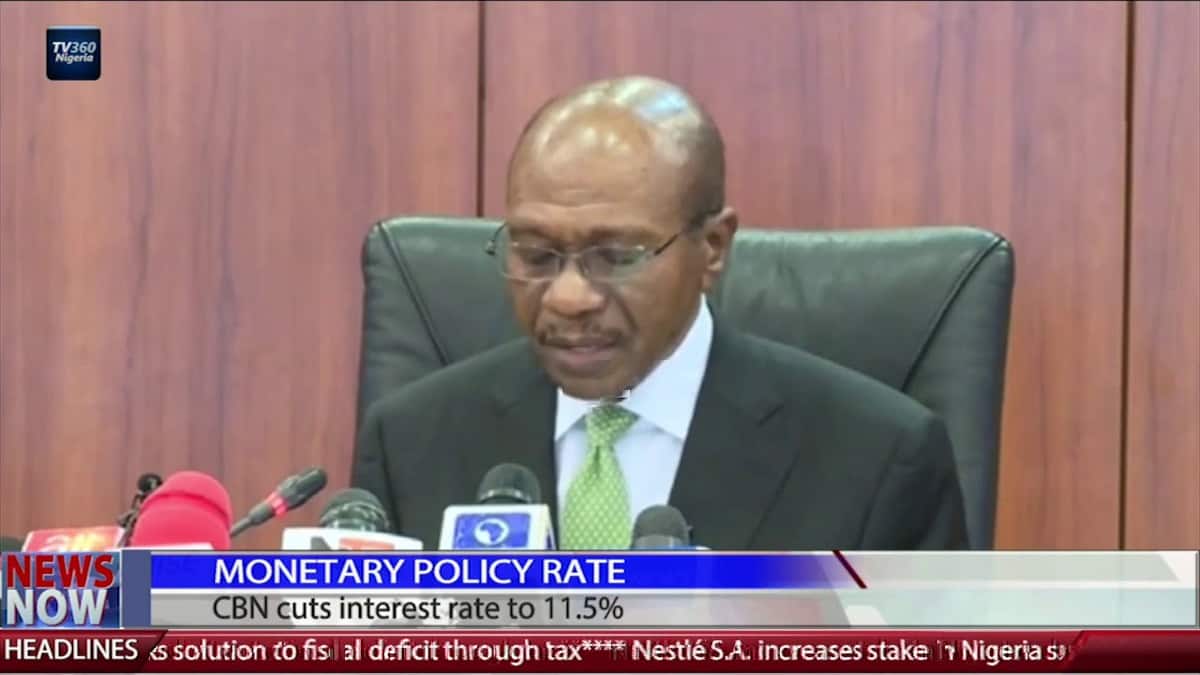
  • CBN Reduces MPR to 11.5%

    CBN Reduces MPR to 11.5%

    The Central Bank of Nigeria (CBN) Tuesday resolved to reduce the Monetary Policy Rate (MPR) by 100 basis points to 11.5 per cent from 12.5 per cent and adjusted the asymmetric corridor to +100/-700 basis points around the MPR.

    The MPR is the rate which the apex bank lends to commercial banks and often determines the cost of funds.

    Addressing journalists at the two-day meeting of the Monetary Policy Committee (MPC in Abuja, the CBN also retained Cash Reserve Ratio (CRR) 27.5 per cent and Liquidity Ratio at 30 per cent.

  • Federal Government Makes a U-turn on Self-Certification Form, Apologizes to Nigerians for Error

    Federal Government Makes a U-turn on Self-Certification Form, Apologizes to Nigerians for Error

    The federal government of Nigeria has announced that the earlier announced self-certification form for all bank owners was a mistake, as the form is not meant to be filled by all Nigerians.

    The official twitter account of the Federal Government of Nigeria had tweeted that all Nigerians should go collect the self-certification form from their respective banks, fill it and submit or lose their bank accounts.

    The now deleted statement reads thus;

    This is to notify the general public that all account holders in Financial Institutions (Banks, Insurance Companies, etc) are required to obtain, complete and submit Self – Certification Forms to their respective Financial Institutions.

    — Government of Nigeria (@NigeriaGov) September 17, 2020

    The statement generated outburst from Nigerians on social media with many asking the question on the need for the form since there is BVN and other biometrics, and why the process has to be analog.

    However, the federal government has made a U-turn on the statement and has apologized stating that the form is not for everyone but certain category of people (reportable persons).

    And here is FIRS’ statement

    They have however stressed that failure to fill the form for all those concerned may lead to the closure of account.

    The form can be accessed on FIRS website.

  • ICRC Dispels Alleged Embankment Collapse in Kainji Dam

    ICRC Dispels Alleged Embankment Collapse in Kainji Dam

    The Infrastructure Concession Regulatory Commission (ICRC) has assured that the integrity of Kainji Dam remained intact following reports of an alleged embankment breach.

    The Director-General/Chief Executive, Infrastructure Concession Regulatory Commission (ICRC), Mr Chidi Izuwah, who disclosed this added that the facility is “operating flawlessly and injecting lowest-cost power to the national grid”.

    The ICRC boss described recent reports about a possible dam collapse as “fake news” adding that “Kainji Dam has one of the most sophisticated real-time inflow prediction and reservoir basin management systems.”

    In a statement, he said, “We inform the public that Kainji is safe and advice them to ignore the fake news. We advice all Nigerians to please kindly check status of our PPP and concession projects on the ICRC disclosure portal or directly with the Commission.”

    Izuwah said during the commission’s last compliance monitoring visit to the dam before the emergence of COVID-19, all aspects of the dam were inspected and appropriate function tested.

    He said: “We thoroughly inspected the Dam Crest, Reservoir, Embankment Rip Rap, Dam Toe, Toe Drain, Piezometers, Spillway, Stilling Basin, Power House etc.

    “Furthermore, Kainji has one of the most sophisticated real-time inflow prediction and reservoir basin management systems. This computer-based system with feeder monitors on the upstream and downstream stretches is designed to ensure world-class hydraulics flow management for dam, upstream and downstream safety management.

    “It’s important to inform Nigerians what an embankment collapse means and its implications. Kainji dam impounds over 16 billion litres of water. Embankment collapse means the dam structure is breached, leading to loss of containment of the impounded water.”
    According to him: “Embankment collapse will result in what is called a dam break wave. Most empirical hydraulic models will show that everything probably some decent distance on both banks of the Niger from Kainji dam location to the sea will be washed away.

    “This will probably be the biggest disaster to hit Nigeria since the turn of the century – destructive power of water. A dam break wave is very similar to a Tsunami wave but is not of seismic origin. We are not sure any person would  wish his or her country this.”

    He, however, noted that as part of the federal government’s power sector reforms initiatives, Kainji Hydropower Facilities were concessioned to Mainstream Energy Solutions.

    He said Mainstream’s responsibility included safe custody of the entire dam structure and appurtenances adding that ICRC being the statutory agency responsible for pre and post contract regulation of PPPs and concessions had continued regular technical and other compliance monitoring of the Kainji concession.

  • FIRS Attributes Improved Non-oil Revenues to Tax Reforms

    FIRS Attributes Improved Non-oil Revenues to Tax Reforms

    The Executive Chairman, Federal Inland Revenue Service (FIRS), Mr. Muhammad Nami said the service has continued to record a significant increase in collectable tax revenue from the non-oil sector of the economy despite the global economic crisis occasioned by the COVID-19 pandemic.

    He attributed the increase in non-oil sector receipts to reform measures introduced by the FIRS board and management since inception as well as the renewed vigour in the service workforce.

    Speaking when members of the board paid a courtesy call on the Minister of Finance and National Planning, Mrs. Zainab Ahmed, Nami said non-oil tax receipts had consistently contributed between 75 per cent and 90 per cent of total tax revenue in recent months.

    He said out of N490 billion collected by the service in July, only N52 billion was from the oil sector as non-oil receipts accounted for the bulk of the revenue.

    In a statement issued Thursday by the Director, Communications and Liaison Department, FIRS, Dr. Abdullahi Ismaila Ahmad, the FIRS boss, however, commended the minister for her support to the board since their inauguration earlier in the year and solicited closer working relationship between the service and her ministry.

    Ahmed, however, commended the FIRS for working to limit the disruptive impact of COVID-19 on government revenue through proactive and bold reforms and noting that this had made it possible for the three tiers of government to receive their monthly statutory allocations from the federation accounts.

    The minister specifically observed that Value Added Tax (VAT) and stamp duties receipts had boosted government revenue despite the pandemic.

    She also promised to continue to support the service, urging it to work harder towards diversifying government revenue sources further away from the dependence on oil.

  • FG Moves to Review Outdated Treasury, Accounting Documents

    FG Moves to Review Outdated Treasury, Accounting Documents

    The Federal Government of Nigeria on Thursday, September 9, 2020, said it has commenced a comprehensive review of treasury forms and other accounting source documents that are in use in all Federal Ministries, Department and Agencies (MDAs), in Nigeria.

    The Accountant General of the Federation (AGF), Mr. Ahmed Idris, who disclosed this said that the contents of the treasury forms and other accounting source documents in use were no longer relevant and useful to drive the various public finance management reforms of the Federal Government, which are mostly ICT-driven.

    He noted that the review was in the exercise of the mandate of the AGF under FR.107 (n) to issue officially approved forms bearing treasury numbers for use in all to ensure uniformity.

    Ahmed had earlier inaugurated an inter-ministerial committee to handle the review.

    He said the committee was expected to identify all treasury forms and accounting source documents presently in use and come up with new formats in line with the public finance reforms.

    Suggested Read: The Need To Document Corporate Entrepreneurial Experiences For Future Studies

    The committee will also recommend additions or deletions of the contents; assign relevant number systems to the treasury forms and review the documents in line with GIFMIS operations.

    In a statement by the Director of Information, Press and Public Relations, Mr. Henshaw Ogubike – the AGF further stressed that in carrying out the assignment, the committee should be guided by the federal government’s quest for adoption of e-governance at all levels.

    He also endeared them to note that the fact that all the public finance reforms initiatives being driven by the treasury are predicated on a full deployment of ICT solutions.

    According to the AGF, a comprehensive review and update of these accounting source documents became imperative for an efficient and successful implementation of governments financial management reforms.

    He reiterated the governments resolved to ensure a successful review of the documents and charged the committee to give the assignment all amount of seriousness it deserves and delivers on time.

  • MSME Survival Fund and Guaranteed Offtake Scheme

    As a part of the federal government plan to sustain Micro, Small and Medium Enterprises most affected by the Covid-19 pandemic, President Buhari approved N60B for the MSME Survival Fund and N15B for the Guaranteed Offtake Scheme. 

    These two initiatives are to stabilize and help micro, small and medium businesses pay employees, which will, in return, save existing jobs, and also increase employment opportunities.

    Note: If you are more interested in the Nigerian Youth Investment Funds (NYIF), go to: https://experts.ng/blog/nigerian-youth-investment-fund-opens

    MSME Survival Fund and Guaranteed Offtake Scheme are a part of the N2.3trn stimulus package of the Nigerian Economic Sustainability Plan (NESP).

    The Nigerian Economic Sustainability Plan was set up by the Federal Government to combat negative economic impacts of the Covid-19 pandemic.

    Suggested: 22 Verified FG & International Grants for Small Businesses in Nigeria

    Related: Nigerian Youth Investment Fund

    MSME Survival Fund

    The MSME survival fund is not a loan, but a conditional grant given to Micro, Small and Medium Enterprises to retain employees and save employment. 

    The Federal Government is targeting to save over 1.3 million jobs nationwide and to impact over 35,000 people per state directly.

    Read: Sources of Funding for Small Business Owners in Nigeria

    Duration of the fund:

    This initiative is to provide immediate relief to businesses for three months.

    Beneficiaries of the fund:

    The focus of the MSME Survival Fund is to help two groups of people: MSMEs and self-employed individuals. 

    Both the MSME Survival Fund and Guaranteed Offtake Scheme have made provision of a 5% special need and 45% female business owners.

    Registration Steps and Requirements

    Requirement for Registration

    To register, you must be the Founder/Proprietor/Administrator of the MSME that you are trying to register.

    Register your personal details to start the payroll support application. Instructions at the top of the form will guide you on the required fields that need to be filled to complete the initial registration.

    On registration, an activation code would be sent to your phone and also your email to enable you to activate your account. On successful activation, you would be asked to log in to your account where you would see your registration progress and other profile details.

    Step 1 – Personal Registration

    Step 2 – Register Your Organization

    Note: You must register for your unique SMEDAN Unique Identification Number (SUIN) and you would need to fill in the details of your employees, but unfortunately, that form is not available until October 1, 2020.

    Guaranteed Offtake Scheme

    While the goal of the MSME Survival Fund is safeguarding employment, the Guaranteed Offtake Scheme is to protect and sustain Micro and Small Enterprises’ income from the adverse effects of the Covid-19 pandemic. 

    This scheme will birth various initiatives geared towards boosting production capacities of micro and small businesses.

    Duration of The Guaranteed Offtake Scheme

    This scheme is to last for a period of 3 months.

    Beneficiaries of the Fund

    MSMEs registered in Nigeria

    Features of the MSME Survival Fund and Guaranteed Offtake Scheme 

    Payroll Support: For a period of 3 months, 500,000 MSMEs affected by the Covid-19 pandemic will be supported with N30, 000 – N50,000 per employees to pay their staff.

    Free Business Registration: 250,000 new small businesses will be provided with free CAC business name registration.

    General Grant: 100,000 MSMEs affected by Covid-19 are to be granted N50,000 each survival grant.

    Operations Grant: 333,000 transport business operators and artisans will be provided with N30,000 each to make up for their income loss during the Covid-19 pandemic.

    Guaranteed Offtake Scheme: The federal government will bulk purchase products from over 100,000 businesses to keep these small businesses functioning and save jobs.

    Conditions for Applicants 

    1. Must be Nigerian owned business

    2. Business must be registered with the CAC

    3. Business must have more than 3 paid employees

    4. The CEO must have BVN

    5. Self-employed individuals include the following:

    A. Transportation business operators like Uber drivers, Bolt drivers, bus drivers, Taxi drivers

    B. Artisans like electricians, bricklayers, plumbers, etc.

    Visit www.survivalfund.ng or https://www.survivalfundapplication.com/ for registration details

    Note: Please ensure you register your business at www.smedanregister.ng before applying for the payroll support fund.

    What is the Take Off Date of the SME Survival Fund

    The take-off dates of the SME Survival funds have been scheduled based on the categories of the intending beneficiaries. They are as listed in the photo attached.Dates for SME survival funds

    What is the address of the SME Survival funds Portal

    The address of the SME Survival funds portal is www.survivalfund.ng. But please ensure that you register your business at www.smedanregister.ng before applying for the payroll support fund.

    Note: If you are more interested in the Nigerian Youth Investment Funds (NYIF), go to: https://experts.ng/blog/nigerian-youth-investment-fund-opens

    RECOMMENDED:

    Loans Without Collateral in Nigeria – ExpertsNG

  • MTN trains 10000 SMEs on smart marketing

    MTN Nigeria has equipped locally owned small businesses with skills on sales and marketing in a training featuring leading industry experts, as part …Read More

  • The Nigerian Youth Investment Fund

    The Nigerian Youth Investment Fund

    The percentage of unemployed Nigerian youth rose to almost 14% according to the International Labour Organization. There’s no denying that Nigerian youths are hardworking, innovative, skilled, enterprising, and talented, but many obstacles hinder them from optimizing their full potentials.

    Among the significant reasons for the increase in the unemployment rate is the lack of funding. Many Nigerian youths have amazing ideas that won’t only create employment opportunities for themselves, but for other youths as well.

    Funding is an essential resource for any enterprise, a crucial aspect of building and sustaining a business for growth and maximum profitability. Luckily, there are several available sources of funds for small business owners in Nigeria.

    Considering the high-interest rates charged by Nigerian banks, business owners – startups and small businesses, find it hard to raise the required funds to get their businesses off the ground, especially within Nigeria – Sources Of Funding For Small Business Owners in Nigeria.

    The federal government of Nigeria in her efforts at meeting the demands of the Nigerian youth for a simplified, SME friendly source of business funds for youths have decided to create the Nigerian Youth Investment Fund.

    Criteria for Applying for the Nigerian Youth Investment Fund 

    To apply for the Nigerian Youth Investment Fund, applicants must meet the following requirements:

    1. Applicants must not be less 18 years or older than 35 years.
    2. National ID card, INEC registration card or international passport
    3. Bank Verification Number (BVN)
    4. The idea must be economically viable
    5. Graduate applicants must have completed NYSC
    6. Non-graduates must have a form of identification
    7. Provide one guarantor
    8. The entrepreneur must have a company that is registered with the CAC
    9. Applicants must have a well-structured business plan that shows the following:
      • Overhead cost
      • Projected Profit margin
      • Target market
      • Business goals

    Suggested: 5 Mentalities Nigerian Youth Must Drop To Succeed

    Two Major Reasons for Establishing the Nigerian Youth Investment Fund (NYIF)

    In a bid to increase the employment rate by making funds available to enterprising youths, the Federal Executive Council led by President Muhammad Buhari approved the sum of N75 billion for the establishment of the Nigerian Youth Investment Fund (NYIF) for the next three years on the 22nd of July 2020. 

    Mr. Sunday Akin Dare, the Minister of Youth and Sports orchestrated the memo that led to the establishment of the Nigerian Youth Investment Fund (NYIF). According to Thisday, the Minister informed the Council that “Nigeria can make one quantum leap to increase its GDP dramatically and per capita realities. But such can only happen if the country begins to invest in the youth through the establishment of a specialized fund that provides accommodating pathways to accessing credit, grants and needed funds for entrepreneurship.”

    Youth Bank

    The Nigerian Youth Investment Fund, unlike other government initiatives, is meant to serve as a bank for innovative Nigerian youth. This program is to support and fund ideas, innovations, talents, SMEs, skills, and other enterprising activities through soft loans and credits. From the meeting held by the Federal Executive Council, the Council agreed that the CBN, Ministry of Finance, Budgeting, and National Planning are to source for the needed funds. 

    Increase in Nigeria’s GDP and Per Capita

    Any country that has a thriving economy is a country that has financially empowered the youths. Nigeria’s GDP is where it is today because the youths have been ignored for so long. Innovative ideas struggle to materialize and even when they do, they are often choked by the many challenges of running a business in Nigeria. 

    The provision of funds for entrepreneurs that are willing to start and grow businesses won’t only have positive effects on our economy, but also the society. Positively engaged minds won’t have the time to conceive and perpetuate evil and become menaces to the nation.

    The creation and smooth operation of the Nigerian Youth Investment Funds would truly increase Nigeria’s GDP per capita.

    Per capita gross domestic product (GDP) is a metric that breaks down a country’s economic output per person and is calculated by dividing the GDP of a country by its population – Investopedia

    Some Frequently Asked Questions on The Nigerian Youth Investment Fund (NYIF)

    Suggested: 5 Mentalities Nigerian Youths Must Drop To Succeed