Let’s face things squarely – most small businesses struggle financially, especially in their early stages. This reality begs for knowing what to do if a small business is struggling financially.
Running a small business can be incredibly rewarding but poses numerous challenges, especially when finances become tight. It’s easy for budding entrepreneurs to feel overwhelmed and frustrated when things aren’t going their way financially. Still, there are simple steps that small businesses can take to weather the financial storm. Find out some of these strategies and what to do if your small business is struggling financially.
File for Bankruptcy
Filing for bankruptcy is a difficult decision that small business owners must make when struggling financially. You may see it as a last resort after other strategies to improve the business’s financial health have failed. Bankruptcy may provide some relief, but it also has long-term consequences that you should consider before filing. A bankruptcy lawyer in NJ can help guide you through this process and answer any questions you may have about your specific situation.
When filing for bankruptcy, it is important to understand the types of bankruptcies available and how they can affect your business. Depending on the type of bankruptcy you file for, some or all of your debts could get erased or restructured so that you can make more manageable payments. This could give you a second chance at getting your finances back on track while allowing you to keep your business afloat.
Cut Down the Budget
As a small business, evaluating your expenses and seeing where you can cut back is essential to managing your finances. By taking a closer look at your expenses, you can identify areas where you can save money. In addition to reducing your total expenses, this also helps improve the financial health of your business.
Look for unnecessary costs and consider ways to reduce them, such as negotiating better deals with suppliers or finding cheaper alternatives. Also, ensure you take full advantage of any tax deductions and credits that may be available to your business. Additionally, it may be beneficial to create a budget and stick to it. This can help you avoid overspending in areas where costs are optional.
Negotiate With Your Suppliers
For small businesses struggling financially, negotiating with suppliers for better rates on products and services can be a great strategy. By taking the time to negotiate with your suppliers, you can often get discounts or other incentives that will help reduce costs and increase savings. It’s important to ensure that your negotiations are respectful and professional to maintain a positive relationship with your supplier.
Make sure to research the market for better rates to know what other suppliers offer when negotiating. Also, consider offering long-term contracts or increased volume purchases in exchange for discounts and other benefits. In this way, your small business can often get favorable terms from its suppliers to help reduce costs and improve profits.
Set Up a Payment Plan With Your Creditors
If a small business is having trouble making ends meet, setting up a payment plan with creditors can be an effective strategy for managing financial struggles. A payment plan allows the business to restructure its debt payments to make them more manageable.
This could involve extending the loan term and lowering monthly payments or converting all or part of the debt into a lump sum payment at the end of the term. It is important to communicate clearly and openly with your creditor to ensure the arrangement is mutually beneficial and that all parties are on the same page.
Seek Out Funding From Grants or Investors
For small businesses struggling financially, seeking out funding from grants or investors can be a great strategy to help keep the business afloat. Grants and investor funds can provide much-needed capital to cover expenses, hire additional staff members, purchase more inventory, or upgrade technology.
Additionally, these funding sources often come with other advantages, such as mentorship opportunities and access to networks of potential customers or partners. However, applying for grant money or pitching your business idea to investors is no easy task — it requires a lot of research and preparation to make a good impression.
The current state of the economy is affecting everyone, even small businesses. If your business is struggling financially, there are steps you can take to improve the situation. Review your expenses and make cuts where necessary. Consider alternative financing options such as government loans or venture capitalists. Small businesses can overcome financial struggles and come out stronger on the other side by taking quick and decisive actions.
The growth of women-owned businesses in Nigeria has been a major development in the Nigerian economy, and it is an encouraging sign of the possibilities for Nigeria’s entrepreneurs.
Women-owned businesses are increasingly important in developing the Nigerian economy and in the empowerment of Nigerian women generally. Women-owned businesses undoubtedly provide an essential economic contribution to society and are a crucial driver of growth.
Unfortunately, female entrepreneurs’ unique challenges can make it difficult to build resilience in female owned businesses and keep the business afloat during difficult times.
Building resilience is critical to ensure the success and potential of these businesses. Being resilient can help female-owned enterprises not only survive during tough times but also grow and thrive.
This blog post will explore the current landscape of women-owned businesses in Nigeria, the challenges they face and the potential for future growth. We will look at the range of opportunities available to women entrepreneurs and their businesses’ impact on the country. We will also look at the role that government, private sector, and civil society can play in supporting and promoting women-owned businesses in Nigeria.
We will explore the key strategies that female entrepreneurs can use to build resilience in their businesses. We will look at the importance of having a well-defined business plan with achievable goals, leveraging existing resources and networks, and managing risks effectively. We will also discuss best practices for developing a resilient mindset and developing the right attitude to tackle challenges head-on. By following these tips and strategies, female entrepreneurs can build strong, resilient businesses that can withstand any challenge.
Get to know yourself and your values
Knowing yourself and your values is the foundation of building resilience in any business. It is important to understand who you are, what you’re capable of, and what you need to succeed. Start by asking yourself questions about your strengths and weaknesses, what motivates you, and what drives you. Then, identify your values and determine how they impact the decisions you make in your business. When you have a clear understanding of yourself and your values, you can develop better strategies for navigating the challenges of owning a business and build a more resilient business.
Create and maintain a support system
Building resilience in female-owned businesses is an important aspect of success. One way to do this is to create and maintain a support system. This support system should be made up of trusted individuals who can provide guidance, encouragement, and resources. These people can become a source of strength in times of adversity and can help entrepreneurs stay focused on their goals. Resources available through this system may include mentorship programs, networking activities, and other forms of support. It is important to remember that having a strong support system is key to staying resilient in the face of challenging times.
Increase self-awareness and practice mindfulness
A key factor in developing resilience in female-owned businesses is increasing self-awareness and practicing mindfulness. Self-awareness is the ability to recognize and understand our own emotions, thoughts, and behaviors and how they affect our lives. Practicing mindfulness can help us to recognize our feelings, thoughts, and behaviors and to respond to them in a more productive and healthy way. Mindfulness can help us become more aware of our own thoughts, feelings, and behaviors so that we can make better decisions and take effective action. It can also help us to develop self-compassion and understanding for ourselves and for others.
Prioritize your physical and mental health
As a female business owner, taking care of your physical and mental health is a top priority. This means eating healthy, exercising regularly, and getting adequate sleep. It also means taking regular breaks, taking time to relax and engage in self-care activities, and seeking support from friends and family. In addition, be sure to make time for mental health activities such as mindfulness, meditation, and journaling. Establishing a healthy routine for yourself will help you build resilience and create a strong foundation for your business.
Develop a growth mindset
Resilience is key to success for any female-owned business, and one of the most important ways to build resilience is to develop a growth mindset. A growth mindset means having a positive attitude towards change and tackling challenges head-on. It’s about understanding that failure is part of the process and not something to be feared. It’s about adopting an attitude of learning, to help you develop skills and knowledge to make you better equipped to face future obstacles. To cultivate a growth mindset in your business, focus on developing an attitude of learning, taking risks, and accepting failure as part of the journey.
In short, resilience is an essential tool for female-owned businesses to succeed. With proper planning, support networks, and self-care, female business owners can face any challenge and emerge stronger than ever. Building resilience should not be viewed as an extra burden, but rather an opportunity to grow, adapt, and ultimately thrive.
As the economy continues to evolve and technology advances, investing in 2023 is becoming increasingly complex. With so many options available, knowing where to start and how to maximize your investments can be difficult. To help you stretch your dollar further, below is a list of eight unique ways to expand your investments in 2023.
1. CryptoCurrency Trading
While volatile, cryptocurrency trading has become increasingly popular in recent years. Some of the most popular cryptocurrencies include Bitcoin, Ethereum, and Litecoin. Cryptocurrencies are digital or virtual tokens that use a code to ensure their transactions and to limit the number of new units.
Cryptocurrency trading typically involves speculating on the price of these tokens in the hopes of making a profit. To trade cryptocurrencies, you must set up a digital wallet and purchase some tokens with traditional currency. Cryptocurrency trading can be a high-risk endeavor but can also lead to high rewards.
2. Angel Investing
This is a type of private equity investment. An angel investor is an individual who provides financial backing for small startups or entrepreneurs. Angel investing is often seen as riskier than traditional equity or debt financing, but it can also offer greater rewards. Startup companies are often unproven and may have limited track records.
As a result, angel investors typically expect to receive a higher return on their investment than they would from a more established company. However, if the startup is successful, angel investing can also offer the potential for large profits.
3. Business Incubators
This describes an organization that helps new businesses get started by providing workspace, resources, and mentorship. Business incubators typically work with early-stage companies seeking to commercialize new products or services.
The incubator provides these companies with the resources they need to grow and succeed, such as office space, funding, and access to networks of mentors and investors. Business incubators have become increasingly popular in recent years as a way to support the growth of new businesses.
4. Real Estate Crowdfunding
Real estate crowdfunding is an investment that allows multiple investors to bring their money together to purchase a property. Real estate crowdfunding platforms facilitate these investments by allowing investors to connect with projects online. These platforms typically charge a fee in exchange for this service.
Real estate crowdfunding can offer investors the opportunity to get involved in projects they might not otherwise have access to. It can also provide diversification for an investment portfolio and the potential for high returns if the property is successful. However, real estate crowdfunding can also be risky, so it is important to do your research before getting involved.
5. A Venture Capital Fund
A venture capital fund is an investment pool that draws from multiple investors and puts money into early-stage companies. Professional investors typically manage venture capital funds using their expertise to identify promising startups with high growth potential. Venture capital funds can offer investors the chance to get in on the ground floor of potentially successful businesses and also provide diversification for their investment portfolios.
6. Collectibles
This investment involves buying and selling collectable items such as coins, BYU digital collectibles, art, antiques, or other rare items. Investing in collectables can be a hobby as well as an investment. Collectables are typically bought for their potential future value rather than their current value. The value of a collectable item is usually determined by factors such as its scarcity, condition, historical importance, and desirability among collectors.
7. Precious Metals
Precious metals have been prized since ancient times for their rarity and beauty. These days they are also popular investments due to their potential for hedging against inflation and currency devaluation.
Investing in precious metals is a safe way to diversify your portfolio and protect yourself from market volatility. Investing in precious physical metals is one option, but you can also invest in ETFs that track the price of precious metals without owning the metal itself.
8. Airbnb Investing
Airbnb investing is a real estate investment where investors purchase properties that can be rented out on Airbnb. This investment can provide investors with a steady income from rental income and potential capital appreciation over time.
However, you need to know the risks involved in Airbnb investment, such as property damage, tenant turnover costs, and potential legal issues with local zoning regulations. It is also important to research before getting involved to ensure you know what you’re getting into.
Conclusion
There are many unique ways you can expand your investments in 2023. From investing in cryptocurrency to real estate crowdfunding and collectibles, a wide range of options available can provide diversification for your portfolio and the potential for high returns. However, it is important to research before getting involved in any investment to ensure that you understand the risks involved.
Data analysis is an essential tool for businesses. It helps business managers and owners to understand their operations to grow and succeed. It is a powerful way of understanding how a business performs and what areas need improvement. It is a valuable tool for businesses to look into the areas that are working well, as well as areas that may need some extra attention. When used correctly, data analysis can be a great asset to any business. It can help identify trends, highlight issues, suggest opportunities and inform decisions.
Data analysis can help businesses in various ways. It can provide insights into customer behaviour, marketing campaigns, and website usage, to name a few. It can also be used to analyze financial and operational performance. By using data analysis, businesses can gain a complete understanding of their customers, operations, competitors and the wider environment.
Without a doubt, Data Analysis is a cost-effective way to gain insights on various topics. It can help businesses make better decisions, leading to improved performance and growth.
In this blog post, we will try to take a deep look into how Data Analysis can be used to enhance business growth.
1. Collecting and analyzing data in Data Analysis
Data analysis is a tool that enables businesses to make better decisions, identify trends and opportunities, and measure performance. By collecting and analyzing data, businesses can gain insights into customer behaviour, performance, operations, and more.
Collecting data can be done in various ways, such as through surveys, interviews, focus groups discussions, customer feedback, and website analytics. Once collected, the data can be organized and analyzed using a variety of software applications and techniques, such as statistical analysis, predictive analytics, and machine learning. By understanding the patterns in the data, businesses can take action to improve their operations, optimize customer experiences, and reach their growth goals.
2. Identifying trends and correlations
Data analysis is a powerful tool for business growth, and one of its most effective aspects is the ability to identify trends and correlations. By analyzing data, business owners can quickly spot meaningful relationships between different pieces of data that could be used to inform decisions. For example, by correlating sales data with customer demographics, businesses can identify customer segments they should target with certain products or services. Identifying trends is also important for spotting changes in customer behavior, competitive landscape, and broader economic conditions. By recognizing patterns in data, businesses can anticipate changes and adjust their strategies to adapt and stay ahead of the competition.
3. Setting measurable goals
Creating measurable goals is an important step when it comes to business growth. It allows you to track your progress and set objectives that you can work towards. By setting goals, you can measure your progress and determine if you are on the right track. In addition, having measurable goals encourages you to be proactive and take concrete steps to reach your objectives. When setting goals, be sure to make them specific, achievable and time-bound. This way, you can easily track your progress and adjust your course of action as needed. Additionally, setting measurable goals allows you to clearly identify what success looks like for your business and develop a roadmap for achieving it.
4. Making informed decisions
Making informed decisions is the ultimate goal of data analysis. With the insight gained from data analysis, businesses can make decisions that are more informed and better suited to their current and future needs. Data analysis helps businesses to make better decisions by providing them with a comprehensive understanding of the data, allowing them to identify patterns, trends, and correlations, as well as potential risk factors. This information can then be used to inform decisions such as where to invest resources, how to adapt to changing market conditions, or which products to bring to market. By leveraging data analysis, businesses can make decisions that are more informed, more accurate, and more profitable.
5. Tracking progress over time
When it comes to data analysis as a tool for business growth, tracking progress over time is essential. It allows you to assess how well your strategies are working and identify what strategies need to be adjusted or replaced. Tracking progress over time also provides an opportunity for you to measure the impact of your decisions, and it allows you to identify any potential roadblocks that may be preventing your business from making progress. In addition, tracking progress over time helps you to develop more informed and accurate forecasts based on the data you have collected.
In conclusion, data analysis is a powerful tool that can help businesses gain a competitive advantage. By leveraging the insights gained from data analysis, businesses can make informed decisions, identify new opportunities, and optimize their operations. This can lead to improved customer engagement, higher customer satisfaction, and ultimately, increased profits. Moreover, businesses can use data analysis to develop more effective strategies and gain a better understanding of their customers, which can help them stay ahead of the competition.
Healthcare boards are responsible, among other things, for guaranteeing that management and finance teams work smoothly while pursuing profit-oriented goals. Healthcare companies must have robust and reliable financial planning plans and processes to succeed and offer excellent healthcare to their clients.
Finance specialists provide senior executives with bookkeeping and other financial details to make good decisions and manage internal and external expenditures. Healthcare finance managers have an essential role in helping providers produce enough money to pay for their expenditures and plan for their future growth.
Careful Evaluation and Planning
Start by evaluating your current financial position and your general financial health. A careful plan allows you to make solid plans for the future.
Their careful planning enables them to think about the future. For example, let’s imagine that an out-of-town health center was losing patients to a nearby clinic due to obsolete and slow technology. In this case, you’ll have to conduct a hospital denial management process.
Generating Income
Investing in assets to ensure long-term financial viability is another goal of financial management. Financial managers regularly assess the costs of medical services to match market rates to earn income and remain competitive. They also assess the efficiency of several hospital sections.
You may also want to consider launching new services to generate revenue. A cannabis dispensary, for example, might be a new source of revenue for some healthcare organizations that also provides a means of ensuring that the substance is legal and safe to be given.
The health care financial manager prepares a proposed new project if the top management approves it. This proposal includes information on the expenses of starting it, funding options, and annual profit estimates.
Protecting Tax Status
State and federal governments can obtain additional cash when a nonprofit group loses its tax-exempt privilege. Commitment to tax-exempt rules and regulations is, thus, essential for health care top management.
Cutting prices for destitute clients is one technique healthcare providers employ to support their status as nonprofit companies. Some organizations conduct a community-specific needs analysis and create strategies to meet those needs. A second method is to construct nursing schools in underserved areas and charge low tuition prices to increase the number of qualified nurses.
Monitoring Internal Spending
To prevent fraud and waste, healthcare finance managers keep a close eye on every dollar spent. Specialists have a significant impact on healthcare spending. A patient’s demands might not be considered when a purchase order is placed, which could lead to legal problems for the organization.
To guard against fraud and the misuse of funds, finance managers set up special committees to undertake monthly audits on all purchases of pharmaceuticals and equipment. A healthcare provider can be disciplined following its regulations or federal fraud and abuse statutes if there is proof of fraud in the physician’s practice.
Influencing Third-Party Payers
Third-party payers, such as health insurers, may pay all or a portion of a patient’s medical expenditures. The insurance industry is profit-oriented, and it’s customary for them to seek reductions when they insure many customers. Healthcare finance managers are responsible for negotiating reasonable rates to ensure that most patients are retained while still receiving the proper reimbursement. By structuring the highest applicable contracts with third-party payers, healthcare financial management teams help hospitals avoid the financial risks involved with engaging in pacts payers.
Long-Term Investment Decisions
Investing for the long term is essential for the long-term health of organizations. When it comes to meaningful investment choices, financial teams typically take the lead, with participation from all levels of management. Various investments are analyzed to see how they might affect their financial future utilizing their knowledge and experience.
If they need to upgrade their software, the financial team will have to figure out the cost and if or not it would bring in more patients or save the company money elsewhere.
Financing
Finance managers must also raise money to cover their expenses. They do this by raising money, taking out loans, or relying on resources. For them to make the right decision, they have to consider both short- and long-term costs and benefits. A specialist may be hired to help evaluate what’s needed, how much it’ll cost, and how to fund it. The senior management usually makes the ultimate option.
Working Capital Management
Working capital can be determined by getting the difference between your current assets and liabilities. This could be cash, liquid assets, or liabilities, or it could be the company’s stock. Organizations can cut expenses while improving efficiency by adequately managing their capital.
Bottom Line
This article has explained different tips for navigating finances for health care needs. From this, we hope you can start your journey on the right foot.
Businesses don’t just fail, they fail after they have given off certain pointers that most business owners either ignore or are not equipped enough to see.
Like in life, however, we must learn from our mistakes and know that there is no such thing as failure; we fail only when we give up.
Entrepreneurship and risk-taking are ‘synonymous words’ – and business failure happens when business owners are unable to mitigate company-specific risks while simultaneously bringing a product or service to the marketplace at a price point that meets consumer demand levels.
Studies show that many businesses don’t exist for more than one year, some last five years and others, ten years. This may be due to an over-confident knowledge-of-the-market point of view that the business owner assumes or otherwise.
To avoid being in the statistic, business owners – or intending owners – need to understand the reasons why businesses fail, and how each challenge or crisis can be managed or avoided altogether.
Financial hurdles – This is one of the major reasons why businesses fail because the owners start without proper funding.
Mis-management – if a business insists on retaining inadequate management team, a pattern will be created and it may lead to business failure.
Ineffective business planning – businesses fail because the owners don’t prioritise effective business planning.
Misplaced marketing campaigns – Business owners often fail to prepare for the marketing needs of a company in terms of capital required, prospect reach, and accurate conversion-ratio projections.
Lack of personal growth – business owners cannot stop learning once the business has launched. They need to invest in themselves.
Lack of a solid system and structire – As an entrepreneur, the best way you might have a chance of claiming back your life while building a successful business is to set up effective processes, systems, and structures.
Financial hurdles
Another major reason why businesses fail has a lot to do with financial management.
Working capital or lack of capital should be an indispensable conversation when setting up a business. Many times, business owners understand how much is spent on daily operations, including funding payroll, paying fixed and varied overhead expenses, such as rent and utilities; and ensuring that outsourced tasks are well-funded.
However, owners of failing companies are less in tune with how much revenue is generated by sales of products or services. This disconnect leads to funding shortfalls that can quickly put a small business out of operation.
Business owners also fail to prioritise financially effective pricing on products and services. Many times, to beat the competition, small business owners take the price far lower with the intent to entice customers. While this is successful in some cases, businesses that end up closing their doors are those that keep the price of a product or service too low for too long. When the costs of production, marketing, and delivery outweigh the revenue generated from new sales, small businesses have little choice but to close down.
How to avoid this problem?
Business owners should learn to be realistic with their budget and be willing to fund the business from their pockets during the startup or expansion phase. Also, business owners should research and secure multiple financing options before funding becomes a problem. When the time comes to obtain funding, business owners should already have a variety of sources they can tap for capital.
Mis-management
Business owners are usually the only senior-level person in a company, especially if the business just launched operations. And, while the owner may have the skills necessary to create and sell a marketable product or service, there may exist a lack of attributes of a strong manager, which should exist since there are other people in the business to manage.
How to avoid this problem?
The business owner can outsource activities where is a lack of skills or time. A strong management team is one of the first additions a small business needs to continue operations well into the future. It is important for business owners to feel comfortable with the level of understanding each manager has regarding the business’ operations, current and future employees, and products or services.
Ineffective business planning
Small businesses often overlook the importance of effective business planning prior to launching. A sound business plan should include, at a minimum:
A clear description of the business
Current and future employee and management needs
Opportunities and threats within the broader market
Capital needs, including projected cash flow and various budgets
Marketing initiatives
Competitor analysis
Challenges are unavoidable, but business owners who fail to address the needs of a well-laid out plan before launching will meet bigger challenges than they can take. Also, a business that does not regularly review an initial business plan—or one that is not prepared to adapt to changes in the market or industry—meets potentially insurmountable obstacles throughout the course of its lifetime. Lack of planning is one single reasons why businesses fail.
How to avoid this problem?
Entrepreneurs should avoid scenarios that lead to reasons why businesses fail by having a solid understanding of their industry and competition before starting a company. A company’s specific business model and infrastructure should be established long before products or services are offered to customers, and potential revenue streams should be realistically projected well in advance.
Misplaced marketing campaigns
These are two problems with the same name. Many times, business owners fail to prepare for the marketing needs of a company in terms of capital required, prospect reach, and accurate conversion-ratio projections. When companies underestimate the total cost of early marketing campaigns, it can be difficult to secure financing or redirect capital from other business departments to make up for the shortfall.
If you can effectively put the required work into your marketing campaign, you would have perhaps avoid another major reasons why businesses fail.
How to avoid this problem?
Business owners need to have realistic projections in terms of target audience reach and sales conversion ratios. Businesses that do not understand these aspects of sound marketing strategies are more likely to fail than companies that take the time to create and implement cost-effective, successful campaigns.
Because marketing is a crucial aspect of any early-stage business, it is necessary for companies to ensure that they have established realistic budgets for current and future marketing needs. Also, companies need to understand the totality of the market before they launch – the target audience, how they behave, how they view the business, their changing needs.
Lack of personal growth
Many entrepreneurs do not invest in themselves. They do not read nor research, neither do they attend seminars and workshops that can increase their knowledge base.
Personal development of your attitude and communication skills is a must. It is hard work and it takes discipline. You will have a hard time succeeding without protecting and working on your attitude. No one gets ahead in life without building themselves with new knowledge.
Conclusion
Remember, businesses don’t just fail, they fail for several reasons that in most cases we have noted but fail to work on. To ignore signs of reasons why businesses fail is to sign the death warrant for your business.
Accessing loans is one of the major necessities in Nigeria.
To get an idea of what sort of loans are available in Nigeria, we decided to find out what funding options are available in the country. We conducted a search on various finance websites and compiled our best picks into this post.
There are so many organisations that grant loans in Nigeria. Some of these organisations are either owned by the Government or owned by private individuals.
This article lists the very functional, top 50 organisations in Nigeria that give loans out.
The Bank of Agriculture is a Nigerian government-sponsored bank that provides loans, credits, and other forms of funding for farmers and farming businesses.
They provide products and services such as Agro-processing facilities, Export finance facilities, and many others. They can award loans up to NGN 5 million Naira, and their interest rate is between 7% and 21%.
The Bank of Industry Limited (BOI) is Nigeria’s oldest, largest and most successful development financing institution. It was reconstructed in 2001 out of the Nigerian Industrial Development Bank (NIDB) Limited, which was incorporated in 1964. The bank took off in 1964 with an authorized share capital of 2 million (GBP).
The BOI’s core mandate is to provide financial assistance for the establishment of large, medium and small projects as well as the expansion, diversification and modernisation of existing enterprises; and rehabilitation of existing ones.
Once you meet its requirements, accessing loans from the BOI is not so cumbersome, the BOI is one of the best sources of funds available to Nigerian businesses.
Development Bank of Nigeria (DBN)
The Development Bank of Nigeria (DBN) was conceived by the Federal Government of Nigeria (FGN) in collaboration with global development partners to address the major financing challenges facing Micro, Small and Medium Scale Enterprises (MSMEs) in Nigeria.
As the name implies, this bank disburses loans to SMEs. DBN loans can be accessed through PFIs, which include Commercial Banks, Microfinance Banks, Development Finance Institutions (DFIs) and other Financial Institutions.
DBN loan repayment tenure is flexible (up to 10 years with a moratorium period of up to 18 months) and the interest rates are on a market-conforming and fully financially sustainable basis.
How to get a DBN Loan
You can access the DBN loan through any of these Participating Financial Institutions (PFIs) by contacting any of the banks listed below:
The NEXIM Bank is mandated to help provide loans to facilitate export goods and services from Nigeria. Only Business owners and organisations related to exporting activities are required to access loans at the bank. NEXIM Bank provides products like direct lending, foreign input, local, and other related services
SMEDAN is charged with granting loan access to MSMEs; it provides schemes such as the commercialisation empowerment initiative, conditional grant scheme and other empowerment schemes for growing business owners.
It was the middle of February 2021, the Nigerian central bank placed a ban on the use and trade of cryptocurrencies in the country. Identified as the second largest “Bitcoin market” after the US, trading no less than $600 million in the last 5 years (Deutshe Welle, 2020) this singular action was received with a mixture of anger and despair as trading cryptocurrencies has become a source of income for many Nigerians amidst the troubled economy. In the summer of 2020, Nigeria’s interest in bitcoin trading piqued and it became a very attractive investment option.
This was not the first time the CBN moved to control the use of cryptos, the apex bank also asked banks to identify and report individuals and entities trading cryptos within their systems. All of a sudden even people that had never heard about cryptos (especially the younger generation) began to ask questions, they wanted to know more and they even wanted to begin to invest. With no central place to get authentic information, and the national concerns about volatility, fraud and the concept of decentralization, they turned to successful crypto investors, many of whom had no formal knowledge about cryptocurrencies, and learned how to trade mostly on their own.
The Nigerian government also had its concerns about its volatility, fraud and the volume of trade going on, an estimated $4billion (BBC News, 2021) and the impact a loss like that could have on the economy. Nigerians have fallen prey to several Ponzi schemes and the reality is that at almost every point in time, there is at least one scheme that is active and that Nigerians are actively investing in. Cryptocurrency trading was also labelled a Ponzi scheme by the majority of the population who still don’t understand how anyone could invest in anything that was “invented” by an anonymous person and owned by no one in particular.
My Interview
I was approached by Channels Television, in February this year to participate in a panel discussion about the Nigerian cryptocurrency ban (see attached link), where I said it would be better to work to regulate rather than attempt to ban its use and also that the concerns that the government had about fraud or misuse could happen with any other investment scheme and even with fiat currency and though valid did not represent a reason strong enough for it to be banned. I concluded by suggesting that we invest more as a country into educating ourselves and our people about cryptocurrencies so people could make an informed decision about whether to invest or not, also making it clear that there was more to the technology beyond cryptocurrencies.
Peer to peer trading redefined
In spite of the ban, Nigerians continued to trade cryptocurrencies. How you may ask? It was all thanks to the exchange platforms like Binance. This was peer to peer trading on a whole new level as it provided the opportunity for Nigerians to fund and withdraw fiat currency from their wallets with no involvement or interference from the government, and in a way that the banks could not do anything about. Let’s say I wanted to buy Ethereum and all I have is my fiat money, I would;
· Log into my Binance account and go to the list of members looking to exchange fiat money for Ethereum, with the exchange rate clearly spelt out;
· I would then click on the most favourable rate and then their registered fiat account details would appear;
· I would transfer the fiat money to their local accounts and they would confirm this and transfer Ethereum to my wallet address which would have been automatically sent to them by Binance (a time window of 20 mins is allowed to initiate and conclude the transaction) and everyone walks away happy.
Is this safe you may say? Binance acts as a sort of escrow for the crypto and you have direct details for the account you send the fiat currency to and as long as I have used this process and others I know have been using it, there have never been any issues. Poor internet connectivity may delay transfers but they eventually always come through.
NIGERIA’S CBDC
So when I discovered that the CBN was looking to launch its own digital currency, I was first amused and then encouraged, as that made it clear that Nigeria was coming to terms with the fact that the trade and use of cryptocurrencies cannot really be controlled. I spoke with Mr Adediji Owonibi, the Founder and COO of Convexity, one of Nigeria’s foremost blockchain solutions and consultancy firm based in Abuja, Nigeria, who has also worked in conjunction with the IMF and the Nigerian CBN as a trainer and a stakeholder.
Mr Owonibi said he could not believe his ears either when first heard about the Nigerian CBDC but then he attended a stakeholder’s meeting at the CBN and realized it was for real. He also mentioned that after the Cryptocurrency ban, he had several engagements with the CBN where his advice was that they should take a more inclusive approach by focusing on regulating rather than imposing a ban on its use. According to Mr Owonibi, they listened and here we are now, October 1st which coincidentally is also our nation’s independence day is a reality.
When asked about the intricate details about the CBN’s plan, Mr Owonibi mentioned that the CBN intends to conduct KYC via the fintech and exchanges that would house the wallet for the e-naira however conversations around conversion rates, buying and selling of other cryptocurrencies and transfers have not yet been concluded. He mentioned that the major promise is faster and cheaper international remittances and regulatory bodies including the IMF and the World Bank are a part of all the proceedings, also approval has been obtained from the Bank of International Settlements.
After ideation comes the hard work – getting capital to launch that business idea.
You must have heard motivational speakers repeatedly saying, “all you need is an idea”. Ermm, it doesn’t always work like that in real life – you are going to need a lot more than an idea. Of course, it’s the best place to start. However, there are a couple of other things you’d need, and you can check them out here. But one of the critical things you need is capital.
So, how do you get that capital that will take your business from an idea in your head to reality – a successful business?
Raising Capital for Your Business: A Case Study
There are a couple of ways you can raise capital for your business. For Bimbo, CEO of Criz Interiors, she started her business with funds from NYSC.
“After NYSC, I used my savings to buy some bedspreads in different sizes and took to Lagos to sell”, Bimbo revealed.
As the business continued to grow came the need to expand. “There was a point I was thinking of buying in bulk and doing photoshoot for my beddings, so I needed more capital”, she continued. Family members came through for her. Though it was not enough, it helped her business grow to an extent.
Today, Criz Beddings has metamorphosed into Criz Interiors, and the business is doing really well. It’s one of the most preferred brands for everything beddings and interior designs on Instagram.
Major Take away from the Case Study
A lot of people wait for that big stark of money before they start a business. But as you must have seen from the story above, sometimes that small money you have saved is enough to start your business. That is if you save, though.
Similarly, it’s a good thing that we humans don’t just fall from heaven. We all come from a family. And because of the bond we share with the people we call family, they can’t look the other way when we are in need, especially when it has to do with doing something that will bring returns in the long run.
Just so we are clear though, your family members don’t owe you anything. Don’t go about saying you read somewhere that “family members must give you capital for your business”. Absolutely no one said that. The point, however, is that you can reach out to family members for assistance, albeit with low expectations. Because at the end of the day, everyone has a “cross” they are bearing.
So, that gives us two places you can get capital for your business – personal savings and family.
Are there other ways of raising capital for your business?
Other Ways to Raise Capital for a Business Idea
1. Business Grants
Do you know that the government give grants to support businesses? Especially small businesses.
Those who understand how economics works will attest that small and medium businesses (MSMEs) are the backbone of the economy. In its 2017 briefing note, Microsave said, “MSMEs are the backbone of the economy of a country in terms of sustainable growth, employment generation, increasing trade, development of entrepreneurial skills and contribution to export earnings.”
In July 2020, The Guardian reported that “MSMEs contribute well over 65 per cent of employment and roughly 48 per cent to the gross domestic product (GDP) in high-income countries, while in low-income countries; they contribute about 30 per cent of employment and up to 15 per cent of GDP.”
You see? Your small business is essential to the government, which explains why they would support you with grants.
The Nigerian government has different grant schemes for small businesses. Some of them include; YouWin Connect Nigeria, Africa’s Young Entrepreneur Empowerment Nigeria (AYEEN), Lagos State Entrepreneurs Trust Fund, and Bank of Industry (BOI).
Aside from the government, private individuals and organizations also give grants to support businesses as part of their corporate social responsibilities. The Tony Elumelu Foundation is probably the most popular here. Others include; USADF grant, Shell Livewire, GroFin and so on.
It’s okay to take loans. In fact, some people have argued that taking loans is the best way to grow a business. This is probably because it makes you work hard, knowing you have some money to refund.
And guess what? Just like the government need your small business to succeed for the economy to grow, banks also need you to take those loans so their business can grow as well. So, it’s a win-win for everybody.
Nonetheless, no bank will give you money if you don’t have a good credit score. Therefore, put your account in order and clear all outstanding debts before applying for business loans from banks.
Other things to note to stand a chance of getting loans from banks include registering with the CAC, opening a corporate account and having a standard business plan.
Do you need a guide on applying for small business loans? Indicate in the comments.
3. Crowdfunding
Most Nigerians will frown at this; I know my people. “A whole me I will now be begging strangers to give money to start a business. God forbid!” Yes, that’s what a typical Nigerian would say to this, including you.
Have you heard of Kickstarter? Kickstarter is a company that is dedicated to helping people launch their business ideas through crowdfunding.
With a platform like this, “begging strangers for money” should not be “shameful”. Simply visit the Kickstarter website and provide all the required information about this business idea. Do that, and absolute strangers who connect with your idea will start sending in funds.
The downside of platforms like this is they may not be the best for those who are into service provision. Most of the businesses that have made a significant success from Kickstarter are those with web-based products.
Nevertheless, whatever your idea is, make sure you clearly explain it in your pitch, so anyone who sees it gets a clear picture of what you are trying to do. Focus enough attention on the benefits of your business to those who would fund it and then to the end-user.
4. Angel Investors
Angel Investors come in different forms and shapes. While some help startups with capital in exchange for owner equity, others invest through an investment pool. Making them another fantastic way to get capital for your business.
Usually, Angel Investors prefer working anonymously via the internet. Little wonder they invest heavily in tech-related businesses.
But how do you meet Angel Investors and get them to invest in your business?
You see, Angel Investors won’t walk into your room to set up a meeting with you? It’s not their kind of thing. If you are serious about meeting investors, you have to step out.
Attend conferences and seminars, especially the ones in your industry. Angel Investors usually make themselves accessible at events like this.
You can also look for them on the internet. Google is your friend. However, this may not be as effective as meeting them in person.
After meeting, you are going to need a highly impressive business pitch. These guys are approached every day for capital but trust me; they don’t just throw money at everyone that comes to them. Your business pitch has to be convincing.
But do you know what a business pitch is and how to write one? Do you need a guide on writing a business pitch? Leave a comment.
5. Contest
The last and actually the least, you can raise capital for your business through contests. This is the least of them all because you honestly can’t bank on this. You don’t want to have a business idea lying around just because you are hoping to win some contests. Not the brightest of ideas. Of course, you should enter such contests, but not as your only hope.
Conclusion
Each of the aforementioned options should be carefully considered. A plan that works for one budding tycoon may not work for another. For instance, if you have a great bank manager you implicitly trust, along with a robust line of credit, a bank loan makes sense for you.
On the other hand, if you have a supportive network of family and friends that are financially secure and willing to back your idea with funds, then by all means, go get that bag.
You may have to combine funding options to get the best rate, but only you will know for sure. The most important thing is to find a funding option that you feel comfortable with and confident about, so you can focus on turning your business idea into a successful reality.
Most often we get to that point where we need extra push to get a business moving, or just need that extra money to keep us afloat until that break through comes. At some of those times, getting such quick loans from friends aren’t all that what we may want to consider – At such instances, we loathe the ideas of walking into a bank.
Luckily, we have some apps and online platforms in Nigeria that would be willing to give out such cash breaks without so much of a collateral that would demand for your head.
Attached is a video that I recommend; it has most of the tips that you need to know before you go for any of these apps.
https://www.youtube.com/watch?v=HDOzHtLa36s
In no particular order, listed below is a list of some of the best loan apps in Nigeria that can help you with that fast loan without collateral. All you have to do to get a loan is to get a smartphone, some data/network access, download any of the listed apps anytime.
No Paperwork needed, No Guarantor. No Collateral; and it is 24/7 Available.
There, you have it, the list of the best loan apps in Nigeria.
They have something in common, which is the fact that they are all money lending apps. However, they are slightly different from each other in terms of interest rate, amount offered, speed of delivery, mode of payment and target market (individuals, businesses or both).
Almost everyone has had those moments when they needed a money lending app to settle a personal or business need – You needed a fast cash.
No one wants to go through that stress of filling papers upon papers and having to look for collaterals to get loans from banks. Not in this era of instant gratification.
Thanks to the recent boom in the Nigerian Fintech industry, there is a rise in the number of apps that borrow money in the country. That means individuals and business owners can now access quick loans for personal use and business development.
So, it’s good news for everyone as there are now several money lending apps that you can download and get a loan from within minutes.
No collateral. No paperwork. No stress. All from the comfort of your home. And very reasonable interest rate.
Arguably the most popular of the lot, Branch is an easy to use app to borrow money in Nigeria. Are you thinking of getting “money at the speed of life”? This is what Branch represents.
The loan app says they are committed to “building a new frontier of finance — where banks aren’t physical, paperwork is obsolete, and possibility is the end game.”
From application to loan dispensation, the entire process of getting a loan from Branch money lending app starts and ends on the Branch mobile app.
While Branch doesn’t require any form of collateral to process your application, they look out for the following:
Your handset details
Repayment history
GPS data
Contact lists
SMS logs
The above are measures the loan app put in place to enable you to pay back loans taken.
How to get a loan from Branch app
The process of getting a loan from Branch is relatively easy and straight to the point.
Download the Branch app from the Google play store
Create your account by filling a form in less than 30 seconds and submit for a review
Apply for the loan that would solve your need and which you can conveniently payback, and have it delivered to your bank account within minutes
Payback your loan on time to unlock larger loan amounts in subsequent applications
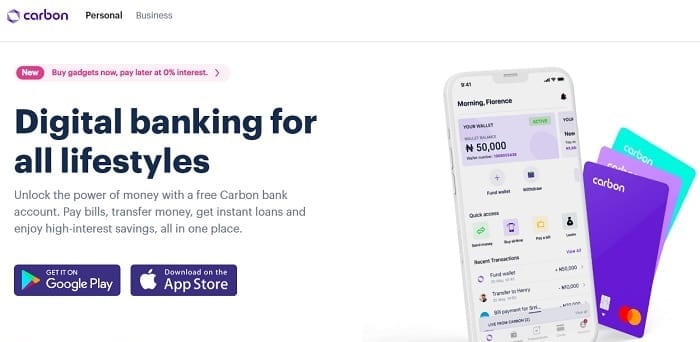
Formerly known as Paylater, Carbon is a digital banking app that also gives out loan to individuals and businesses. The app provides all sorts of exciting financial services, including savings, investment, payments and so on.
Hence, Carbon is more than an app for borrowing money; it is an app that offers “digital banking for all lifestyles”. However, for this post, let’s focus on its loan feature.
Insured by NDIC and certified by the Central Bank of Nigeria (CBN), Carbon loan does not require any form of collateral, neither would you have to fill any form. The entire process is online, and you will receive your loan within minutes.
How to get a loan from Carbon app
Download the Carbon app from the iOS app store or Google Play store
Register in few minutes by providing a few details about yourself
Go ahead and apply for loans
Your loan would be sent to your wallet on the app from where you can use it for different transactions. You can also send the money from your wallet to your bank account so you can withdraw it.
Payback your loan on time to unlock higher amounts. Also, you stand a chance of getting 10 – 100% cashback when you pay back your loan on time.
PalmCredit is another mobile app that gives Nigerians easy and convenient loan. Boasting of being “Nigeria No. 1 online loan…”, the money lending app offers flexible loans with reasonable interest rates.
As with most other loan apps, paying back your loan on time on PalmCredit helps you to update your credit score. The implication of that is you get higher offers when next you apply for a loan.
Some of its unique fixtures include offering up to 100k loan with a daily interest rate of 1.2%.
How to get a loan from PalmCredit
Download the Palmcredit mobile app from your app store
Register and set your account in minutes
Apply for a loan
Get approval within minutes
The loan is disbursed to your bank account
Interest Rate: 14% – 24%
Loan amounts: ₦2,000 – ₦100,000
Loan terms: 14 – 180 days
Target market: Individuals
Okash
A product of OPay, Okash is another loan app that offers loans to Nigerians. The app is committed to increasing access to loan facilities to the underserved section of the society.
You get loan decisions on Okash within seconds, and once your loan is approved, you’d receive funds within 5 minutes.
For your first loan application on Okash, you can’t get more than ₦10,000. The money will increase in subsequent applications, especially if you pay back your loan on time.
Okash loans are provided in partnership with Blue Ridge Microfinance bank; hence you can pay back your loan via direct transfer to Blue Ridge Microfinance bank account (Zenith Bank Account No:1130085518)
How to get loan from Okash
Download and install the Okash app from your app store
Register an account
Select the product or loan amount you’d like to apply for
Provide necessary information and submit your application
You may get a call for verification after submitting your application. Ensure you provide the right information
E-sign the loan agreement after approval
After this, the approved loan will be dispensed to your registered bank account
Interest Rate: 23 – 35%
Loan amounts: ₦3,000 – ₦500,000
Loan terms: 7 days – 365 days
Target market: Individuals and businesses
Fairmoney
Fairmoney is a money lending app for Nigerians where you can get a loan within 5 minutes. You know this is a big deal if you’ve had to wait for days to get a loan from your bank.
Fairmoney is not just a loan app, by the way. The app also provides some essential financial solutions such as airtime recharge and payment of bills.
The primary requirement for a Fairmoney loan is your BVN, and you can get as much as N500,000. And you can spread repayments in multiple instalments for ease and flexibility.
How to get a loan from Fairmoney
Download the Fairmoney app from the Playstore
Signup with your phone number and create your PIN
Click apply on the home page
Answer the few questions provided
Get a loan offer
Choose amount and tenor
Accept the loan offer
Provide bank details where you want your money sent and get it within minutes
Interest Rate: 10 – 30%
Loan amounts: ₦1,500 – ₦500,000
Loan terms: 61 – 180 days
Target market: Individuals and businesses
Aella Credit
Aella Credit is a fintech app that provides such services as payments, investment, and loans. The app makes it “super easy for anyone to borrow, invest and make payments” without excuses.
The money lending app even offers affordable insurance services for its customers. Now, that’s something different compared to others in the list.
For Aella, the end goal is to provide financial inclusion for all, irrespective of social class or profession.
How to get a loan from Aella Credit
Download the Aella app from your app store
Create your account by filling out your details in less than a minute
Answer some quick questions to update your profile
Click the “check eligibility” button to see if you qualify for a loan and how much
Apply for the loan, and it will be sent to your provided bank account within minutes
Payback your loan on time
Interest Rate: 4 – 20%
Loan amounts: ₦2,000 – ₦1,000,000
Loan terms: 1 – 3 months
Target market: Individuals and businesses
Blackcopper
If you are thinking of an app where you can borrow money to grow your business, then checkout Blackcopper. The app is committed to keeping “the wheels turning for your business”.
Aside from giving quick loans to individuals and businesses, Blackcopper also has investment opportunities for its users. Sign up to benefit from either of the two services the app offers.
How to get a loan from Blackcopper
Download the Blackcopper mobile app from Apple store or Google Play store
Register your account by providing the required information. Secure your account by verifying it via mail
Access Quick loans for your business needs or access investment opportunities on the app
Interest Rate: As low as 3.74%
Loan amounts: ₦500,000
Loan terms: Up to 6 months
Target market: Individuals and Businesses
FAQ
What are the main eligibility conditions precedent to loan
1. You must bee between the ages of 22 – 59 years old2 2. Have a verifiable source of income 3. Live and/or work in cities where we operate 4. Have a savings or current bank account with any commercial bank
What are the required documentation to apply for a loan, using any of the loan apps?
You need your bank statement, a government issued ID card and utility bill (optional).
Branch offers loans from ₦1,000 to ₦200,000. Loan terms range from 4 – 40 weeks. Interest ranges from 15% – 34% with an equivalent monthly interest of 3% – 21% and APR of 33% – 261%, depending on your loan option.
Conclusion
Accessing loans for personal needs and business development is no longer so much of an issue. However, resist the urge to get a loan when you don’t need one or don’t have a clear plan to pay back.
Also, take your time to study these money lending apps’ terms and conditions before submitting your application for loans. Be sure you agree with these terms to prevent future regrets, especially in terms of the interest rate.
Do you know of other loan apps with amazing offers and excellent services? Share in the comments.