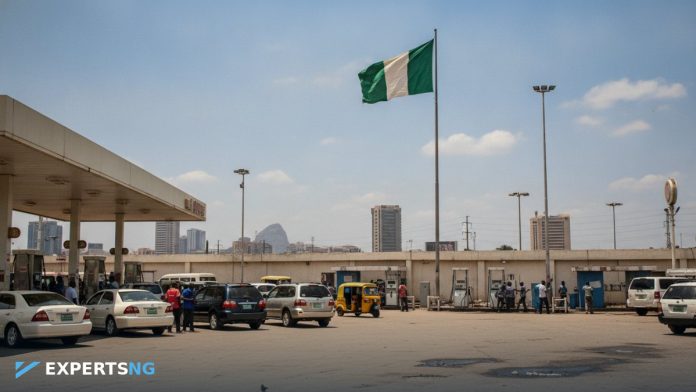


The petrol pump price Nigeria motorists pay has eased at several major filling station chains, following a N51 per litre cut in the gantry price at Dangote Refinery. A market survey on Tuesday, reported by Daily Post, found that AA Rano, NIPCO, AP Ardova and other retail outlets now sell petrol at between N1,350 and N1,385 per litre.
That means pump prices have dropped by between N20 and N60 per litre. The new prices are in force at AA Rano, NIPCO and AP Ardova stations in Abuja and its environs.
For entrepreneurs and SME owners, fuel is rarely a small line in the budget. This article sets out what changed, who charges what, and how to turn a modest price drop into a real saving for your business.
Key facts at a glance
| Item | Detail |
| Dangote Refinery gantry price (before) | N1,210 per litre |
| Dangote Refinery gantry price (now) | N1,159 per litre |
| Size of the gantry cut | N51 per litre |
| Imported petrol price parity | N1,063 per litre |
| Gap between import parity and new gantry price | About N96 per litre |
| Pump price at AA Rano, NIPCO, AP Ardova and others | N1,350 to N1,385 per litre |
| Pump price at NNPCL stations (Abuja) | N1,325 per litre |
| Pump price at MRS, Ranoil and Empire Energy | N1,399 to N1,420 per litre |
| Reduction in pump prices | N20 to N60 per litre |
| Area covered by the survey | Abuja and its environs |
How the petrol pump price Nigeria drivers see has changed
Dangote Refinery reduced its gantry price over the weekend, taking it from N1,210 to N1,159 per litre. Retailers who buy from the refinery responded by adjusting what they charge motorists.
The gantry price is what marketers and retailers pay at the depot before adding their own costs and margins. When it falls, filling stations have room to lower the pump price, although they do not all do so at the same speed or by the same amount.
The report also notes that the imported petrol price parity currently stands at N1,063 per litre. That is about N96 below the refinery’s new gantry price, which is worth watching if you track where local prices may head next.
Who charges what in Abuja
- NNPCL stations: N1,325 per litre, still the lower end of the market.
- AA Rano, NIPCO, AP Ardova and others: N1,350 to N1,385 per litre after the latest cuts.
- MRS, Ranoil and Empire Energy: N1,399 to N1,420 per litre.
The gap between the cheapest and most expensive of these outlets is therefore about N95 per litre.
That spread matters more than it looks. A business that fills up several vehicles or generators every week can feel a difference of this size quickly, so the choice of station is itself a cost decision.
Understanding the gantry price and import parity
Two terms in this story are worth understanding if you want to follow fuel prices more closely.
The gantry price is the price at which a refinery or depot sells petrol to marketers and retailers. It is the starting point for what you eventually pay at the pump.
The import parity price is a benchmark of what it would cost to bring petrol into the country from abroad. When import parity sits below the local gantry price, as it does now, imported fuel can in principle compete with local supply. The source does not say whether that will lead to further cuts, so treat it as something to monitor rather than a forecast.
What the petrol pump price Nigeria business owners face means for costs
For any business that runs on petrol, whether a delivery rider, a logistics start-up, a food vendor with a generator or a salon with a small power set, a drop of N20 to N60 per litre is modest but real. Over a month of daily use, it adds up.
- Shop around before you refuel. A spread of about N95 per litre between stations in Abuja is large enough to matter for fleets and generator-heavy operations. If you buy in bulk or run several vehicles, compare outlets regularly rather than defaulting to the nearest pump.
- Review your pricing and delivery fees. If you raised delivery charges or transport surcharges when fuel was dearer, check whether they still reflect your actual costs. Customers notice when competitors adjust first.
- Do not assume the cut is permanent. Prices moved because of one refinery’s gantry decision. Avoid locking in long contracts or fixed quotes on the assumption that this level will hold.
- Track fuel as a separate cost line. Recording fuel spend by vehicle or by generator makes it easier to see the saving, and to spot waste. Our guide on accounting and bookkeeping for small businesses explains how to set this up.
- Watch the import benchmark. With import parity below the refinery’s gantry price, there may be room for further competition. It is not guaranteed, but it is worth monitoring if fuel is a major expense for you.
What to do now: a practical checklist
A price cut only helps your business if you act on it. Work through this checklist over the next week or two.
- List every petrol-powered asset. Include vehicles, motorcycles, generators, pumps and any other equipment that burns fuel.
- Check the pump price at stations near you. Note the price at each outlet on the same day so the comparison is fair.
- Decide where to buy. Weigh the price against queue times, fuel quality, location and whether the station gives receipts you can use for your records.
- Update your cost sheets. Replace the old per-litre figure with the current one, and note the date so you know when it was last checked.
- Recalculate your delivery and service prices. If fuel is built into your charges, check whether your margins have changed.
- Set a review date. Fuel prices can move again, so diarise a monthly check rather than waiting for a surprise.
- Keep a small buffer. If you bank the saving, you are better placed if prices rise again.
How to work out your own monthly saving
You do not need complicated software to estimate what the cut is worth to you. A simple method is enough.
First, find out how many litres your business buys in a typical month. Your fuel receipts, bank statements or a simple notebook log will give you this figure. If you do not track it yet, start now, because you cannot manage a cost you do not measure.
Next, multiply those litres by the reduction you are actually seeing at your usual station. The report puts the drop at between N20 and N60 per litre, so use the real difference between your last purchase and your latest one rather than a guess.
Finally, compare that figure with what you would save by moving to a cheaper outlet. In Abuja, the survey shows about N95 per litre between the cheapest and dearest stations listed, so switching can sometimes save more than the cut itself.
Questions to ask before you switch stations
Price is important, but it is not the only factor. A few practical questions can stop a small saving from turning into a bigger problem.
- Is the fuel quality reliable? Poor fuel can damage engines and generators, which would cost far more than you save at the pump.
- Are the pumps accurate? If you suspect short measures, report it and consider another outlet.
- How long will staff spend queuing? Paid time lost in a long queue can wipe out a small saving.
- Can you get a receipt? Proper receipts make bookkeeping and expense claims easier.
- Is the station on your regular route? A detour to a cheaper pump uses fuel and time of its own.
Managing fuel costs beyond the price per litre
Falling prices are welcome, but the cheapest litre is the one you never burn. Small operating habits can cut your fuel bill whatever the pump price does.
- Plan delivery routes. Grouping drop-offs by area reduces wasted kilometres and idle time.
- Service vehicles and generators on schedule. A well-maintained engine generally uses fuel more efficiently than a neglected one.
- Set clear rules for fuel use. If staff use company vehicles, agree on who authorises refuelling and how it is recorded.
- Switch off generators when they are not needed. Running a set for hours with little load wastes petrol.
- Review whether every trip is necessary. Some errands can be combined or handled by phone or online.
If fuel is a large part of your overheads, it may also be worth asking whether your business model is built on costs you can control. Our list of fastest growing businesses in Nigeria shows how different sectors carry very different cost structures.
Why you should not lock in prices on the back of one cut
It is tempting to treat any price drop as the start of a trend. The report does not support that conclusion. The reduction followed one refinery’s decision on its gantry price, and the source does not say how long the new pump prices will last.
For business owners, the safer approach is to treat the current level as useful but temporary. If you quote fixed prices to customers over several months, build in some room for fuel costs to rise. If you pass savings on to customers, be ready to explain that prices may need to change again.
Limits of the report
The survey covers Abuja and its environs, so prices in Lagos, Port Harcourt, Kano or other cities may differ. The source does not say whether the cuts apply nationwide, or how long the new prices will last. Business owners outside Abuja should check local pump prices rather than assume the same reductions.
The report also does not name every station in the market. Independent outlets and smaller chains may charge differently from the brands listed, so a local check is always worthwhile.
For now, the direction is welcome for anyone who spends heavily on fuel. The sensible approach is to take the savings where they exist, update your cost sheets, and keep some room in your budgets in case prices move again.
Frequently asked questions
How much did Dangote Refinery cut its gantry price by?
Dangote Refinery cut its gantry price by N51 per litre over the weekend. The price fell from N1,210 to N1,159 per litre.
What is the new petrol pump price at AA Rano, NIPCO and AP Ardova?
According to the Tuesday market survey, AA Rano, NIPCO, AP Ardova and other retail outlets now sell petrol at between N1,350 and N1,385 per litre. These prices are in force in Abuja and its environs.
How much have pump prices dropped?
Pump prices have dropped by between N20 and N60 per litre at the outlets covered by the survey.
Which stations in Abuja are cheapest?
NNPCL stations sell at N1,325 per litre, which the report describes as the lower end of the market. MRS, Ranoil and Empire Energy charge between N1,399 and N1,420 per litre.
What is the imported petrol price parity?
The imported petrol price parity currently stands at N1,063 per litre. That is about N96 below the refinery’s new gantry price of N1,159 per litre.
Do the new prices apply across Nigeria?
The source does not say. The survey covers Abuja and its environs, so prices in other cities may differ and should be checked locally.
Will petrol prices keep falling?
The report does not say how long the new prices will last or whether further cuts will follow. Business owners should avoid assuming the current level is permanent.
How can small businesses benefit from the cut?
Compare stations before you refuel, update your cost sheets, and review any delivery or transport charges that were raised when fuel was dearer. Tracking fuel as its own cost line also helps you see the saving clearly.
If your fuel spend feeds into wider plans for your company, our guide to how to calculate a company valuation shows how cost control can affect the numbers investors look at.
Source: dailypost.ng