Enough capital is essential for businesses to support growth, create novel goods, and have a strong market presence. Entrepreneurs may overcome financial challenges and concentrate on creating a successful firm with the appropriate finance approach. Often, we hear that cash flow is the one thing that you should not take your eyes off to have a successful business, but only a few get by with the right funding that is good enough to ensure adequate cash flow. In this post, five crucial financing alternatives for startups in 2023 are given, providing insightful analysis and advice that will help you stay ahead of the competition and acquire the cash you need to succeed.
Venture Capital Funding
When looking for substantial financial assistance, many entrepreneurs turn to venture capital investment. In order to do this, money must be raised from investors with a keen interest in high-potential, early-stage businesses. Typically, venture capitalists make investments in return for stock or equity in the business. You need great growth potential, a compelling company strategy, and an original value offer to attract venture capital financing. Researching and preparing for your company pitch to venture investors is essential.
Crowdfunding
As a direct method of fundraising for companies, crowdfunding has become incredibly popular in recent years. Entrepreneurs may display their company ideas and solicit financial support from others who share their convictions through online venues like Kickstarter and Indiegogo. Startups can encourage potential supporters to fund their enterprise by providing a range of rewards or incentives. Crowdfunding may also be an effective marketing technique for entrepreneurs, assisting them in establishing a base of devoted clients even before the release of their goods or services.
Reward-Based Crowdfunding
Reward-based crowdfunding is one type of popular crowdfunding. It involves offering a reward to contributors in exchange for financial backing. These benefits may include first access to the good or service, exclusive items, or tailored experiences. Startups should thoroughly consider their target audience’s interests and demands before designing alluring rewards that fit those needs.
Angel Investors
Angel investors are wealthy individuals who invest in startups in return for equity or convertible debt. These investors may contribute essential expertise, contacts in the industry, and mentorship because they are frequently seasoned business owners themselves. It may be necessary to network within entrepreneurial networks, go to industry events, or use internet platforms that link businesses with possible investors in order to find angel investors. When addressing angel investors, it is crucial to have a well-prepared pitch deck that highlights your business idea, market potential, and growth strategy.
Small Business Administration (SBA) Loans
There are a number of loan programs available from the SBA that can help you get your small business off the ground. Advantages of these loans include low-interest rates and extended repayment terms. While working with qualified lenders to guarantee a percentage of loans, the SBA does not lend money directly. You need a strong business plan, a high credit score, and collateral to be eligible for an SBA loan. It’s crucial to carefully consider the available financing programs and select the one that best satisfies the requirements of your business.
Startup Business Loans
One of the SBA loan programs worth exploring is the 7(a) Loan Program, which provides financial assistance to small businesses, including startups. These loans may be used for a variety of things, including real estate, equipment acquisitions, and operating capital. Startup business loans may be a good choice for business owners looking for finance because of their low-interest rates and extended payback terms.
Incubators and Accelerators
Startups can find a friendly atmosphere, resources, mentorship, and frequent money at incubators and accelerators. These initiatives are made to support the quick development and success of companies. Early-stage firms are often the focus of incubators, which also offer office space, access to common resources, and professional advice.
On the other side, accelerators work with highly developed firms and provide intense programs that include mentoring, opportunities for networking, and access to possible investors. Joining an incubator or accelerator may help you traverse the early phases of your business by offering financing as well as helpful advice and assistance.
The acquisition of seed money marks a significant turning point on the path to commercial success. You can improve your chances of getting the required cash by looking at options like venture capital investment, crowdsourcing, angel investors, SBA loans, incubators/accelerators, etc. Always do extensive study on each possibility, adjust your strategy to meet the demands of any prospective lenders or investors, and make a strong business case. You can get the money you need to realize your company aspirations with persistence, smart preparation, and a compelling proposal.
Everyone has bills, and the day of their arrival can be a time of dread. But those monthly payments don’t have to be stressful, especially if you’ve spent time planning when you will pay them.
It’s easy to get carried away with what you might owe. But if you are still determining how much your upcoming bills will be for the next few months, you might pay more than you have to. Or worse – in some cases, you may have an outstanding bill that goes from the due date to the next date without being paid and gets locked in collections before you realize it. Sometimes bills can be overwhelming, and staying on top becomes difficult. Here are some tips to help you to organize your bills better and pay them on time.
1. Create a Spreadsheet for Your Budget
A spreadsheet refers to rows and columns, a great way to track financial obligations. Input your latest bills, how much you paid, and when they are due. The use of color-coding can also help identify debts that may need paying earlier than the others.
In addition, you can break down your monthly budget into categories. For instance, create one column for monthly recurring expenses such as rent, utilities, and insurance payments. Then you can create another column for monthly fees needed immediately and one for those required in three months or longer. The purpose of creating categories is to see what is coming up at a glance.
2. Use an Online Bill Payment System
If you are looking for ways to organize your bills, consider doing so online. Using a system that connects to your financial accounts, you’ll be able to track all of the payments you make in one place. This will give you a more accurate picture of what is coming in and going out each month and year. It also allows you to set reminders for when payments are due so that there are no surprises when they arrive in the mail or inbox just before they are due.
Setting up an online bill pay platform can be simple to help you maximize your budget and keep track of your expenses. It comes in many forms, but some are free, and they are worth exploring. See what options are available, and select the one that best meets your needs.
3. Budgeting Journal
Another way to better organize your upcoming bills and your budget is to create an ongoing log. Write down each of the bills you will be paying each month, how much those bills are costing you, and the date you will start making payments.
Creating your budget journal is a good idea for those with discipline issues when paying their bills. It will help to keep you on top of your obligations and remind you what bills need to be paid before others do. Keeping this log will also help you plan so that when your bills come in, there is no nasty surprise waiting for you.
4. Consult Your Budget
Be aware of any upcoming changes in your budget. Consult your budget when you get a raise or a new job with better pay. Consider increasing your contributions to retirement accounts and other savings, and you may want to put some money into savings for car repairs on the way. But if you don’t refer back to your budget from time to time, you can easily spend more on non-recurring expenses.
In addition, be aware of the upcoming bills you could use to help reduce spending. You may have overdue utilities, a new vehicle, or a mortgage payment. With a budget, you may find it cheaper to pay them in smaller chunks rather than one large bill all at once.
5. Pay Bills Early
Another way to help organize your upcoming bills is to pay them ahead of time. If your accounts are due on the 10th of each month, you can startmaking payments on the 3rd. That way, when the date arrives, you’ll be ready if you forget. If you do so for your bills, you’ll always be aware of the situation and can avoid unexpected penalties.
Using these tips, you can better organize your upcoming bills so that they become a less stressful part of life. That way, you’ll avoid late fees and penalties, saving you some extra money in the long run.
Earning a return on your investment is the goal of every serious business owner. The year 2022 will see a whole host of new opportunities to do just that. This is the time when you can take full advantage of a wide variety of exciting new trends. Here are 5 great new ways for you to increase revenue for your business.
1. Find a Partner to Expand Your Revenue
You can experience one of the hottest new online marketing trends of 2022 when you find a media partner. This type of partnership was already on the rise since the very earliest days of the world wide web. But it has risen to a peak of influence and profitability in the past few years. 2022 will be no exception.
Working with a media partner, especially a major corporation, will help you to reach a whole new level of influence. The higher you rise as a household name, the more profits you will make. There are plenty of places on the web to learn more about how to find such a partner. It’s a trend that is worth looking into.
2. Don’t Even Bother with a “Free” Plan
Do you want people to chomp at the bit to enjoy your various goods and services? Perhaps the first thing you need to make them do is to pay for it. Sure, it’s a cliche that samples are the way to bait someone’s appetite into wanting more. But if your goods are truly first-rate, you don’t need to bait anyone.
If you have enough quality user reviews and testimonials for your services, you already have good publicity. You should be getting as many of these online reviews and testimonies as possible. This will help you to create the authority you need to skip the free option. The more you get, the less you need samples.
3. Up-Sell and Cross-Sell as Much as Possible
One of the best ways toincrease your profits is to never stop selling. This is true even when a customer has already gone to checkout with an item. Once they get there, you can tantalize them with a few related “must-have” items. If you pitch it just right, you may just get a hard-earned up-sale.
You can also send emails to your customers who have already bought from your store. You can remind them of the related items they may have passed on. Emails can also be used to let them know about other items that they may have an interest in. The more you up-sell and cross-sell, the more loyal they will be.
4. Use an Email Address Capture Program
Sometimes it pays to be a little bit sneaky. We are not implying any kind of illegal Watergate behavior by saying so. But we do recommend that you make use of new tools such as an email address capture program. Doing so will give you a new means of reaching people and reminding them why they were on your website.
5. Create Multiple Pricing Tiers for Your Items
Do you have a whole new set of goods or services ready to offer to the public? You should know by now that the cheaper you price them, the more interest you will draw. People naturally expect to pay as little as possible. But is this the best way to go? After all, you want to profit as much as you can.
Why not offer your item in several different packages? These can include items by themselves for a certain price, the item plus several extras for a bit more, and the full package for a premium price. This will be a fair way to draw the attention of buyers from all available levels of income.
Increasing Your Revenue is a Click Away
The most exciting thing for you to keep in mind about all of these new trends is how easy they are to get in tune with. You don’t have to spend all of your budgets on advertising your business. You don’t even have to spend much time doing so. These are trends that anyone can use to raise profits to the maximum.
Accessing loans is one of the major necessities in Nigeria.
To get an idea of what sort of loans are available in Nigeria, we decided to find out what funding options are available in the country. We conducted a search on various finance websites and compiled our best picks into this post.
There are so many organisations that grant loans in Nigeria. Some of these organisations are either owned by the Government or owned by private individuals.
This article lists the very functional, top 50 organisations in Nigeria that give loans out.
The Bank of Agriculture is a Nigerian government-sponsored bank that provides loans, credits, and other forms of funding for farmers and farming businesses.
They provide products and services such as Agro-processing facilities, Export finance facilities, and many others. They can award loans up to NGN 5 million Naira, and their interest rate is between 7% and 21%.
The Bank of Industry Limited (BOI) is Nigeria’s oldest, largest and most successful development financing institution. It was reconstructed in 2001 out of the Nigerian Industrial Development Bank (NIDB) Limited, which was incorporated in 1964. The bank took off in 1964 with an authorized share capital of 2 million (GBP).
The BOI’s core mandate is to provide financial assistance for the establishment of large, medium and small projects as well as the expansion, diversification and modernisation of existing enterprises; and rehabilitation of existing ones.
Once you meet its requirements, accessing loans from the BOI is not so cumbersome, the BOI is one of the best sources of funds available to Nigerian businesses.
Development Bank of Nigeria (DBN)
The Development Bank of Nigeria (DBN) was conceived by the Federal Government of Nigeria (FGN) in collaboration with global development partners to address the major financing challenges facing Micro, Small and Medium Scale Enterprises (MSMEs) in Nigeria.
As the name implies, this bank disburses loans to SMEs. DBN loans can be accessed through PFIs, which include Commercial Banks, Microfinance Banks, Development Finance Institutions (DFIs) and other Financial Institutions.
DBN loan repayment tenure is flexible (up to 10 years with a moratorium period of up to 18 months) and the interest rates are on a market-conforming and fully financially sustainable basis.
How to get a DBN Loan
You can access the DBN loan through any of these Participating Financial Institutions (PFIs) by contacting any of the banks listed below:
The NEXIM Bank is mandated to help provide loans to facilitate export goods and services from Nigeria. Only Business owners and organisations related to exporting activities are required to access loans at the bank. NEXIM Bank provides products like direct lending, foreign input, local, and other related services
SMEDAN is charged with granting loan access to MSMEs; it provides schemes such as the commercialisation empowerment initiative, conditional grant scheme and other empowerment schemes for growing business owners.
The Bank of Industry (BOI) is a development finance institution (DFI). The BOI is the oldest and largest financing institution dedicated to business development in Nigeria. It succeeded the Nigerian Industrial Development Bank (NIDB), which was first founded in 1964. It was recapitalised and reformed in 2001, becoming the Bank of Industry.
The BOI works in collaboration with some partner institutions such as the Federal Ministry of Industry, Small and Medium Enterprises Development Agency of Nigeria (SMEDAN), the Federal Ministry of Finance, Trade and Investment, the Central Bank of Nigeria (CBN) and a host other public/private sector organisations. Also, BOI sits with other DFIs such as the Bank of Agriculture (BOA) and the Development Bank of Nigeria (DBN).
The main aim of the Bank of Industry is to give long term funding to businesses in the Nigerian industrial sector. It focuses on providing credit to micro, small and medium enterprises (SMEs) and even bigger corporations. Newer companies may get this loan facility, just as it may also be given to existing businesses to diversify, expand, and modernise.
Currently, the Bank of Industry has four subsidiaries including:
BOI Microfinance Bank
BOI Investment and Trust Company Limited
Leasing Company of Nigeria (LECON)
BOI Industrial and Development Insurance Brokers
Bank of Industry loan and funding types
Different types of funding are available from the Bank of Industry. Some of the options available include secured loans, asset financing, working capital loans, among others.
Businesses from a variety of industries can access these funds through the BOI. It focuses mainly on agriculture, information communication technology, agro-processing, oil and gas, the creative sector and solid minerals sectors.
In addition to offering competitive rates and relatively long repayment terms, the program provides other support incentives. Loans typically have terms of one to five years (plus). Loans are usually structured in a way that allows for borrowers to enjoy a moratorium period or incubation period during which they are not required to repay.
Also known as intervention funds, managed funds are monies the federal government, private institutions or individuals set aside to cater for a particular interest or intervene in a specific sector.
Many attractive features are included with these funds, including low or no interest rates, longer tenors and moratoriums, among others.
The Bank of Industry manages a number of these funds directly under several different schemes. In other words, the bank of industry manages the disbursement, implementation, monitoring, and recovery of these funds.
Managed funds include:
BOI/CBN Intervention Fund
Cement Fund
Cassava Bread Fund
FGN Special Intervention Fund for MSME (NEDEP)
Cottage Fund
National Program on Food Security (NPFS)
NADDC Fund
Sugar Development Council Fund
Rice and Cassava Intervention Fund
Therefore, if you have businesses that fall under any of the listed categories, then you should reach out to the bank of industry. Read on to see how you can apply for funds or loans are the bank of industry.
BOI matching funds
Matching funds aim to provide SMEs and larger businesses with increased funding opportunities. These specialized funds are meant to drive economic growth, industrial development, and sustainable development in Nigeria.
Through matching funds, the Bank of Industry works in collaboration with different partner institutions such as wealthy individuals, multilateral organizations and state governments.
Matching funds include:
BOI/Dangote Foundation Matching Funds
BOI/State Matching Funds
How to qualify for a bank of industry loan
The number one requirement for a bank of industry loan is that your business must be registered with the Corporate Affairs Commission (CAC). It is therefore essential to have a registration number for a Business Name or a Limited Liability Company.
Priority is given to companies in the following sectors:
It is expected that you will have to complete a lengthy application process when applying for loan at the bank of industry. Loan requirements will vary from loan to loan. Additionally, the requirements differ according to the size of your business (micro, small or large enterprise) and how much money you are seeking.
As a result, you will need to present some standard documents, such as financial statements, collateral details, an overview of your company, and information about how you intend to use the money.
The following is a list of what you may need:
Fill out the loan application form
Memorandum and Articles of Association
Incorporation certificate
Feasibility study
Business plan
Raw material supply quotation
Equipment and machinery supply quotations
BVN (Bank Verification Number) and passport photos.
Identification documents (passports, driving licenses, and permanent voters cards).
Audited financial accounts
Certificate of tax clearance
Bank statements for a company
Information about the security or collateral being offered
Statement of current liabilities
Contract of lease (if you are operating in a rented space)
Frequently asked questions about BOI
Which items can be financed by the Bank of Industry?
Among the main loans of BOI are for industrial equipment used in manufacturing. Land and buildings are not funded by the BOI. You may seek alternative funding solutions if you have additional working capital requirements.
What is the process by which the Bank of Industry disburses loans?
If your loan application is successful, money will not be deposited directly into your bank account. Loans are instead advanced to the vendors and suppliers of the equipment being the money was loaned for.
What is my borrowing limit with the Bank of Industry?
The minimum amount you can borrow is 5 million Naira. Loan requests of up to 5 million Naira can be accommodated through the BOI matching fund platform and its Bottom of the Pyramid scheme (BOP).
Is collateral required by the Bank of Industry?
Yes, you need to pledge some assets as collateral with the Bank of Industry. However, collateral need not be physical assets; alternative forms of security are accepted, such as:
A legal mortgage on property
Guarantee from the bank
Debentures secured by assets of a company
Collateral from third parties
Third-party or external guarantors
Assets pledged previously to other lenders (as long as the BOI’s loan is adequately covered)
Can the Bank of Industry fund my startup?
The bank typically requires pre-existing companies with a track record to apply for a loan, but it does grant startup loans at its discretion. In order for the bank to consider financing a startup, they would need a sound business plan and proof of competence in the chosen industry.
What is the Bank of Industry’s interest rate?
The annual interest rate at the Bank of Industry is typically 9%. However, the exact finance products and schemes will determine whether this is lower or higher. Also, there may be other applicable charges such as appraisal fees, processing fees, and monitoring fees.
What is the term of Bank of Industry?
An average BOI loan term lasts 12 to 60 months. In addition, a moratorium of up to 12 months may also be offered, depending on the exact loan term.
The Bank of Industry approves loans in how long?
A loan will typically be processed in 30 to 40 working days as long as all the required documents are attached. For bigger loan requests, there will be a longer processing time.
Are there any types of businesses that the Bank of Industry supports?
Liquefied petroleum gas and compressed natural gas
Meat processing
Mechatronics
Movie production (Nollywood)
Plastics
Quarries
Recycling
Restaurants
Roofing sheets
Shoemaking
Soaps and detergents
Solar (off-grid)
Technical and vocational schools (offering city and guild certificate)
Theme parks
Water transportation
In Conclusion
If you are looking for capital to grow your existing business, the Bank of Industry is surely a good place. With this guide, you now know all about the requirements and procedures.
It was the middle of February 2021, the Nigerian central bank placed a ban on the use and trade of cryptocurrencies in the country. Identified as the second largest “Bitcoin market” after the US, trading no less than $600 million in the last 5 years (Deutshe Welle, 2020) this singular action was received with a mixture of anger and despair as trading cryptocurrencies has become a source of income for many Nigerians amidst the troubled economy. In the summer of 2020, Nigeria’s interest in bitcoin trading piqued and it became a very attractive investment option.
This was not the first time the CBN moved to control the use of cryptos, the apex bank also asked banks to identify and report individuals and entities trading cryptos within their systems. All of a sudden even people that had never heard about cryptos (especially the younger generation) began to ask questions, they wanted to know more and they even wanted to begin to invest. With no central place to get authentic information, and the national concerns about volatility, fraud and the concept of decentralization, they turned to successful crypto investors, many of whom had no formal knowledge about cryptocurrencies, and learned how to trade mostly on their own.
The Nigerian government also had its concerns about its volatility, fraud and the volume of trade going on, an estimated $4billion (BBC News, 2021) and the impact a loss like that could have on the economy. Nigerians have fallen prey to several Ponzi schemes and the reality is that at almost every point in time, there is at least one scheme that is active and that Nigerians are actively investing in. Cryptocurrency trading was also labelled a Ponzi scheme by the majority of the population who still don’t understand how anyone could invest in anything that was “invented” by an anonymous person and owned by no one in particular.
My Interview
I was approached by Channels Television, in February this year to participate in a panel discussion about the Nigerian cryptocurrency ban (see attached link), where I said it would be better to work to regulate rather than attempt to ban its use and also that the concerns that the government had about fraud or misuse could happen with any other investment scheme and even with fiat currency and though valid did not represent a reason strong enough for it to be banned. I concluded by suggesting that we invest more as a country into educating ourselves and our people about cryptocurrencies so people could make an informed decision about whether to invest or not, also making it clear that there was more to the technology beyond cryptocurrencies.
Peer to peer trading redefined
In spite of the ban, Nigerians continued to trade cryptocurrencies. How you may ask? It was all thanks to the exchange platforms like Binance. This was peer to peer trading on a whole new level as it provided the opportunity for Nigerians to fund and withdraw fiat currency from their wallets with no involvement or interference from the government, and in a way that the banks could not do anything about. Let’s say I wanted to buy Ethereum and all I have is my fiat money, I would;
· Log into my Binance account and go to the list of members looking to exchange fiat money for Ethereum, with the exchange rate clearly spelt out;
· I would then click on the most favourable rate and then their registered fiat account details would appear;
· I would transfer the fiat money to their local accounts and they would confirm this and transfer Ethereum to my wallet address which would have been automatically sent to them by Binance (a time window of 20 mins is allowed to initiate and conclude the transaction) and everyone walks away happy.
Is this safe you may say? Binance acts as a sort of escrow for the crypto and you have direct details for the account you send the fiat currency to and as long as I have used this process and others I know have been using it, there have never been any issues. Poor internet connectivity may delay transfers but they eventually always come through.
NIGERIA’S CBDC
So when I discovered that the CBN was looking to launch its own digital currency, I was first amused and then encouraged, as that made it clear that Nigeria was coming to terms with the fact that the trade and use of cryptocurrencies cannot really be controlled. I spoke with Mr Adediji Owonibi, the Founder and COO of Convexity, one of Nigeria’s foremost blockchain solutions and consultancy firm based in Abuja, Nigeria, who has also worked in conjunction with the IMF and the Nigerian CBN as a trainer and a stakeholder.
Mr Owonibi said he could not believe his ears either when first heard about the Nigerian CBDC but then he attended a stakeholder’s meeting at the CBN and realized it was for real. He also mentioned that after the Cryptocurrency ban, he had several engagements with the CBN where his advice was that they should take a more inclusive approach by focusing on regulating rather than imposing a ban on its use. According to Mr Owonibi, they listened and here we are now, October 1st which coincidentally is also our nation’s independence day is a reality.
When asked about the intricate details about the CBN’s plan, Mr Owonibi mentioned that the CBN intends to conduct KYC via the fintech and exchanges that would house the wallet for the e-naira however conversations around conversion rates, buying and selling of other cryptocurrencies and transfers have not yet been concluded. He mentioned that the major promise is faster and cheaper international remittances and regulatory bodies including the IMF and the World Bank are a part of all the proceedings, also approval has been obtained from the Bank of International Settlements.
Facebook is the world’s largest social networking site. Anybody can earn money on Facebook, regardless of whether they have a full-fledged business or just one item to sell.
As Facebook has grown, it has become a competitive home for marketing and making money. However, it is common for beginners to misuse Facebook strategies. These people are either learning these strategies from Fake Gurus or not understanding the process.
In any case, selling stuff on Facebook is the primary source of income on the social media platform. You can make money by either selling a product of your own, or you can become an affiliate for someone else’s product.
Affiliate marketing is a good option for beginners who don’t have their own product to sell.
Well, these are just two of the many ways you can earn money on Facebook. In this article, you will find out all the different ways you can make money on the platform. But first, what are the things you should do to set the tone for making money on Facebook.
Making Money on Facebook: What You Need to Do First
You cannot earn money on Facebook in an overnight miracle, nor is it an easy, straightforward process. However, even if there is no financial investment required, you need to put in some energy, diligence, time and be dogged to earn money.
Here are the first steps you should take:
Develop an extensive network of friends
There is a 5000-friend limit on Facebook, so we recommend exhausting the list. Five thousand friend requests will be difficult to send and respond to, so be committed to your goal.
Create a Facebook page and get a lot of likes
The process of creating a page is simple, and it can be done in about 10 minutes. It is, however, more challenging to get people to like and follow it. Pages with buzzing activity are followed by people without being asked. It is therefore crucial for your page to have solid content and to be engaging.
Create a group and grow the members
Next is to create a Facebook group and add as many friends as possible to it. A Facebook group’s most significant advantage is that its members can run it. While it is not necessary for you to constantly post updates, you should maintain the group’s quality by removing spam.
It is important that every post on the group is approved before it is displayed. Followers are always drawn to groups with good content.
To earn money on Facebook, the three steps above are necessary. As a result, you have created a niche for yourself with many regular followers in addition to the audiences that now follow you. All of these are pretty important in making money on Facebook.
Can you sell anything on Facebook?
Not really. Facebook has some exceptions to things you can sell on the platform, and they include:
Alcohol
Firearms
Illicit drugs
Tobacco
Real money gambling products
Animals
Some healthcare products
Facebook prohibits the sale of products that fall in the above-listed categories for some legal and moral reasons.
7 Ways to earn money on Facebook
Develop an app
You could create an app for Facebook if you have an idea for one. You don’t have to be a developer or programmer to do this, as you can hire them to help develop your idea into a Facebook app.
As a part of their college assignments in 2007, a group of Stanford students designed Facebook apps that ultimately made them millionaires. Therefore, get inspired and unleash those creative juices you’ve got!
You can sell products on Facebook Marketplace
The Facebook marketplace was launched in 2007, and it’s like a virtual garage sale where you can buy almost anything for a few bucks. It is possible to list anything for sale or purchase and then wait for offers to come in. In addition, you can also search for potential buyers or sellers in your friends’ networks.
No matter what you want to sell, whether it is that dress you never wore again for an office party or a collection of romantic songs, some buyers will definitely be looking at it.
Social media influencing
Having the habit of sending friend requests first and getting to know people later can be very useful here. In other words, you make friends effortlessly and post consistently in a niche.
To get their products out there, companies are always looking for social media influencers with huge followings. If you have a Facebook page with a relatively high followership, you could help businesses promote their products and services on your Facebook and get paid for it. Apparently, the larger your network on Facebook, the more money you can potentially make from this on Facebook.
By sharing your link on Facebook or following the Facebook page of certain companies and blogs, you will earn entries for their contests. Also, you can join giveaways and contest groups for the latest opportunities.
Many contests are free to enter, so the only thing you must provide is your time. The prizes vary from giveaway to giveaway, but you might win prizes as big as a car, as small as an Amazon gift card, or even a recharge card.
Affiliate marketing
Affiliate marketing and social media influencer marketing are pretty similar. As an exception, you have to choose a product or service from an affiliate network that your friends are likely to find interesting.
This is how it usually works. You will get a link from the affiliate marketing website and post it on your Facebook wall. The link will have a unique code and your affiliate ID. Hence, whenever someone clicks on the link and purchases on the website, you get a commission from the company.
Earn refer-a-friend bonuses
Are there any online services that you absolutely love and want to spread the word about? One of the most effective forms of advertising is word of mouth. Because of this, companies offer referral bonuses when you invite friends via social media.
Share your referral link with others by sending an email invitation or via social media sharing buttons within your account. You get to earn a cash bonus if a friend signs up through your referral link!
Sell likes and shares
That’s absolutely right. It’s relatively new, but yes, you can now sell shares and likes on Facebook. Though the amount per like or share may not be all that, it’s something, and it increases depending on how much you are willing to ‘work’.
Businesses who want their products to appear more credible buy ‘likes and shares’ from genuine Facebook profiles. According to the logic, a Facebook page with several likes and shares gives buyers more confidence in the brand.
Conclusion
There are many ways to earn money with Facebook, and this is merely a small list. The best part is that everyone can find something they enjoy. Facebook will become even more important to us in the future as the digital divide between people closes.
Do you have any experience making money through Facebook? Tell us about it below if you have.
Cryptocurrency is a big opportunity, says the famous crypto masterclass founder, Tola Fadugbagbe.
How big of an opportunity is it really?
Let’s talk through it together.
Many Nigerians are yet to grasp this whole fad about digital currency and its effect on the financial market. Talk more of embarrassing its future. I mean, there are a bunch of people on the streets of Lagos who do not own a bank account and have no interest in any financial institution. Talk more about the number of people that are unaware of the potentiality of cryptocurrency.
This puts the CBN a few steps ahead of many business sectors and individuals that stand to benefit from a future where the currency is digital.
So, how big of an opportunity is the cryptocurrency for Nigerians?
Before delving into the future of cryptocurrency in Nigeria, we must first talk about its past. Only then can one come to terms with the pretended future of cryptocurrency and the consequences of the CBN current restrictions and intended altcoin.
Nigeria Before Crypto
Let’s take a look at a few facts. Before the age of digital currency, Nigeria ranked 26th in the world economy.
Then Crypto came, and it eliminated the limits, and more people could do business online with other countries, and bam! We shot up that ladder and were ranked 16th.
I mean, sending money across countries has always created such a hassle. Sending money into Nigeria became more stressful.
I recently realised I couldn’t pay for services like purchasing an app or renewing my iCloud storage using my local bank’s Mastercard. The stress of finding whose card I could borrow to perform certain international transactions was a real bother, and I realise I could do without this stress.
Talk about the whole stock exchange palava with the Nigerian currency, rich in naira, and broke in the dollar.
Then there is that endless unexplainable deduction from banks and complaints about the limitations of our local currency. These complaints are not particularly peculiar to Nigeria, but they fueled the need for a currency that eliminates these risks.
Benefits Of Cryptocurrency in Nigeria
What’s in it for you and me as Nigerians?
Scalability to How We Spend Money
Imagine being able to do so much with your money and not deal with all the middle management, AKA banks. It may seem like a leap into the past in a certain way where an individual’s negotiating power determined prices. Everyone did whatever they wanted with the money they had in their wallet.
Indeed the ability to deal directly with whomever we are transacting with at any given point is bliss.
Think of the barter system when a man deals directly with customers and clients. None of all that issue where you make a transfer to one bank and both parties get deductions.
But before you say, why try to fix what isn’t broken? You need to understand that banks aren’t exactly monsters, but in an age when we could do more, why settle for less?
Ease of Commerce
I stated earlier that Nigeria’s position in the world economy has since improved thanks to crypto-traders. In the US, Crypto was readily adopted as a form of currency for services and in trade. People converted their hard cash to digital coins, although they had issues given that they were part of the first people to use it on such a scale.
Smart contract
A smart contract creates an insurance policy between traders. The contract serves as an agreement between any individuals carrying out transactions at any given time. Due to the absence of KYC (Know your customer), all coins are first held in a smart contract till the sales have been confirmed before they can be released to the appropriate party.
Volatility
It makes for employment opportunities through crypto trading.
Curbs Inflation
The creator of bitcoin from the origin programmed a limit in the number of coins in circulation. Inflation arises due to excess money in circulation, and crypto curbs these acts from ever happening.
Financial Security
Coins held in wallets increase in value. Let me explain.
If you were on Twitter just before the ban, you’d remember how many people panicked about how fast their coin depreciated. It became scary even to get anyone to invest in cryptocurrency.
What was all the panic about buying or not buying the dip?
There’s a given number of coins that can be in circulation at any given point. If the number is exceeded, the computer automatically deletes the excess, but the price on the coin that’s left increases value.
When people buy and hold their coins, the value increases. But what led to the drop in value was that many people were selling out of panic. It’s the same with the stock exchange market; any small news can influence stockholders to sell their current stock in any company for fear that such a company was losing its value or its sales had dropped, and their returns are no longer guaranteed.
I remember when Snapchat lost its value because people pulled out when Kylie Jenner said she doubts anyone made use of Snapchat.
The Current Problem with Money in Nigeria
For one thing, it costs to maintain money but is Crypto the alternate solution?
Recently I observed my bank statement, and then I told my sister that I was just about done with local banks and all their drama. I may not be big on banks, but I know when something smells phoney.
I remember the joke on Twitter that you could keep as much as seven thousand nairas in your savings account for a couple of months, and when you return, you’d be lucky to find a thousand naira.
It became more and more unreasonable to store money in financial institutions, and this lack of trust drove many to use online banks and eventually cryptocurrency.
With paper money, stockbrokers determine the value of a given currency, and they do this through publicly traded companies listed on the stock exchange. However, Crypto created an avenue for any given individual to deal directly.
One day a naira had equal value with one dollar, and another time, the value dropped to as much as five hundred naira to a dollar.
Keeping assets in Nigerian currency became a problem for many individuals, causing them to risk the idea of a currency that eliminates such issues.
The Problem with Cryptocurrency
Newness
Since it is still a budding concept and is not widely accepted, Crypto has a lot of grey areas.
Now the intent for which Crypto was created and the thoughtfulness in its design has contributed to its immense success. But perhaps its greatest strength has also posed as a great weakness. That’s the lack of KYC (Know your customer).
This enabled the initial users of Crypto to carry out secret and near terrorist transactions and whatnot. It spiked distrust and damaged the image of Crypto in the eye of the public.
Lack of Understanding
The second problem with Crypto can be summed in this conversation from Big Brother Nigeria. While drafting this article, I overheard a housemate talking about his experience as an average Nigerian.
So I’m watching White Money talk about the fact that he doesn’t understand Crypto and has not been open to adopting it as a trading system. He tells his customers that he can accept cash and transfer with a POS but not Crypto because the more his friends post about it on social media, the more confused he gets.
BBN White Money
Here’s a guy hustling like everyone else, giving his opinion on the whole cryptocurrency craze. But who’s to say things can’t take a turn for good.
For business opportunities in cryptocurrency, read this article.
Security Concerns and CBN’s Attempted Regulation on Crypto
Banks weren’t always so secure. I remember when banks foreclosed, and many individuals suffered significant losses, including many famed footballers in Nigeria.
The lack of regulation has also made it problematic for a country like Nigeria that has taken its sweet time to get in line with technological advancement worldwide.
Acceptability
Before money became the accepted legal tender, people had questions and concerns. People still have questions and concerns if any of it was worth it.
However, if we toss government regulations into the mix, cryptocurrency may lose its essence.
This is why many crypto traders kicked against the CBN attempt to bring in regulation to the coin market.
Alternatively, what the CBN and other government currency regulators can do is create an altcoin permissible for trade. This does not impact the use of already existing currencies such as bitcoin.
So we’d then have the centralised coin and then the decentralised coin. A centralised coin refers to any alternate coin that the government or banks regulate, while a decentralised coin refers to the coin whose price is controlled by those who hold it.
Demystifying Cryptocurrency
Bitcoin is a decentralised digital currency that uses cryptography to secure transactions. Bitcoin transactions are recorded in a digital ledger called a blockchain.
I remember my class lessons on money and how the world evolved from the batter system. I remember the drawings of people who buried their money as a form of security, and then they forgot the exact location, or worse, it was stolen. Paper Money was the new wave.- the newly accepted form of trade. Banks were the middlemen. I imagine it must have felt like the dawn of a new age.
I wonder if some might have feared the idea of change.
Then came the idea of a cashless economy, and for some reason, people adjusted to that idea just fine because many of the financial structures they knew were still relevant.
So why the aversion to cryptocurrency?
For a start, many people do not understand the concept of computer-based currency? Some have concerns about hackers and all. Not everyone is tech-savvy.
How about when big players try to control the coin’s price by buying a more significant cut of the number of coins in circulation?
Coin Mining
What does your friend mean when they upload on their status that they’ve been mining coins?
Cryptocurrency relies on supercomputers to perform complex algorithms to ensure that a coin transaction moves from one wallet to another. Such computers require a constant power supply and 24hours access to the internet.
So when a coin is created and is yet to become an accepted currency in the coin market, creators need people to perform simple tasks like sharing a link or making a post on social media to help promote the use of or the knowledge of the coin and the usage of such platforms. For every task performed, such individuals are rewarded with a token informing them of the coin. These individuals are said to be mining for coins, and with time, they hope that when this coin becomes an accepted form of trade, they’d have a good amount in their wallet and sell it for profit.
The second way a coin is mined is that miners own supercomputers that assist in coin transactions. For every number of algorithms the supercomputer performs in a day, the owner receives a fraction of that transaction which is known as transaction charge, not unlike the banks charge on every text alert or Interswitch transaction.
Nigeria’s Current Stand on Cryptocurrency
The primary reason for considering alternate measures for financial assurance has been for security against theft and overcoming the current limitations of the financial institutes.
However, there are so many questions that need to be answered when the CBN plans to step in to regulate the coin market. Who can own these supercomputers if multiple Nigerians opt to embrace this form of trade? Is the cost any different when compared to maintaining current financial solutions such as banks?
With the recorded challenges to promote a cashless economy in Nigeria, how soon will cryptocurrency take over existing tenders? Would Crypto resolve issues like misuse of public funds in Nigeria?
There is so much to answer.
I know that whenever the government feigns to put its finger in any file, the ultimate goal is to see where the money goes and tax it.
Most often we get to that point where we need extra push to get a business moving, or just need that extra money to keep us afloat until that break through comes. At some of those times, getting such quick loans from friends aren’t all that what we may want to consider – At such instances, we loathe the ideas of walking into a bank.
Luckily, we have some apps and online platforms in Nigeria that would be willing to give out such cash breaks without so much of a collateral that would demand for your head.
Attached is a video that I recommend; it has most of the tips that you need to know before you go for any of these apps.
https://www.youtube.com/watch?v=HDOzHtLa36s
In no particular order, listed below is a list of some of the best loan apps in Nigeria that can help you with that fast loan without collateral. All you have to do to get a loan is to get a smartphone, some data/network access, download any of the listed apps anytime.
No Paperwork needed, No Guarantor. No Collateral; and it is 24/7 Available.
There, you have it, the list of the best loan apps in Nigeria.
They have something in common, which is the fact that they are all money lending apps. However, they are slightly different from each other in terms of interest rate, amount offered, speed of delivery, mode of payment and target market (individuals, businesses or both).
Almost everyone has had those moments when they needed a money lending app to settle a personal or business need – You needed a fast cash.
No one wants to go through that stress of filling papers upon papers and having to look for collaterals to get loans from banks. Not in this era of instant gratification.
Thanks to the recent boom in the Nigerian Fintech industry, there is a rise in the number of apps that borrow money in the country. That means individuals and business owners can now access quick loans for personal use and business development.
So, it’s good news for everyone as there are now several money lending apps that you can download and get a loan from within minutes.
No collateral. No paperwork. No stress. All from the comfort of your home. And very reasonable interest rate.
Arguably the most popular of the lot, Branch is an easy to use app to borrow money in Nigeria. Are you thinking of getting “money at the speed of life”? This is what Branch represents.
The loan app says they are committed to “building a new frontier of finance — where banks aren’t physical, paperwork is obsolete, and possibility is the end game.”
From application to loan dispensation, the entire process of getting a loan from Branch money lending app starts and ends on the Branch mobile app.
While Branch doesn’t require any form of collateral to process your application, they look out for the following:
Your handset details
Repayment history
GPS data
Contact lists
SMS logs
The above are measures the loan app put in place to enable you to pay back loans taken.
How to get a loan from Branch app
The process of getting a loan from Branch is relatively easy and straight to the point.
Download the Branch app from the Google play store
Create your account by filling a form in less than 30 seconds and submit for a review
Apply for the loan that would solve your need and which you can conveniently payback, and have it delivered to your bank account within minutes
Payback your loan on time to unlock larger loan amounts in subsequent applications
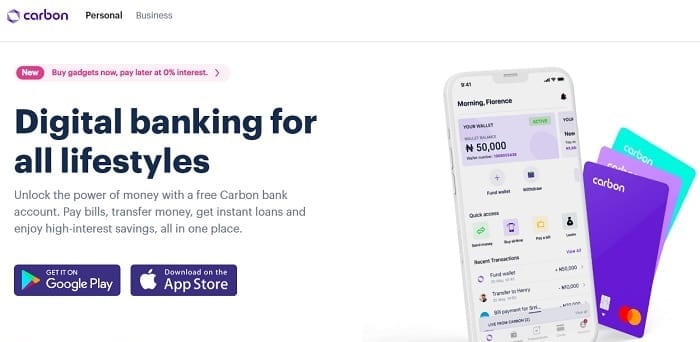
Formerly known as Paylater, Carbon is a digital banking app that also gives out loan to individuals and businesses. The app provides all sorts of exciting financial services, including savings, investment, payments and so on.
Hence, Carbon is more than an app for borrowing money; it is an app that offers “digital banking for all lifestyles”. However, for this post, let’s focus on its loan feature.
Insured by NDIC and certified by the Central Bank of Nigeria (CBN), Carbon loan does not require any form of collateral, neither would you have to fill any form. The entire process is online, and you will receive your loan within minutes.
How to get a loan from Carbon app
Download the Carbon app from the iOS app store or Google Play store
Register in few minutes by providing a few details about yourself
Go ahead and apply for loans
Your loan would be sent to your wallet on the app from where you can use it for different transactions. You can also send the money from your wallet to your bank account so you can withdraw it.
Payback your loan on time to unlock higher amounts. Also, you stand a chance of getting 10 – 100% cashback when you pay back your loan on time.
PalmCredit is another mobile app that gives Nigerians easy and convenient loan. Boasting of being “Nigeria No. 1 online loan…”, the money lending app offers flexible loans with reasonable interest rates.
As with most other loan apps, paying back your loan on time on PalmCredit helps you to update your credit score. The implication of that is you get higher offers when next you apply for a loan.
Some of its unique fixtures include offering up to 100k loan with a daily interest rate of 1.2%.
How to get a loan from PalmCredit
Download the Palmcredit mobile app from your app store
Register and set your account in minutes
Apply for a loan
Get approval within minutes
The loan is disbursed to your bank account
Interest Rate: 14% – 24%
Loan amounts: ₦2,000 – ₦100,000
Loan terms: 14 – 180 days
Target market: Individuals
Okash
A product of OPay, Okash is another loan app that offers loans to Nigerians. The app is committed to increasing access to loan facilities to the underserved section of the society.
You get loan decisions on Okash within seconds, and once your loan is approved, you’d receive funds within 5 minutes.
For your first loan application on Okash, you can’t get more than ₦10,000. The money will increase in subsequent applications, especially if you pay back your loan on time.
Okash loans are provided in partnership with Blue Ridge Microfinance bank; hence you can pay back your loan via direct transfer to Blue Ridge Microfinance bank account (Zenith Bank Account No:1130085518)
How to get loan from Okash
Download and install the Okash app from your app store
Register an account
Select the product or loan amount you’d like to apply for
Provide necessary information and submit your application
You may get a call for verification after submitting your application. Ensure you provide the right information
E-sign the loan agreement after approval
After this, the approved loan will be dispensed to your registered bank account
Interest Rate: 23 – 35%
Loan amounts: ₦3,000 – ₦500,000
Loan terms: 7 days – 365 days
Target market: Individuals and businesses
Fairmoney
Fairmoney is a money lending app for Nigerians where you can get a loan within 5 minutes. You know this is a big deal if you’ve had to wait for days to get a loan from your bank.
Fairmoney is not just a loan app, by the way. The app also provides some essential financial solutions such as airtime recharge and payment of bills.
The primary requirement for a Fairmoney loan is your BVN, and you can get as much as N500,000. And you can spread repayments in multiple instalments for ease and flexibility.
How to get a loan from Fairmoney
Download the Fairmoney app from the Playstore
Signup with your phone number and create your PIN
Click apply on the home page
Answer the few questions provided
Get a loan offer
Choose amount and tenor
Accept the loan offer
Provide bank details where you want your money sent and get it within minutes
Interest Rate: 10 – 30%
Loan amounts: ₦1,500 – ₦500,000
Loan terms: 61 – 180 days
Target market: Individuals and businesses
Aella Credit
Aella Credit is a fintech app that provides such services as payments, investment, and loans. The app makes it “super easy for anyone to borrow, invest and make payments” without excuses.
The money lending app even offers affordable insurance services for its customers. Now, that’s something different compared to others in the list.
For Aella, the end goal is to provide financial inclusion for all, irrespective of social class or profession.
How to get a loan from Aella Credit
Download the Aella app from your app store
Create your account by filling out your details in less than a minute
Answer some quick questions to update your profile
Click the “check eligibility” button to see if you qualify for a loan and how much
Apply for the loan, and it will be sent to your provided bank account within minutes
Payback your loan on time
Interest Rate: 4 – 20%
Loan amounts: ₦2,000 – ₦1,000,000
Loan terms: 1 – 3 months
Target market: Individuals and businesses
Blackcopper
If you are thinking of an app where you can borrow money to grow your business, then checkout Blackcopper. The app is committed to keeping “the wheels turning for your business”.
Aside from giving quick loans to individuals and businesses, Blackcopper also has investment opportunities for its users. Sign up to benefit from either of the two services the app offers.
How to get a loan from Blackcopper
Download the Blackcopper mobile app from Apple store or Google Play store
Register your account by providing the required information. Secure your account by verifying it via mail
Access Quick loans for your business needs or access investment opportunities on the app
Interest Rate: As low as 3.74%
Loan amounts: ₦500,000
Loan terms: Up to 6 months
Target market: Individuals and Businesses
FAQ
What are the main eligibility conditions precedent to loan
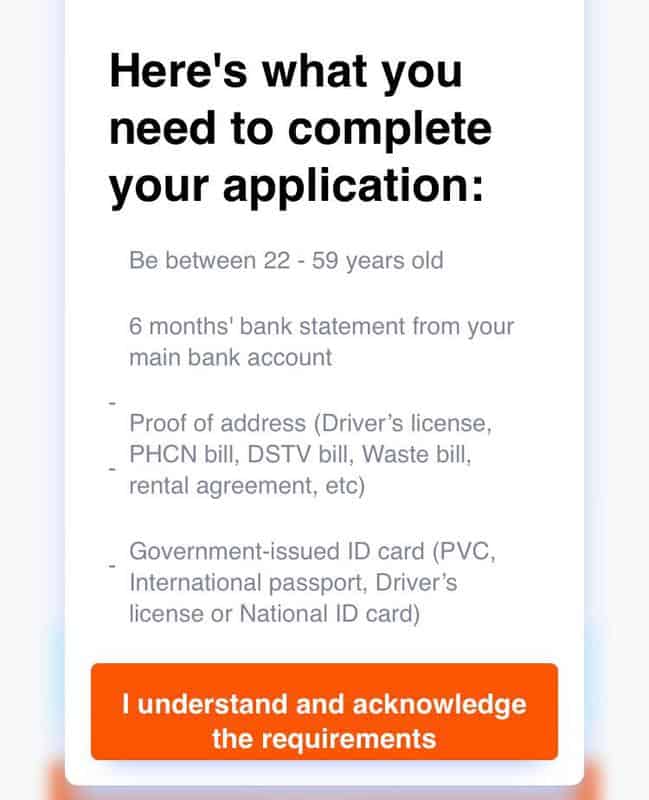
1. You must bee between the ages of 22 – 59 years old2 2. Have a verifiable source of income 3. Live and/or work in cities where we operate 4. Have a savings or current bank account with any commercial bank
What are the required documentation to apply for a loan, using any of the loan apps?
You need your bank statement, a government issued ID card and utility bill (optional).
Branch offers loans from ₦1,000 to ₦200,000. Loan terms range from 4 – 40 weeks. Interest ranges from 15% – 34% with an equivalent monthly interest of 3% – 21% and APR of 33% – 261%, depending on your loan option.
Conclusion
Accessing loans for personal needs and business development is no longer so much of an issue. However, resist the urge to get a loan when you don’t need one or don’t have a clear plan to pay back.
Also, take your time to study these money lending apps’ terms and conditions before submitting your application for loans. Be sure you agree with these terms to prevent future regrets, especially in terms of the interest rate.
Do you know of other loan apps with amazing offers and excellent services? Share in the comments.
Though there are a lot of money lending apps out there, When it comes to sourcing loans for your business, Renmoney is one of the leading microfinance banks providing financial solutions to small business owners.
With its seamless interface and a convenient workspace in 25 out of 36 States in Nigeria, Renmoney offers financial solutions to individuals and small businesses in states where it owns an operating office.
The biggest challenge of small businesses is access to funds.
This is in spite claims by Financial institutions when campaigning about luxurious loan offers at presumably favourable costs to SME’s.
Renmoney prides in its use of tech to provide financial solutions to businesses that fall below the Small and Medium Enterprise(SME) rankings, through easy access bite-size loans with a customized return policy that won’t break your back.
What is SME Ranking?
SME’s are ranked by staff capacity. Lower capacity may affect your chance at getting funds from investors.
Of the 41.5 million enterprises in Nigeria, 99% of these enterprises rank as small scale enterprises.
Yet, there are lots of small businesses that do not meet the criteria.
Small firms are generally those with fewer than 50 employees, while micro-enterprises have at most 10, or in some cases 5, workers.
This number varies across countries. In Nigeria, the upper limit designating an SME is 250 employees, as in the European Union.
However, some countries set the limit at 200 employees. The United States considers SMEs to include firms with fewer than 500 employees. Source.
If you run a solo outlet with no real assets or credible employment history, then accessing loans may prove difficult.
With the upshoot of small businesses in Nigeria, a loan remains the best option in seeking funds that would help grow your business.
The SME rank data may have placed a limitation on low-income earners when it comes to accessing funds for growing their business.
But with Renmoney, you can access loans and grow your business with little to no hassle.
What is Renmoney?
Renmoney is a microfinance bank that prides itself as Nigeria’s most convenient lending company with innovations that deliver outstanding service experiences.
They grant both personal and micro-business loans ranging from N50,000 to N6 million.
What makes them different from other loan outlets?
Renmoney covers a variety of loans to suit each individual’s needs. The loans can be for school fees, smartphone funding, point of sale and loan at work.
It is open to self-employed and employed individuals.
What Renmoney Offers:
Flexible loan tenures
Competitive rates
No guarantor required
Zero hidden fees.
Does not require collateral
Get money in 24 hours
Why Get a Business Loan From Renmoney?
At some point, you would need a business loan to scale up in other to reach a larger market that in turn guarantees profit and growth.
It’s Fast and convenient
No collateral or guarantor needed
Flexible repayments
Competitive rates
Our loans are designed to meet your financial needs. So, whether you’re employed or run your own business, you can get a loan of up to ₦6,000,000 today.
Renmoney currently operates in 25 out of 36 States in Nigeria.
How Can I get a business loan from Renmoney?
Step by Step Guide to Accessing Loan on Renmoney
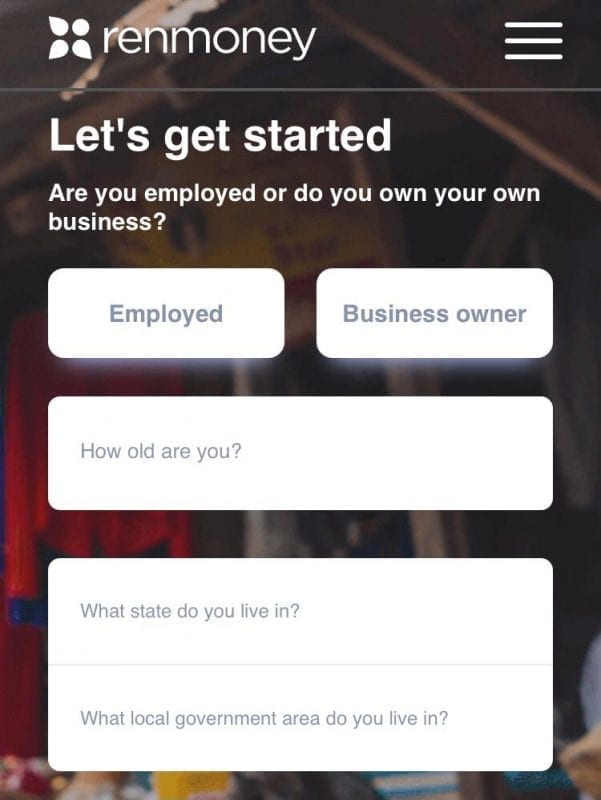
Step 1: Apply
You can apply by visiting the official website.
The first thing I noticed is that the user interface is cool and easy to navigate.
Renmoney loans are accessible to anyone between the age of 22 and 59.
The first part of the form requires your employment details. Next, you fill your name and other details as proof of identity and address.
You’d notice there are two categories for employees and entrepreneurs. This would help Renmoney determine the kind of loan that is applicable to you.
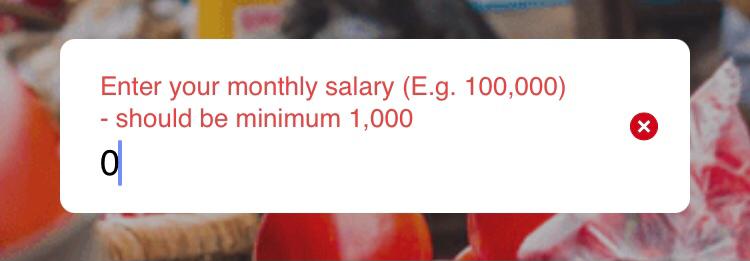
I applied for a loan as an employee. The meaning amount that you can enter as monthly salary is N1000.
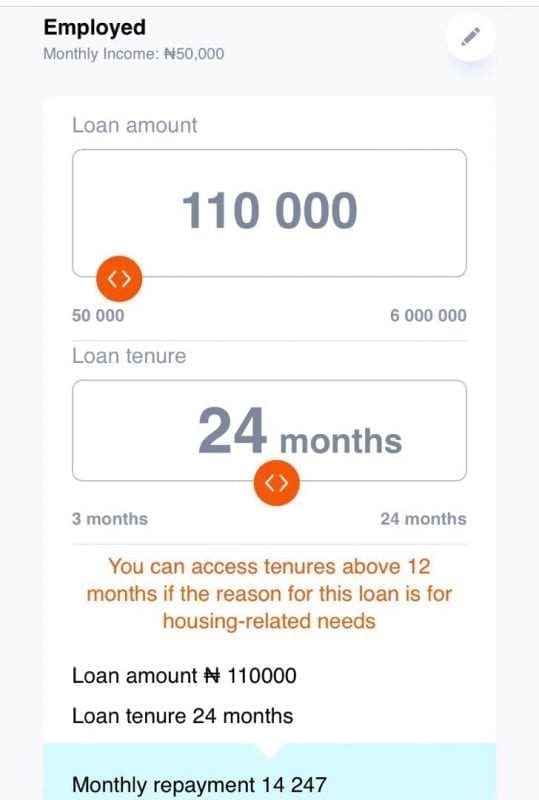
I entered an estimated salary of N50,000 and the site suggested a loan of N110,000 for a 24month tenure.
This does not imply that I am eligible for such loan.
You may have noticed red ink stating that: I can access loans outside the 12 months tenure if the purpose is for rent.
This implies that other loans may have a maximum 12 months tenure.
With a monthly repayment of 14,247, I’ll be paying a total of 231,928 in interest.
Renmoney does not out-rightly state it’s interest rate on any loan, rather it uses an inbuilt loan calculator to determine interest on loan.
After Choosing a loan amount and tenure you can move to step 2.
Step 2: Verify
Verify the information that you’ve provided.
More personal information is required at this point, including your ID number for whatever mode of identification you choose (but it’s optional).
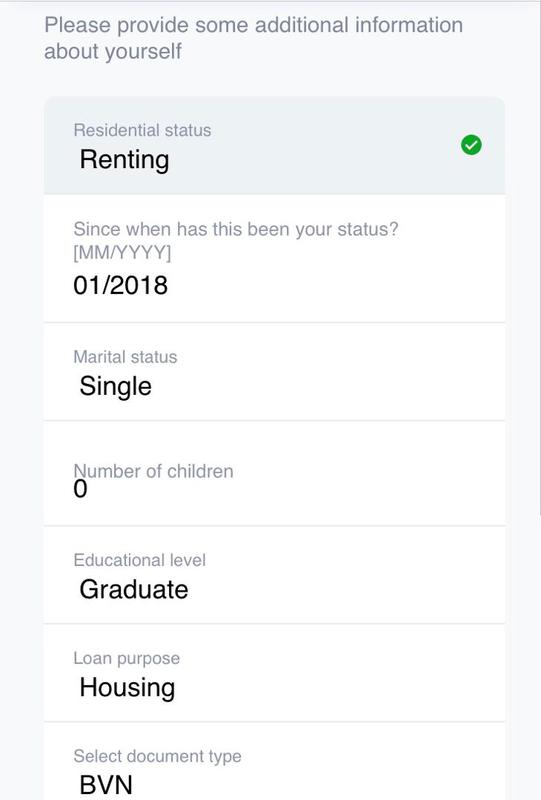
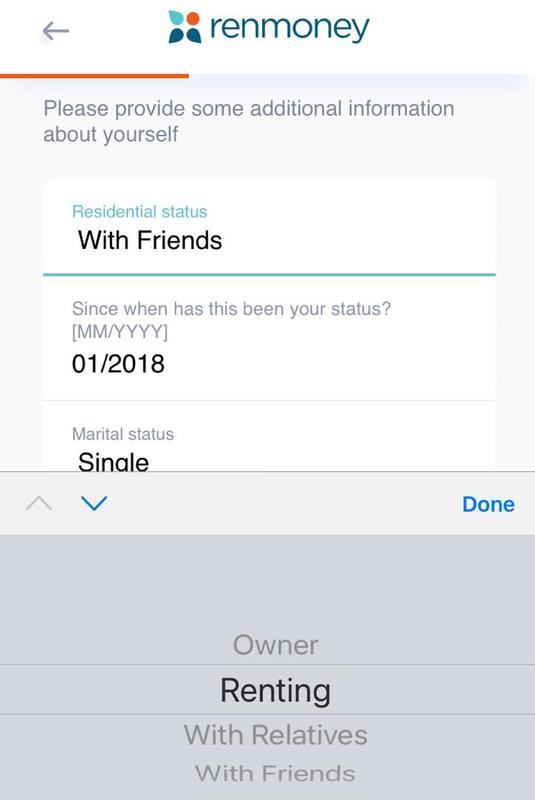
Renmoney would require your residential and marital status to enable them work out your financial responsibilities and advice on a suitable loan.
Upload a clear photograph or take a quick selfie for identification.
I did not get beyond this point, considering I didn’t need a loan in the first place.
However I got a call from a customer management staff offering to assist in completing the the form.
Step 3: Receive loan
I guess this is where the disgruntled reviews come in when people get loans way below their expectations.
Financial Institutions do not give loans in good faith. Understand that it’s a business risk, and they have to tread with caution.
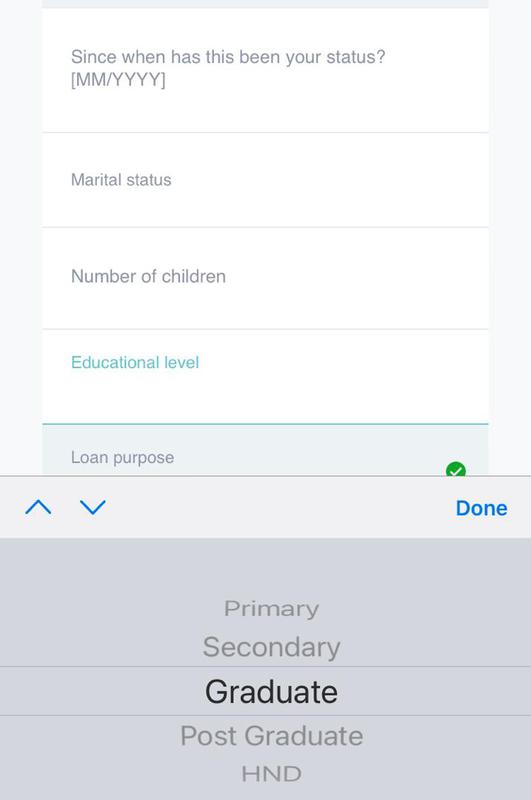
Here are other aspects of the form that could guide you on what to expect when applying for a loan from Renmoney.
Look through the questions in each image. Your answer might affect how you score. Work on improving your score.
You could set a financial target to reach your desired loan and work toward it.
Business requires planning. As you plan toward growing your business, prepare your business to be credible for loans.
Get money in your bank account within 24 hours if your loan is approved.
How to Get a Good Credit Score for Your Business
If you are a sole entrepreneur who multitasks your few staff or doubles as everything, the first step to creating a good credit score is by separating business from personal finance.
Keep proper financial records because Renmoney would request for a six months financial statement before granting a loan.
The financial institution measures your credit score through the use of algorithms that determine if you’re creditworthiness.
Most scoring models take into account your payment history on loans how long you’ve had accounts open, the types of accounts you have and how often you apply for new credit.
Pay your bills. It’s hard to measure bill payment in Nigeria, and most financial institutions request for your Power bill at the time of opening an account. Renmoney tracks the amount of money that enters your account against the mode of spending to determine if you’d be able to meet the monthly payments. That is why it’s good to keep proper bank records for your business. If you earn cash, ensure to make deposits into the account as proof of your actual financial capacity.
Don’t run your business account in the red. Set a minimum amount that must remain as a minimum balance every month. As a business owner with no real asset, your only asset is in the proof of consistent cash flow.
Old credit records. Some banks offer small loans to their customers. If you plan on taking a business loan in the next 6months, try applying for a small loan. It doesn’t have to be large and ensure you refund in time. This would boost your credit score. In the absence of such record, your loan may be significantly reduced to an amount that Renmoney considers borrowable.
Borrow now. Alternatively, you can start borrowing in small bits to build your credit score. As you repay loans, Renmoney increases the margin on the amount that can be borrowed to you.
Reviews
Before jumping into bed with any business, always consider a handful of reviews.
While the interface was great and my short talk with the agent went smooth, here are some reviews from other customers.
Note these reviews have been included in this post to help you make informed decisions when it comes to growing your business with renmoney.
Hello my name is Mrs folakem, I filled out all of my information and on the final stage to get approved they went numb, waiting for the so-called code up till now to finalize my activation and still haven’t heard anything, I just hope these guys aren’t fraudsters because I have given all of my information to them Useful Share
I wish there was a no star option, that is the best to describe the type of horrible service that this company dishes out to her customers. I have been a customer for over 14 Months and everything was going fine but just before the corona pandemic, i had financial crisis which then was worsened by the shutdown of the nation. Through out the lock-down i keep getting calls from different agents with various threats as if threats will yield money, i tried severally to know if those agents were calling from another planet other than earth, cos i believed everyone on earth knows what is going on has the world is almost completely shut down, they told they are on earth and infact in Lagos, to me that shows the level of wickedness of a company whose only interest is how to recoup their money not even taking into consideration the payment history of the customer. Its extremely sad that at a time every corporate organization is looking for ways to impact the people by means of preaching hope, all that matters to Renmoney is their money. Let me emphasize here that threats doesnt bring about money,compassion does. I will be unfair if i do not single out a particular lady who was exceptionally different ” Ester” she spoke well and kept on encouraging me that things will get better and yes its getting better and i have since began paying, by God’s grace i will soon finish my repayment and i will warn even the worst of my enemy not to near anything that starts with REN……Its been hell of an experience. I will nominate RENMONEY for an award for the company with the most heartless set of customer care team, i am confident that you will surely have no rival for the award.
Currently even having issues with renmoney , they claim you get your credit alert on or before 24hours, it’s just not true, the customer service is just inconsiderate, and some cases ill mannered.. They have no respect for client time, and they just switch off once the loan has been applied for and the payment mandate is placed on your account… Credit doesn’t come within 24hours as they advertise and their interest rates are high..i still have an uncredited loan as we speak, with a payment mandate on my account
Now you know what to expect when applying for a business loan on Renmoney. From Snapshots of loan forms to client reviews, this article provides a step by step guide to loan application and insight on improving your credit score.