Category: TIPS

  • Launching and Managing a Successful Care Business in the United Kingdom

    Launching and Managing a Successful Care Business in the United Kingdom

    Are you considering launching and managing a successful care business in the United Kingdom? If so, you’ve made a wise decision. The ageing population and the increasing need for in-home care services throughout the UK have created a high-demand industry that is set to continue growing in the coming years.

    However, like any other venture, starting a care business involves several steps and requires careful planning and execution. In this comprehensive guide, we will walk you through each stage of starting and running a successful care business.

    1. Market Research and Business Planning

    The foundation of starting a home care business, care home, or simply starting a care staffing agency, requires a carefully crafted business plan, with comprehensive market research. This phase involves:

    • Identifying Your Target Market: Your potential clients may include the elderly, those with disabilities, or other individuals who need in-home care. Research your local area’s demographics, and make sure there is a demand for your services.
    • Competitor Analysis: Identify other care agency businesses in your area. What services are they offering? What are their rates? Consider their strengths and weaknesses to determine your unique selling proposition (USP).
    • Formulating a Business Plan: Your business plan should cover your company’s mission and goals, expected expenses and earnings, marketing strategy, and staffing needs.

    2. Licensing and Legal Requirements

    To operate a care agency, you will need to comply with a set of standards and regulations laid out by the Care Quality Commission (CQC) in England or its equivalent in other UK countries. Consider these essentials:

    • Register Your Business: Register your business with Companies House as soon as possible. You can choose from sole trader, partnership, or limited company. Learn the requirements on how to register a care agency and related service companies.
    • CQC Registration: Your care agency needs to be registered with the CQC, which will involve inspections to ensure you are meeting the government’s health and social care standards.
    • Insurance: It is crucial to get the appropriate insurance for your care agency business to protect your company and staff.
    • Also consider this with regards to CQC compliance:
    • Registration & Licensing: You must register with the CQC before any service provision, whether your organization is a residential care business, a domiciliary care agency, or other healthcare services. Registration with the CQC usually takes several weeks, though uploading the requested documents might take from a few hours to days, depending on how prepared you are.
    • Key Lines of Enquiry (KLOEs): These are the high-level questions that the CQC asks about services to get to the heart of the type of care they’re providing. KLOEs are structured around the five key questions: Safe, Effective, Caring, Responsive, and Well-Led.
    • Meeting Fundamental Standards: The fundamental standards are the standards below which care must never fall. This includes personal dignity and respect, freedom from abuse and harm, quality of treatment and care, and good governance among others.
    • Maintaining Ratings: Once your care service is up and running, the CQC will continue observing and rating your service on a scale of Inadequate, Requires Improvement, Good, or Outstanding. To meet and maintain the high standards, continuous improvement and regular internal audits are essential.
    • Provider Information Return (PIR): The Provider Information Return is a self-assessment that care providers must periodically submit to the CQC. It requests information about their service and what they are doing well, and can be requested at any time.
    • Staffing Requirements: Staff members must be properly qualified, competent, and given the necessary training. It is also important to ensure there is enough staff to meet the needs of the people using your service.
    • DBS Checks: Every staff member must undergo a Disclosure and Barring Service (DBS) check to prevent unsuitable people from working with vulnerable groups of people.
    • Policies and Procedures: The CQC requires you to have a set of policies and procedures fit for your service types, including safeguarding, whistleblowing, health and safety, equality and diversity, and more.
    • Remember, these are just a few key aspects, and running a successful care service requires a multitude of other considerations too. Consulting with a legal expert can be beneficial to ensure that you are complying with every aspect of CQC requirements.

    3. Hiring Highly-Qualified Staff

    Your staff depict the face of your business, and a skilled, empathetic team of caregivers can ensure your care agency’s quality and reputation. As the needs and expectations of care-dependent individuals rise, so does the need to pick highly-qualified staff in care agencies. Hiring the best individuals – capable, empathetic and professional, is critical for a care agency’s reputation and success. They can effectively support service users, ensuring that the care provided is not only satisfactory but also of high quality. Here’s a look at key strategies for hiring highly qualified care agency staff.

    a. Thorough Job Descriptions:

    Getting the best candidates starts with clarity on what the job entails. Crafting a comprehensive and clear job description that outlines all expectations, necessary qualifications, responsibilities, and obligations is crucial. This directs the recruitment efforts towards the right candidates, saving both time and resources.

    b. Implement a Rigorous Screening Process:

    To get highly qualified staff, set up a robust screening and interview process that helps filter candidates based on professional credentials, experience, skills, and personalities. This includes detailed checks of all claims made in their application and interviews. Prior experiences, qualifications, and references should be thoroughly vetted. High-caliber candidates can effectively handle client needs and are likely to have a history of being proactive, reliable, and engaging in their previous roles.

    c. Invest in Training:

    Part of hiring highly-qualified care agency staff is continually building their skills and knowledge. Routine training and professional development are essential for equipping your team with the latest best practices in care delivery. Even highly-qualified staff can benefit from training, which helps them adapt to new care techniques, legal requirements, technologies and evolving care dynamics in different settings.

    d. Prioritize Soft Skills:

    A care agency employee’s role involves more than technical skills and following procedures; they engage with people regularly. Empathy, communication skills, patience, and resilience are invaluable as much as formal qualifications. Gauge these during interviews or reference checks to ensure that you hire well-rounded candidates who can deliver holistic care.

    e. Offer Competitive Compensation:

    To attract and retain the best talents in the care industry, offer competitive salaries and benefits. These could include health benefits, flexible work schedules, training opportunities, and more. A competitive compensation package gives your agency an edge in the crowded market of care providers. By all means, understand the answer to the inevitable question of how much do care agencies charge per hour.

    f. Foster A Strong Company Culture:

    A healthy agency culture not only retains talents but also attracts similar-minded individuals ready to add to the existing vibrancy. The culture should genuinely care about employee well-being, promoting inclusivity, collaboration, and respect. Agencies with strong, positive cultures often have dedicated, satisfied staff, hence reduced turnover rates.

    Hiring highly-qualified personnel in the care agency sector may be challenging due to its complex nature and high expectations. Still, with attention to detail, a keen focus on people skills, and a supportive work environment, care agencies can successfully recruit and retain top-notch staff. High-quality care hinges on the quality of personnel; thus, it’s an investment worth every effort.

    Suggested Reading: The Ultimate Guide to Launching a Successful Supported Living Service

    4. Establishing Your Brand

    How your brand appears and how you market it plays a pivotal role in the success of your care agency.

    • Create a High-Quality Website: Your website is the first point of contact many potential customers will have with your agency. Make sure it is professionally designed, user-friendly, and has clear contact information.
    • Marketing Campaign: Traditional methods like leaflet distribution, newspaper ads, and word-of-mouth advertising are beneficial. However, in today’s digital age, online marketing on social media platforms and care service directories should also be utilized.
    • Chose and be known with a council: Since the local councils would be your primary clients, you should establish your brand locally and be known with names like – Generixcare Luton, showing where your office(s) are, and where you like to operate.

    5. Day-to-Day Operations

    Running the day-to-day operation of your care business requires meticulous organization.

    • Scheduling: Based on the clients’ needs and preferences, create a roster for your caregiving staff.
    • Quality Assurance: Regularly evaluate the quality of your services. This can involve inspections, client feedback, and personnel performance reviews.
    • Operational Software: Consider investing in agency management software that can handle client records, staff scheduling, invoicing, and more.

    6. Continual Improvement

    The care industry is constantly evolving, and so should your agency. Stay updated with the latest industry trends, participate in relevant training, and commit to continually improving your services.

    Whether you have previous experience in the care industry or you’re a newcomer with a passion for helping others, running a care agency can be a rewarding, profitable venture. However, it’s vital to bear in mind the immense responsibility that comes with it. The operations you set up have a direct impact on your client’s quality of life.

    Remember, your priority should always be to provide top-notch, compassionate care. With commitment, perseverance, and the right planning, starting a home care business and running a home care business in the UK should be a walk in the park for most people. It is a challenging journey, but the reward of making a significant difference in people’s lives is well worth it.

    Click here to see a sample of CQC rating for Generixcare, Luton, UK.

    Suggested Reading: How To Start A Home Help Business and Understanding Domiciliary Care Agency UK.

    How do I get clients for domiciliary care UK?

    Of course, providing the best care for your current clients is crucial. But you need to think outside the box a little when attracting new ones.
    Volunteering, networking, and using the internet are great ways to start. But that’s only scratching the surface. Read more here

    What is an introductory care agency?

    Introductory Agencies put care-seekers in contact with self-employed Nurses or Carers, from which the individual may select a Nurse/Carer who he/she will then employ or use.
    Unlike traditional care providers, Introductory Agencies do NOT
     play an ongoing role in care planning or the practical delivery of care.

    What is the average Salary of a Domiciliary Care Worker in the UK?

    This may vary due to a lot of factors like company profitability and other business factors, however, the Scottish government minimum wage for care workers of £10.02 per hour (equivalent to NHS Band 2), announced on 6 October 2021;
    NHS Band 3 with 2+ years’ experience – £11.14 per hour; 
    A competitive labour market wage rate in parts of the south and southeast of England of £12.50 per hour, which providers in some areas are finding it necessary to offer to attract any applicants

    Suggested Reading: Challenges of Small Business Owners

    In conclusion: launching and managing a successful care agency business is not rocket science, however, there must be carefully designed and implemented strategies in place to ensure the profitability of the business. A major success factor depends also on how you are able to align your team and get them to work as a team. With the right team, strategy and technological systems in place, you are sure to successfully run your care business and smile home to the bank on a regular basis.

  • 6 Tips to Increase Productivity and Efficiency in Tech

    6 Tips to Increase Productivity and Efficiency in Tech

    Technology is taking the lead in our daily lives. People increasingly depend on today’s advanced gadgets and software for work or leisure. While, in some cases, technology can be a friend to make our lives easier, increasing productivity and efficiency in tech is not always easy. Many productivity and efficiency apps, programs, software, and gadgets are available in today’s modern world. Here we shall discuss some tips to help you enhance your productivity and efficiency in tech.

    1. How to Get Started with Technology

    The first thing you need to do to increase productivity and efficiency in tech is get started. The best way to begin is by organizing or setting up your computer. Several software and desktop programs will help you manage your computer and make things easier. There are a few other options for this, but this software allows you to organize your computer, much like the settings on your phone and tablet. For example, you can use music, documents, and photo folders. You can also create shortcuts to process files or emails from the start menu or the taskbar, which takes care of those annoying things that pop up while working.

    2. Improving IT Efficiency through Digital Transformation

    Today’s IT department is not only responsible for supporting legacy platforms, but also for innovation. The demand to innovate using new technologies is rising, making IT departments and information technology professionals work harder. Organizations are constantly striving to improve efficiency in technology through digital transformation practices such as mobility, cloud computing, and big data analytics. This is rapidly increasing the demand for IT efficiency and transformation.

    3. Use Technology to Stay Organized

    Modern IT professionals have to handle many tasks that require their attention and also ensure they stay organized with everything else that happens in their lives. The backlog of emails and essential files sitting on personal computers is expected, translating into wasted hours searching for information. Several smartphone apps help you stay organized and reduce the stress of everyday life. If you need IT Support in San Antonio, TX, you can visit our website to find a company that can help you.

    3. Improve Productivity by Automating Tasks

    Modern companies have a plethora of tasks to complete daily and weekly. While maintaining normal processes and following strict schedules is essential, forgetting something important and being unable to pick up the phone when needed can cause stress for employees in the office. Several apps available for smartphones will help you remind you about your tasks or let you know when it is your turn to take a break. It is also essential to use technology to automate specific tasks so that you can focus on your work.

    4. Invest in Technology to Reduce Costs

    One of the essential aspects for IT is cost reduction. Today’s organizations need to focus on their bottom line and ensure their resources are being used efficiently, with no gaps and waste of money. Noticeable benefits include the reduction of overhead expenses, an increase in productivity and efficiency in tech, as well as other financial performance indicators. Get better productivity from IT by focusing on best practices to reduce costs associated with this department.

    5. Emphasize Collaboration

    Collaboration is essential for the success of any enterprise and an important aspect that today’s managers and CIOs have emphasized. Teamwork is being emphasized more than ever before, creating a need for technology to support that workflow. Today’s business models require a collaborative approach to achieve what an organization needs, and IT professionals play a significant role in collaboration success.

    6. What Technology Is Right for You?

    While there are various ways, today’s technology can increase productivity and efficiency. Certain technologies are best suited for every individual. Mobile devices are growing increasingly popular and have become an essential part of our daily lives. For example, tablets have taken off as one of the most common devices business professionals use for productivity and efficiency in tech. With an increasing number of people buying smartphones, deciding which one will be most suitable for your work is necessary.

    Technology is often taken as a friend, but there are several challenges an IT professional faces daily. It is essential to understand the limitations of technology and not rely on it. Taking time to unplug, relax and have some downtime can improve productivity by reducing burnout and stress. Improving productivity and efficiency in tech can be done by focusing on an effective IT operation, building a strong team, and investing in the right technology.

  • Data Analysis As A Tool For Business Growth

    Data Analysis As A Tool For Business Growth

    Data analysis is an essential tool for businesses. It helps business managers and owners to understand their operations to grow and succeed. It is a powerful way of understanding how a business performs and what areas need improvement. It is a valuable tool for businesses to look into the areas that are working well, as well as areas that may need some extra attention. When used correctly, data analysis can be a great asset to any business. It can help identify trends, highlight issues, suggest opportunities and inform decisions.

    Data analysis can help businesses in various ways. It can provide insights into customer behaviour, marketing campaigns, and website usage, to name a few. It can also be used to analyze financial and operational performance. By using data analysis, businesses can gain a complete understanding of their customers, operations, competitors and the wider environment.

    Without a doubt, Data Analysis is a cost-effective way to gain insights on various topics. It can help businesses make better decisions, leading to improved performance and growth.

    In this blog post, we will try to take a deep look into how Data Analysis can be used to enhance business growth.

    1. Collecting and analyzing data in Data Analysis

    Data analysis is a tool that enables businesses to make better decisions, identify trends and opportunities, and measure performance. By collecting and analyzing data, businesses can gain insights into customer behaviour, performance, operations, and more.

    Collecting data can be done in various ways, such as through surveys, interviews, focus groups discussions, customer feedback, and website analytics. Once collected, the data can be organized and analyzed using a variety of software applications and techniques, such as statistical analysis, predictive analytics, and machine learning. By understanding the patterns in the data, businesses can take action to improve their operations, optimize customer experiences, and reach their growth goals.

    2. Identifying trends and correlations

    Data analysis is a powerful tool for business growth, and one of its most effective aspects is the ability to identify trends and correlations. By analyzing data, business owners can quickly spot meaningful relationships between different pieces of data that could be used to inform decisions. For example, by correlating sales data with customer demographics, businesses can identify customer segments they should target with certain products or services. Identifying trends is also important for spotting changes in customer behavior, competitive landscape, and broader economic conditions. By recognizing patterns in data, businesses can anticipate changes and adjust their strategies to adapt and stay ahead of the competition.

    3. Setting measurable goals

    Creating measurable goals is an important step when it comes to business growth. It allows you to track your progress and set objectives that you can work towards. By setting goals, you can measure your progress and determine if you are on the right track. In addition, having measurable goals encourages you to be proactive and take concrete steps to reach your objectives. When setting goals, be sure to make them specific, achievable and time-bound. This way, you can easily track your progress and adjust your course of action as needed. Additionally, setting measurable goals allows you to clearly identify what success looks like for your business and develop a roadmap for achieving it.

    4. Making informed decisions

    Making informed decisions is the ultimate goal of data analysis. With the insight gained from data analysis, businesses can make decisions that are more informed and better suited to their current and future needs. Data analysis helps businesses to make better decisions by providing them with a comprehensive understanding of the data, allowing them to identify patterns, trends, and correlations, as well as potential risk factors. This information can then be used to inform decisions such as where to invest resources, how to adapt to changing market conditions, or which products to bring to market. By leveraging data analysis, businesses can make decisions that are more informed, more accurate, and more profitable.

    5. Tracking progress over time

    When it comes to data analysis as a tool for business growth, tracking progress over time is essential. It allows you to assess how well your strategies are working and identify what strategies need to be adjusted or replaced. Tracking progress over time also provides an opportunity for you to measure the impact of your decisions, and it allows you to identify any potential roadblocks that may be preventing your business from making progress. In addition, tracking progress over time helps you to develop more informed and accurate forecasts based on the data you have collected.

    In conclusion, data analysis is a powerful tool that can help businesses gain a competitive advantage. By leveraging the insights gained from data analysis, businesses can make informed decisions, identify new opportunities, and optimize their operations. This can lead to improved customer engagement, higher customer satisfaction, and ultimately, increased profits. Moreover, businesses can use data analysis to develop more effective strategies and gain a better understanding of their customers, which can help them stay ahead of the competition.

  • 7 Hacks to Advanced Trading Management

    7 Hacks to Advanced Trading Management

    Advanced trading management is a term used to describe the higher level of trading that traders must master to succeed and make a living from trading. While not everyone needs to trade their way to the top of Wall Street, trading is an important part of many people’s career paths. Also, since this is such an important skill for anyone looking to earn money as a trader, it’s essential that you learn how to trade effectively and efficiently. Here are 7 hacks you can use to become an advanced trader.

    1. Know your edge

    You need to know why you are a good trader and why you are not. This may seem strange, but it’s one of the most important things to consider when trading without leverage. If you trade without leverage and don’t have an edge, the markets will eat you alive. You have two options: become better at trading or find an edge that works for you. Advanced trading management means knowing your edge and how to use it when making trades.

    2. Know your market

    You need to know your market inside and out so that you know what opportunities to take advantage of and which ones not to take. This is one of the most crucial aspects when trading without leverage since you need to know what stocks are good for you, whether or not the stock will move in your favor and how the stock has performed in the past. You also need to be aware of the news in the market, whether or not it is important and what people are saying about it. You also need to know your competitors inside and out to know when they have a bad or good day and how they trade. This way, you can look at their trades from an informational standpoint and evaluate how smart they are.

    3. Have a consistent methodology

    Have a specific system that you trade and only trade. It doesn’t matter whether you like to trade off support, resistance, or news; have a specific trading methodology that you use repeatedly. The more times you do something, the more comfortable it will become when making trades, and the better decisions you will make. It’s essential to stick with a consistent methodology, whether or not it is profitable for you. Establish patterns you follow and stick with them, regardless of whether or not they create profits. Harmonic patterns indicator for NinjaTrader enables you to easily recognize and trade Harmonic patterns by displaying indicators for them on your chart. It also includes a Harmonic patterns indicator for NinjaTrader that can be used to identify Harmonic patterns from the outside and trade them the same way you would normally trade Harmonic Patterns.

    4. Establish entry and exit points

    Entry and exit points are known as your risk management parameters. Before you make a trade, you need to know how much money you are willing to lose on each trade and what the upside is for each trade. The same is true for taking profits. You need to know how much money you are willing to make on each trade and the downside of the trade before deciding whether or not you should take a specific trade.

    5. Understand your emotions.

    You need to understand how you feel and react to risk and reward. For example, if you smack a hornet’s nest, do you run away or start attacking it? Are you scared when the market goes against your positions, or are you calm and collected? You need to be able to recognize the emotional response in your body after making a trade so that you can evaluate whether or not it was effective or not.

    6. Cut your losses short.

    This is one of the most obvious trading tips, but it’s also one of the most important. You need to know when a trade will go bad to get out before it has a chance to do damage. This means you need to take your profits when they’re there and get out when the market turns against you. That’s just something that comes with experience and discipline. As an advanced trader, you need to be able to make smart decisions and trust your gut.

    7. Develop a plan for the future.

    Make sure that you have a plan in place for the long term, and don’t just trade based on yesterday’s results or the day’s news. This is an important aspect of trading without leverage since you need to be flexible and adapt to changes in the market. You also need to know where you will go with your trading career and what skills you will need to do so. One of the traders’ greatest mistakes is failing to prepare for their futures. Without a plan in place, you are very likely to fail.

    Conclusion

    Advanced trading management is about becoming comfortable with your trades and consistently making the best choices. You also need to know your trading edge and have a consistent methodology for making trades. This will enable you to make the best decisions, regardless of whether or not you are profitable at the time. Advanced trading management is about knowing yourself, the market, and your competitors to make smart decisions that will lead to profits in the long run.

  • How to Pronounce Entrepreneur

    How to Pronounce Entrepreneur

    In this post, we’ve discussed how to break up the word “entrepreneur” into four syllables, as well as bonus recommendations from an expert on how to learn how to pronounce it correctly quickly.

    In this post, we’ll show you how to correctly pronounce the word “entrepreneur” by breaking it down into its component syllables.

    To help you pronounce Entrepreneur correctly, we’ve broken it into four syllables and explained how to do so.

    English is a complex language. Even after years of study, many of us still have difficulty pronouncing some of the most familiar but difficult words. English has an odd quirk: it’s not always true that talks with the exact spelling also have the same pronunciation. That said, the word ENTREPRENEUR, comes from French, and it is really tough to pronounce.

    How to Pronounce Entrepreneur is the subject of this article and how you can learn to say it correctly from experts. It is important to note that the actual pronunciation of the word “entrepreneur” has been explained in this article, which may vary depending on your regional dialects, tone of voice, and other factors.

    How to Pronounce Entrepreneur in English?

    The French term entreprendre, which means “to undertake,” is the root of the English word “entrepreneur.” An entrepreneur may be broken down into four distinct sections, and each syllable will be examined in detail to help you pronounce the word correctly.

    How to Pronounce Entrepreneur?

    By omitting the l from words like lawn or d from dawn, you can readily decipher the pronunciation of ‘en,’ which means “awn.”

    How to Pronounce Entrepreneur in English?

    Trah is how you say the word “tre.” Some people find it difficult to pronounce ‘the,’ but try to interpret it this way. Tré is composed of three consonants. When saying ‘tre’ as ‘truth,’ make sure your teeth are close together and your lips are flared. The ‘r’ sound in the word will be produced when your tongue pulls back from the top of your mouth.

    Read: What is Office Procedure In Business Studies?

    Phew!

    How to Pronounce Entrepreneur correctly?

    There are two ways to pronounce ‘pre.’ even though many people get confused and pronounce it as pre fro the prepare, this is a misunderstanding you must avoid. It is possible to pronounce the truth ruh as the ru sound in the word crus

    nyow

    How to Pronounce Entrepreneur in English?

    A silent r is used to pronounce ‘neur,’ which is pronounced nyow. Aside from pronunciation rules, many people prefer to use your instead of the word’s correct pronunciation.

    The question of how to say “entrepreneur” can be answered in this manner. Each sound should be combined and spoken as a single sound. As a result, awn+truh+pruh+nyow or awn+truh+pruh+neur is the correct pronunciation of the term “entrepreneur.”

    To learn the correct pronunciation of words, consult Orthoepy.

    How to Pronounce Entrepreneur in English?

    A lot of people use the term “entrepreneur” nowadays.

    Anyone who organizes, manages, and takes on the risks of their own business or venture is considered an entrepreneur.

    The word’s root is entreprendre, which means taking up a French task.

    To be successful in their entrepreneurial endeavors, many of the people I train to improve their American accent must be able to articulate this word clearly and correctly.

    How to say “Entrepreneur” correctly – Additional Tips!

    To assist you in your day-to-day quest to learn how to pronounce Entrepreneur correctly, our consultants have compiled the following list of suggestions:

    • Practice saying each word one time, then repeat the process several times.
    • Practice pronouncing in front of a mirror to see if you’re utilizing the correct mouth formations.
    • Be aware of what you say, and pay attention when you do.
    • Imitate the correct pronunciation by listening to the audio recording.
    • Learn to speak like the people you see in videos.
    • Pay attention to the intonation of your words.
    • The proper syllables should be stressed, so make sure you check!

    Recommended Post: Entrepreneur Burnout, 7 Practical Ways to Avoid It

    Conclusion

    We hope that our guide to pronouncing Entrepreneur correctly was helpful to you. However, the tone and dialect of your voice and the acceptable forms of pronunciation in different places can significantly impact how you pronounce the word. We’ve already discussed and expounded on a commonly accepted pronunciation of the term “entrepreneur.” Take a look at the most recent articles about start-ups and entrepreneurship on Times Next.

    Question:

    Does Starting Your Own Business Make You An Entrepreneur?

    Let’s have your thoughts on this question, please give it using the comment section below, who knows who may benefit a thing or two from your thoughts. Thanks

  • How to Write Stunning Blog Titles [a Template]

    How to Write Stunning Blog Titles [a Template]

    You see, writing is hard. I would know because this is what I’ve been doing for over four years now. I’ve written for different audiences, for different clients and on various platforms, and I know for a fact that the process can be tedious.

    There are many factors to consider when writing, and this can vary depending on the type of writing and platform. But when it comes to writing blog posts, your title takes the crown.

    Why are you reading this piece? Because you know me from somewhere? Most likely not. You sure decided to open this and read because you saw a title that spoke to you, a title that seeks to help you in writing stunning titles.

    So, how do you write stunning blog titles like the one that brought you here?

    You see, creating great content is one thing; getting it read and ranked is another, which is why you should nail your title.

    A title is what sells a piece of content. They are what people see on social media, in emails, and in search engines. Therefore, it’s no surprise that crafting suitable titles is one of the challenges writers face.

    Is there a length requirement for headlines? How should I phrase it? Is there any word that should be avoided? Does it need to be optimised for social, search engines or both?

    In this post, you’ll find a formula for writing good headlines and blog titles. Let’s get started, shall we?

    Related: How To Start A Blog in Nigeria

    An Easy Guide to Writing Stunning Blog Titles and Headlines

    1. Begin with a working title

    Starting with a working title before getting into the nitty-gritty of picking the perfect title is an ideal approach. There is a tendency for people to confuse topics and working titles. Let’s clarify that.

    Generally speaking, topics are vast and could result in several blog posts. Take, for instance, “raising healthy kids” or “kitchen storage.” Both of those topics might be approached in very different ways by a writer.

    In contrast, a working title is particular and guides the writer’s creation of a particular blog post. To illustrate, here are some working titles you could derive from the topic “cryptocurrency in Nigeria”:

    “Current Business Opportunities in Cryptocurrency in 2021“

    “Nigeria- From cryptocurrency ban to CBDC launch in 9 months“

    “Cryptocurrency and Its Future in Nigeria“

    Aren’t they all different and unique? The reason for that is that they are working titles, not broad topics. It’s also worth noting that none of those titles is perfect – they should just be specific enough to guide your blog post. Making them perfect is what we will worry about later.

    2) Be accurate

    A title needs to be accurate if you wish to set clear expectations for readers. To begin with, the title should accurately reflect the content that follows.

    How can you ensure accuracy? Clarify your headline with brackets, just as we’ve done here: 5 Excellent Tips to Attract New Customers (without leaving your office)

    The key is to set clear expectations. According to one study, headlines that include clarifying information outperform headlines without it by 38%. That’s because, before the readers clicked, the brackets clarified exactly what they were getting into.

    This should be the most crucial rule for titles: Respect the readers’ experience. Readers will lose trust in your work when you set high expectations in your title and then can’t fulfil them in the content.

    3) Make it appealing

    The fact that your title must be accurate does not mean that you cannot make it appealing to the eye. You can make a title look more appealing in many ways.

    All of this depends on your understanding of your core buyer personas. Finding what resonates with them and knowing what they find valuable will help you to speak their language.

    You can use the following tips to make your blog titles more appealing after you’ve learned your buyer persona’s preferred style:

    • Play with alliteration. Alliteration makes your titles a little more appealing to read and it can have both a subtle and a strong impact on your reader.
    • Put strong language to use. The power of strong phrases (especially negative ones) like “Things People Hate” or “Stunning” can hit really hard. Nevertheless, they must be used with moderation.
    • Clearly state the value. Having your format and/or contents displayed to readers is a way to make your content look a little bit more appealng. Studies have shown templates to be very effective for increasing CTR: so, do not hesitate to put “Temlate” in a bracket whenever your blog content can pass for a template.
    • Give it a visual appeal. Would it be possible to include visuals within your post? The title should reflect that. A study found that headlines that included the word “photo(s)” performed 37% better than those that did not.
    • Don’t get caught up in the whys; focus on the “whos”. Would you like your audience to be intrigued? Highlight the “who”: Headlines containing the word “who” attracted 22% higher click-through rates. As an example, let’s say you’re writing a post titled, “15 of Our Favorite Brands on Snapchat.” What could we add to our accurate-yet-boring working title? The following options may be considered:

    15 Brilliant Brands Who Are Killing It on Snapchat

    15 Must-Follow Brands That Are Seeing Snapchat Success

    Snapchat Success: 15 Inspiring Brands Who Just Get It

    4) Keep it short

    It’s impossible to set a definitive length or length requirement for your title. You need to consider your goals and where you’ll place your headline.

    Would you like this post to rank well in search? Keep your title under 70 characters, so search engines won’t cut it off.

    Are you optimizing your title for social sharing? In a study by Hubspot, headlines with 8–12 words got more Twitter shares than those with less words. Among Facebook users, the most popular headlines were those with 12 or 14 words.

    In addition, headlines with eight words received 21% more clickthroughs than the average title, according to Outbrain.

    What is the lesson? Getting to know what works for your particular audience through testing is always a good idea.

    Let’s asume I was writing a blog post with this working title: “Think Social Media Is Just for Kids? Here Are 10 Statistics Guaranteed to Prove You Wrong.” 

    Shortening it simply requires rephrasing it and eliminating extraneous words. Here’s how I might approach it:

    Before: Think Social Media Is Just for Kids? Here Are 10 Statistics Guaranteed to Prove You Wrong

    After: 10 Stats That Prove Social Media Isn’t Just for Kids

    See? That’s how easy it is. Think about how your titles will sound in your head to ensure that readers will be able to understand them. Keep your titles short and sweet.

    Optimizing a title for your audience is paramount, but if you can also optimise it for search and social factors, that’s fantastic.

    What’s the secret to looking at all three at once? Make sure you are using keywords your audience is already searching for, then find out how many people are searching for them.

    In order to catch your readers’ attention, you should place your keyword as close as possible to the beginning of your headline. (Again, your headline should not exceed 70 characters, so that it doesn’t get cut off by search engine results.)

    Another important factor? Ensure your headlines are tweetable. An analysis of 200,000 tweets with links found that the 120-130 character range provides the highest clickthrough rates.

    In conclusion

    Your blog title can make all the difference for your blog, so getting it right is quite crucial. The above tips will help you come up with stunning titles that will change your blog performance forever.

    Do you have other ways of creating blog titles that have proven effective? Share in the comments.

    If you read this in preparation for starting a blog, you will find this guide useful in successfully launching a profitable blog.

  • Sweet Tips on How to Sell Yourself as a Content Creator in Nigeria

    Sweet Tips on How to Sell Yourself as a Content Creator in Nigeria

    If you want to sell as a content creator, you must learn how to create fantastic content. 

    It may sound on the nose, but hear me out, the first skill any good content creator has is the ability to appeal to human instinct. Did you know that human psychological response to content generally is what makes people want to consume your content? And most people like content that gives them a sense of who they are.

    Additionally, 69% of people engage with online content to fulfil personal desires, and 84% share information about matters that interest them.

    To sell yourself as a great content creator, you must do the following:

    Develop Your Skill Set

    Content creation is mostly influenced by changes in the technological space. New technologies across the various forms of media – Text, audio, visual, graphics and videos, spring up regularly to either enhance or disrupt the existing space.

    While Instagram was blowing up with influencers, TikTok came right along and changed the game while creating a chance for new sets of influencers and content creators.

    You may try to develop the basic skills required to be a writer, an audio artist – voice over, music producer, or singer. Your content may be more visual, like graphic arts, cartoonist, or the performing arts.

    The next thing you need is to take advantage of the technological trends. Fortune always favours the first set of individuals who can take advantage of the digital tools provided by any given platform at any given time.

    Build an Online Profile

    Whether it’s Twitter, Medium, LinkedIn, TikTok, Instagram, YouTube, or perhaps you decide to create a web page and get an email listing, your profile provides a digital footprint. It serves as your CV in the content creation market.

    These days, as we try to forge a balance between our work and our private life, we realise that our life becomes our work.

    My friends and family and my social community get a sense of who I am and the issues I care about, and in the same breath, I find self-fulfilment and get paid for it.

    We like to think that we can curate a completely different online life, but in the end, our instinctive reaction to online content reflects our truest self. Yikes, I wonder what my excessive use of emoticons speaks of me.

    Thin Lines Between Fragile Concepts

    Everyone with a smartphone is creating some form of content but is anyone with a smartphone a content creator?

    You’re probably reading because you’re considering a job in content creation. I mean, here we are in 2021, where job adverts promise easy money from the comfort of your home or your phone. You know those ads that end with “all you need is a smartphone and access to the internet”. Yes, those.

    Suppose anyone with a smartphone can curate content and upload it to different digital platforms. Then it leaves us wondering who these content creators truly are and why is there such high demand for content creators?

    I remember a friend passively commenting on the level of passion with which Nigerians make Youtube content. It’s hard to miss one of those – Hi guys, welcome to my youtube channel.

    Defining Content Creation

    Imagine the web like a mirror world and all the social networks are like different regions, and the individual websites are like landed properties. Content then are the materials that fill up the many rooms within each apartment block.

    By extension, a content creator is someone who curates appealing content for digital space. Emphasis on the word appeal.

    You appeal to the individuality of your audience, to their values and nuances.

    Humans have basic needs.

    • Self-preservation
    • Social networking
    • Sex
    • Information

    The best contents appeal to a combination of these needs.

    There’s a reason image attracts more than text. It has little to do with reading and more to do with our basic instinct for sensuality and attractiveness. So brands play with colour, the human skin, and even words that appeal to these senses. Don’t go religious on me; put it in any media and see the result. The most exciting subject to humans will always be humans.

    Most businesses naturally produce their content but may require a skilled manager to organise and maintain its digital world. Remember, the web has been described as a mirror world. Don’t look that up, as I’ve only just thought of it.

    Types of Content Creators

    Before delving into the world of content creation, you need to understand the various types of content creators and the possible career path of content creation.

    Majorly, the content we consume online falls into four categories, text, image, video, audio. These categories can be merged depending on the experience recreated on any media platform.

    As you grow your trade, you might find the need to separate your private media from your business handles, and for some, branding may come as quite a challenge. Nevertheless, I got you covered with this article on choosing a brand name.

    Content Writers

    These are the creative writers that fill the blogs and websites with text, so when you open Wikipedia or www dot, whatever rocks your world, the search engine can bring to your device all the beautiful words of a diligent writer or someone who’s attempting to be one.

    You can write for a fashion blog, a business site or a general knowledge platform like wikiHow.

    Your Super Power includes:

    Knowing Tech stuff like SEO even though you flunked your science subjects — yeah, life creeps on you like that. Your other superpower is reading voraciously and consuming pages and pages of text, and being able to boil it all down and feed it back to your audience in a way they understand. Oh, did I mention that you’ll need to improve on persuasion? You’ll need it if you intend to grow into a content writer—I hear that’s where the big fish swim.

    Visual Artist

    These video platforms make it easy to learn the basic skills of video editing. It’s not so hard; most platforms take great pride in their user-friendliness. A smart way of saying even if you’re daft, you can work your way around this app.

    Your superpowers include:

    Performing. The ability to ridicule yourself for my delight. Or to flaunt your grace and humanity in the form of dance, drama, or pose.

    Audio Artist

    Thanks to mashups and covers, humanity has had the privilege to experience a wide array of vocal prowess.

    Composers and producers flaunt the best of their work, and we’ve never said thank you—well, here’s to you for thrilling our ears.

    Need I spell out your superpowers? Would you mind not making me?

    Creative Artist

    The untalented talents of the industry. The ones who can take bits and pieces from all others and put them together.

    Well, Can We Talk About Money Already!

    I was getting carried away.

    After all, the goal is to make money; that’s why I was hired—to tell you the many ways you can explore this market.

    Take every advantage you can to build a network. You’re a content creator, and the digital marketer is your zone. Reach out to that prospect on LinkedIn or any social media, pitch to them and don’t forget to show your track record by dropping a link to your social media page—wherever that is to you.

    Teachers

    I’m running out of subtitles okay, bear with me.

    Now I don’t mean traditional teachers but teachers; nonetheless, these groups of individuals serve perhaps one of the greatest needs of humanity—the need for knowledge.

    If you have something to say, don’t let it die with you that on that camera write that article however badly edited it may be on second thought don’t put out poorly edited text. Call me; I’ll be fair with the price. What are experts for? Winks.

    Final Words

    Every day, you’re a content creator; you are given a chance to live that elevator pitch moment across multiple platforms with a multitude of prospects—Carpe diem.

  • Top Productivity Apps for Entrepreneurs

    Top Productivity Apps for Entrepreneurs

    Here is a list of top trending productivity Apps that entrepreneurs are using to make the most of their time, develop skills and sell their talent and product.

    Microsoft To Do

    When you think of success, you think of all the goals you need to accomplish in other to feel productive. This cloud-based task management application allows you manage your tasks from a smartphone, tablet and computer.

    You can keep a bunch of Apps and still feel overwhelmed with task and end up procrastinating or doing things at the last minute.

    Here’s a tip for using task management Apps. Write ten things you need to do for the day in order of relevance. Cross off every item leaving the top three. Begin with the first and then move on to the next.

    If you found this helpful, leave a comment or share your task management tip in the comments below.

    Google Tasks

    Second on our list of productivity apps for Entrepreneurs is Google Task. Accordingly Reddit user favour Microsoft To Do over Google Tasks but it’s a good alternative. However if you prefer a complex task manager based on your work requirement, then try Google Tasks. A friend of mine uses both and recommends it, so why not.

    Pages

    Surprisingly one of my least used productivity apps and I use an iPhone but still use Google Docs for my word based documents. For the life of me, I don’t know why and after this post, I’ll be giving pages a try. Expect and update on this post when I do. What word processor do you use and why? Let’s talk.

    Glassdoor

    Glassdoor is a website where current and former employees anonymously review companies. Before working with any brand or taking on a new role, you might want to look them up on Glassdoor. Leaving an anonymous review on companies could save someone else from making a poor decision.

    Vocabulary Builder by Magoosh

    This interactive productivity App includes a vocabulary game that builds your vocabulary no matter your competence level. You can also invite others to play.

    In a world where communication leads speaking better never hurts.

    Skillshare

    This subscription based App, is great for visual learning. The courses are however unaccredited but it is interactive and is designed to help you gain and improve on new skills. Name a better way to get productive, I’ll wait.

    One way to increase productivity is by gaining a new skill because learning challenges your mind.

    Can I distract you for a moment?

    Keep scrolling if you are super focused.

    For the honest entrepreneurs who struggle with distractions I have something for you here.

    Blind

    Blind is were professionals meet to talk about there work. Through its community style approach, hierarchy is broken, allowing for easy communication. 4.1M+ professionals worldwide talk salary, company reviews, and interview experiences anonymously.

    Udemy

    Udemy is a great place for professional learning. If you’re making a switch in fields, Udemy affords you that opportunity through its dozens of free and paid courses. Get new skills and get accredited on several topics for way less than a college degree.

    LinkedIn Learning

    Entrepprenues know that when you stop learning, you start dying. If you are looking industry experts in software, creative, and business skills then try this App. LinkedIn Learning is more professional and the courses are streamlined to a limited category.

    Gebeya Talent

    Finally, on my list of productivity App is Gebeya talent. Get listed on Africa’s top tech talent market.

    This list of trending productivity Apps that entrepreneurs are using to make the most of their time was compiled to keep you up to date on current tech trends and also inspire productivity.

    Speaking of keeping up with tech, read this article I wrote on getting your business listed on google.

  • 7 of The Best Loan Apps in Nigeria

    7 of The Best Loan Apps in Nigeria

    Estimated reading time: 11 minutes

    Most often we get to that point where we need extra push to get a business moving, or just need that extra money to keep us afloat until that break through comes. At some of those times, getting such quick loans from friends aren’t all that what we may want to consider – At such instances, we loathe the ideas of walking into a bank.

    Luckily, we have some apps and online platforms in Nigeria that would be willing to give out such cash breaks without so much of a collateral that would demand for your head.

    Attached is a video that I recommend; it has most of the tips that you need to know before you go for any of these apps.

    https://www.youtube.com/watch?v=HDOzHtLa36s

    In no particular order, listed below is a list of some of the best loan apps in Nigeria that can help you with that fast loan without collateral. All you have to do to get a loan is to get a smartphone, some data/network access, download any of the listed apps anytime.

    No Paperwork needed, No Guarantor. No Collateral; and it is 24/7 Available.

    1. Branch – https://branc.co
    2. Carbon – https://ng.getarbon.co
    3. Palmcredit – NEWEDGE (newedgefinance.com)
    4. Okash – Home (o-kash.com)
    5. Fairmoney – FairMoney Loan App
    6. Aella Credit – Quick and easy financial services (aellaapp.com)
    7. Blackcopper – Blackcopper

    There, you have it, the list of the best loan apps in Nigeria.

    They have something in common, which is the fact that they are all money lending apps. However, they are slightly different from each other in terms of interest rate, amount offered, speed of delivery, mode of payment and target market (individuals, businesses or both).

    Almost everyone has had those moments when they needed a money lending app to settle a personal or business need – You needed a fast cash.

    No one wants to go through that stress of filling papers upon papers and having to look for collaterals to get loans from banks. Not in this era of instant gratification.

    Thanks to the recent boom in the Nigerian Fintech industry, there is a rise in the number of apps that borrow money in the country. That means individuals and business owners can now access quick loans for personal use and business development.

    So, it’s good news for everyone as there are now several money lending apps that you can download and get a loan from within minutes.

    No collateral. No paperwork. No stress. All from the comfort of your home. And very reasonable interest rate.

    Must Read: Preparing for the New Year: A Guide for Business Owners

    Branch

    Arguably the most popular of the lot, Branch is an easy to use app to borrow money in Nigeria. Are you thinking of getting “money at the speed of life”? This is what Branch represents.

    The loan app says they are committed to “building a new frontier of finance — where banks aren’t physical, paperwork is obsolete, and possibility is the end game.”

    From application to loan dispensation, the entire process of getting a loan from Branch money lending app starts and ends on the Branch mobile app.

    While Branch doesn’t require any form of collateral to process your application, they look out for the following:

    1. Your handset details
    2. Repayment history
    3. GPS data
    4. Contact lists
    5. SMS logs

    The above are measures the loan app put in place to enable you to pay back loans taken. 

    How to get a loan from Branch app

    The process of getting a loan from Branch is relatively easy and straight to the point. 

    1. Download the Branch app from the Google play store
    2. Create your account by filling a form in less than 30 seconds and submit for a review
    3. Apply for the loan that would solve your need and which you can conveniently payback, and have it delivered to your bank account within minutes
    4. Payback your loan on time to unlock larger loan amounts in subsequent applications

    Interest Rate: 15% – 34%

    Loan amounts: ₦1,000 – ₦200,000

    Loan terms: 4 – 40weeks

    Target market: Individuals and businesses

    Must Read: How to Start an Online Business

    Carbon (Paylater)

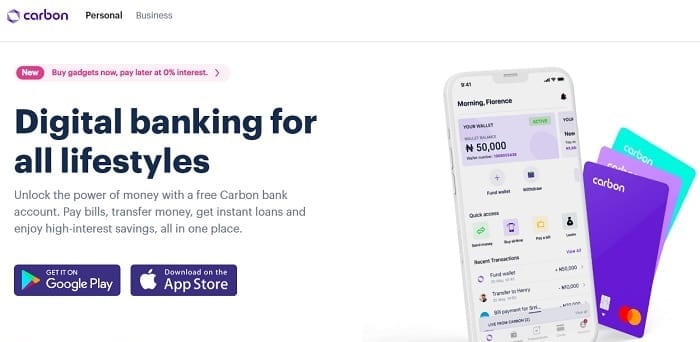
    Formerly known as Paylater, Carbon is a digital banking app that also gives out loan to individuals and businesses. The app provides all sorts of exciting financial services, including savings, investment, payments and so on.

    Hence, Carbon is more than an app for borrowing money; it is an app that offers “digital banking for all lifestyles”. However, for this post, let’s focus on its loan feature.

    Insured by NDIC and certified by the Central Bank of Nigeria (CBN), Carbon loan does not require any form of collateral, neither would you have to fill any form. The entire process is online, and you will receive your loan within minutes.

    How to get a loan from Carbon app

    1. Download the Carbon app from the iOS app store or Google Play store
    2. Register in few minutes by providing a few details about yourself
    3. Go ahead and apply for loans
    4. Your loan would be sent to your wallet on the app from where you can use it for different transactions. You can also send the money from your wallet to your bank account so you can withdraw it.
    5. Payback your loan on time to unlock higher amounts. Also, you stand a chance of getting 10 – 100% cashback when you pay back your loan on time.

    Interest Rate: 1.75% – 30%

    Loan amounts: ₦1,500 – ₦1,000,000

    Loan terms: Up to 64 weeks

    Target market: Individuals and businesses

    Must Read: 7 Financial Tools for Small Business Owners

    PalmCredit

    PalmCredit is another mobile app that gives Nigerians easy and convenient loan. Boasting of being “Nigeria No. 1 online loan…”, the money lending app offers flexible loans with reasonable interest rates.

    As with most other loan apps, paying back your loan on time on PalmCredit helps you to update your credit score. The implication of that is you get higher offers when next you apply for a loan.

    Some of its unique fixtures include offering up to 100k loan with a daily interest rate of 1.2%.

    How to get a loan from PalmCredit

    1. Download the Palmcredit mobile app from your app store
    2. Register and set your account in minutes
    3. Apply for a loan
    4. Get approval within minutes
    5. The loan is disbursed to your bank account

    Interest Rate: 14% – 24%

    Loan amounts: ₦2,000 – ₦100,000

    Loan terms: 14 – 180 days

    Target market: Individuals

    Okash

    A product of OPay, Okash is another loan app that offers loans to Nigerians. The app is committed to increasing access to loan facilities to the underserved section of the society.

    You get loan decisions on Okash within seconds, and once your loan is approved, you’d receive funds within 5 minutes.

    For your first loan application on Okash, you can’t get more than ₦10,000. The money will increase in subsequent applications, especially if you pay back your loan on time.

    Okash loans are provided in partnership with Blue Ridge Microfinance bank; hence you can pay back your loan via direct transfer to Blue Ridge Microfinance bank account (Zenith Bank Account No:1130085518)

    How to get loan from Okash

    1. Download and install the Okash app from your app store
    2. Register an account
    3. Select the product or loan amount you’d like to apply for
    4. Provide necessary information and submit your application
    5. You may get a call for verification after submitting your application. Ensure you provide the right information
    6. E-sign the loan agreement after approval
    7. After this, the approved loan will be dispensed to your registered bank account

    Interest Rate: 23 – 35%

    Loan amounts: ₦3,000 – ₦500,000

    Loan terms: 7 days – 365 days

    Target market: Individuals and businesses

    Fairmoney

    Fairmoney is a money lending app for Nigerians where you can get a loan within 5 minutes. You know this is a big deal if you’ve had to wait for days to get a loan from your bank.

    Fairmoney is not just a loan app, by the way. The app also provides some essential financial solutions such as airtime recharge and payment of bills.

    The primary requirement for a Fairmoney loan is your BVN, and you can get as much as N500,000. And you can spread repayments in multiple instalments for ease and flexibility.

    How to get a loan from Fairmoney

    1. Download the Fairmoney app from the Playstore
    2. Signup with your phone number and create your PIN
    3. Click apply on the home page
    4. Answer the few questions provided
    5. Get a loan offer
    6. Choose amount and tenor
    7. Accept the loan offer
    8. Provide bank details where you want your money sent and get it within minutes

    Interest Rate: 10 – 30%

    Loan amounts: ₦1,500 – ₦500,000

    Loan terms: 61 – 180 days

    Target market: Individuals and businesses

    Aella Credit

    Aella Credit is a fintech app that provides such services as payments, investment, and loans. The app makes it “super easy for anyone to borrow, invest and make payments” without excuses.

    The money lending app even offers affordable insurance services for its customers. Now, that’s something different compared to others in the list.

    For Aella, the end goal is to provide financial inclusion for all, irrespective of social class or profession.

    How to get a loan from Aella Credit

    1. Download the Aella app from your app store
    2. Create your account by filling out your details in less than a minute
    3. Answer some quick questions to update your profile
    4. Click the “check eligibility” button to see if you qualify for a loan and how much
    5. Apply for the loan, and it will be sent to your provided bank account within minutes
    6. Payback your loan on time 

    Interest Rate: 4 – 20%

    Loan amounts: ₦2,000 – ₦1,000,000

    Loan terms: 1 – 3 months

    Target market: Individuals and businesses

    Blackcopper

    If you are thinking of an app where you can borrow money to grow your business, then checkout Blackcopper. The app is committed to keeping “the wheels turning for your business”. 

    Aside from giving quick loans to individuals and businesses, Blackcopper also has investment opportunities for its users. Sign up to benefit from either of the two services the app offers.

    How to get a loan from Blackcopper

    1. Download the Blackcopper mobile app from Apple store or Google Play store
    2. Register your account by providing the required information. Secure your account by verifying it via mail
    3. Access Quick loans for your business needs or access investment opportunities on the app

    Interest Rate: As low as 3.74%

    Loan amounts: ₦500,000

    Loan terms: Up to 6 months

    Target market: Individuals and Businesses

    FAQ

    What are the main eligibility conditions precedent to loan

    1. You must bee between the ages of 22 – 59 years old2
    2. Have a verifiable source of income
    3. Live and/or work in cities where we operate
    4. Have a savings or current bank account with any commercial bank

    What are the required documentation to apply for a loan, using any of the loan apps?

    You need your bank statement, a government issued ID card and utility bill (optional).

    What is The Interest Rate on Branch Loan App?

    Branch offers loans from ₦1,000 to ₦200,000. Loan terms range from 4 – 40 weeks. Interest ranges from 15% – 34% with an equivalent monthly interest of 3% – 21% and APR of 33% – 261%, depending on your loan option. 

    Conclusion

    Accessing loans for personal needs and business development is no longer so much of an issue. However, resist the urge to get a loan when you don’t need one or don’t have a clear plan to pay back.

    Also, take your time to study these money lending apps’ terms and conditions before submitting your application for loans. Be sure you agree with these terms to prevent future regrets, especially in terms of the interest rate.

    Do you know of other loan apps with amazing offers and excellent services? Share in the comments.

    Suggested Readings:

  • It’s Not Business It’s Personal: The Ideal Work-Life Balance

    It’s Not Business It’s Personal: The Ideal Work-Life Balance

    Balancing work and life takes a physical toll on us. But it also affects us emotionally.

    64% of consumers expect brands to be more human than business.

    Simply put, business is personal; very personal.

    Here’s a little back story.

    I recently got contracted to work with a leader who had just lost a much-valued employee in his startup to a fierce competitor. He had invested a large amount of time in mentoring and training said person and had high hopes and expectations of what they could achieve together with the business. The employee was identified as a top talent within the company’s ranks, and what’s more, the resignation came as a complete surprise. Expectedly, the team leader felt let down as he recounted the events to me and in an attempt to downplay these feelings he resigned to this;

    “I guess the conclusion I have come to,” he said, “is that I just mustn’t take this personally.”

    Is It Business, or Is It Personal?

    This is a sentiment we have all often heard in work contexts: “Don’t take it personally” or “Hey, it’s not personal; it’s business.”

    I’ve heard it said about feedback, conflict, difficult conversations, restructuring, losing deals, collaboration, dealing with career ups and downs — all kinds of workplace and business issues. And yet I feel it’s an absurd idea. In an attempt to protect ourselves, we have gone on to breed lacklustre and ineffectiveness among existing and new startups.

    In a 2018 article written by Lucy Brian of the six-vertical, she outlined the top five qualities of a successful entrepreneur which all happened to be “personal” qualities:

    1. Resolute motivation and passion

    2. Self-discipline

    3. Risk-taking ability

    4. Creative thinking

    5. Persistence

    If this is true of an entrepreneur, then it’s safe to say that taking things personally at work is the first step to maximizing capacity as an entrepreneur, leader or a team member.

    Furthermore, work is the place where I’m going to spend the bulk of my waking hours — indeed, the majority of my life — and yet I’m not supposed to take it personally? I should accept the idea that the bulk of my life from my twenties to sixties is somehow not personal?

    While I fully understand that by “not taking it personally” we are better able to protect ourselves in work contexts that can often be challenging, threatening, and relentless, there are benefits to making our work-business personal.

    Efficiency

    The first relates to success and well-being at work. Take a moment and think about the people you’ve encountered whom you consider inspired, energized, and successful. They probably take work personally. And the flip side is that the people who have depersonalized their work are probably not the people you have enjoyed their experience. Your own experience thus indicates that success seems to be linked to taking your work personally.

    But this is not about nuanced language and personal psychology; it is also about real business results.

    Consider the connection between engaged employees and business performance.

    What is engagement if not “taking it personally“? And when we consider the low levels of reported workplace engagement, it becomes clear that “not taking it personally” can have real costs.

    Consider these statistics curated from GetVoIP: 64% of consumers want brands to connect with them. This is to say consumers rely on you taking your work-business personally as this is the best way to connect with them truly, and that is a relatively high percentage. It would be disadvantageous to be on the wrong side of such statistics.

    Most of these consumers have grown increasingly aware of the facade or faux commitment from brands and can almost immediately tell when a brand takes them personally.

    Ethics

    Then there’s ethics. “Not taking it personally” lies at the heart of many corporate ethics scandals, from embezzling and accounting fraud to issues of worker safety and environmental protection. It’s when executives and teams adopt the mindless notion of “it’s not personal, it’s business” that they absolve themselves of their responsibilities as social actors, custodians of the planet, and guardians of the well-being of their employees, customers, and communities.

    For these reasons and more, it seems clear to me that if we are to fulfil our responsibilities and obligations as executives — and our potential as leaders — we need to take things deeply personally. Put simply; in a depersonalized workforce employees are likely treated poorly.

    Now, of course, there is a big, big difference between taking it personally and not being able to manage your boundaries. There is a distinction between having a passion for your job and attaching so much self-worth to it. Not being able to protect yourself psychologically, taking every mishap and mistake to heart that it penetrates the core of your self-esteem isn’t a good thing. If work becomes too dominant a part of your identity, that can also be dangerous.

    But surely, there’s an appropriate happy medium to be found; a place somewhere between workaholism and anesthetizing the spirit.

    Making it Personal

    Going back to our manager at the beginning of this article, I wish I had said a few things to him: 

    1. Don’t beat yourself up. Don’t overly introject this as a failure that is a representation of your value and worth as a person.
    2. Your life and your career are not defined by this.
    3. But do be disappointed. Be frustrated.
    4. Seek to understand what happened; to know if you could develop your management and leadership. Do seek to learn from this experience.

    But please, please don’t drop that soul-crushing curtain of “it’s not personal.” because it is.

    Losing an employee or a business deal is the same as losing a friend or a relationship you’ve invested. Being aloof doesn’t make you professional, in-fact being sensitive helps you relate better to employee and customer needs.

    Yes, if you take work personally, you will get hurt along the way. You will be disappointed, be let down, and sometimes wonder if it is worth it.

    But just like that other great mystery of life — being in love — what really is the alternative? To not love at all, to never be heartbroken? Surely not.

    To not take it personally so as never to be disappointed? Surely not.

    For your own sake, for the people who work with you, and for the sake of humanity, this is your life. Take it — all of it — personally.

    SEE: How to Position Your Brand in the Mind of Your Audience.